Sheet metal multi-bending machining device capable of detecting bending angle

A technology of bending angle and processing device, which is applied in the direction of feeding device, metal processing, metal processing equipment, etc., can solve the problems of poor quality of finished products, difficult processing, and inability to guarantee the symmetry of stamping and bending positions, and achieve the accuracy of finished products The effect of high quality and high processing efficiency

CN113290135AInactive Publication Date: 2021-08-24长沙市雄武自动化设备有限公司
0 Cites 3 Cited by

Patent Information

Authority / Receiving Office
CN · China
Patent Type
Applications(China)
Current Assignee / Owner
Publication Date
2021-08-24
Estimated Expiration
Not applicable · inactive patent

Smart Images

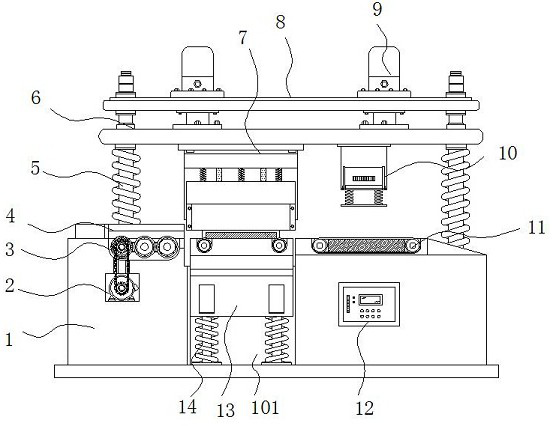
  • Figure 1
    Figure 1
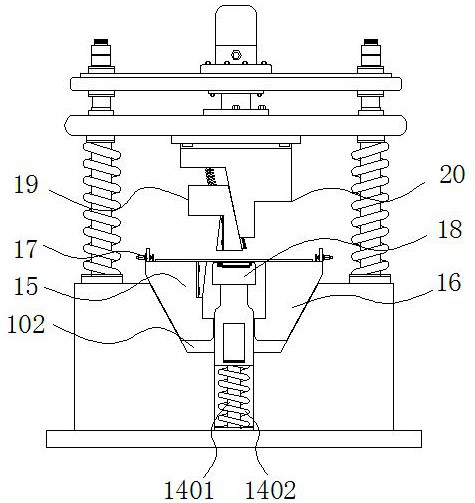
  • Figure 2
    Figure 2
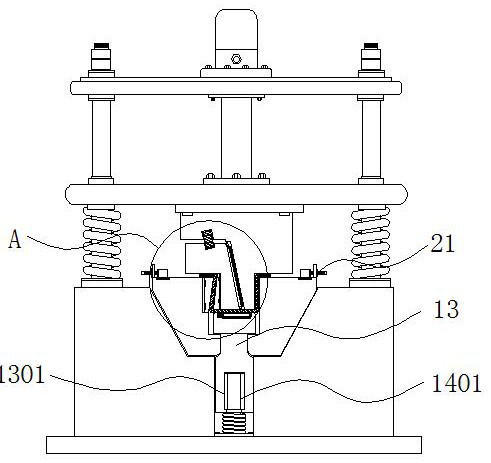
  • Figure 3
    Figure 3
Patent Text Reader

Abstract

The invention discloses a sheet metal multi-bending machining device capable of detecting a bending angle. The device particularly comprises a workbench, a bending mechanism, a detection mechanism and a pressure bearing table, wherein supporting columns are installed at the four corners of the top of the workbench, a top plate is fixed to the top ends of the supporting columns, a lifting plate is installed on the portions, below the top plate, of the supporting columns, the bending mechanism is installed on one side of the bottom of the lifting plate, hydraulic cylinders are installed on the two sides of the top of the top plate, and the output ends of the hydraulic cylinders penetrate through the top plate to be connected with the lifting plate. According to the sheet metal multi-bending machining device capable of detecting the bending angle, the bending mechanism, a first edge pressing seat and a second edge pressing seat are installed, all bending operation can be achieved through one-time downward pressing of the bending mechanism, the whole process is completed in one step, multi-step bending operation is completed in one step, the machining efficiency is higher, it can be guaranteed that the bending positions on the two sides are symmetrical, and the quality of finished products is higher.
Need to check novelty before this filing date? Find Prior Art

Description

technical field

[0001] The invention relates to the technical field of automatic processing of sheet metal parts, in particular to a multi-bending sheet metal processing device capable of detecting bending angles. Background technique

[0002] Sheet metal parts are products processed by sheet metal technology. We cannot live without sheet metal parts. Sheet metal is a comprehensive cold processing process for thin metal plates (usually below 6mm). Its notable feature is that the thickness of the same part is the same. , there is a sheet metal part with negative angle bending on one side and vertical bending on the other side, which needs to be bent step by step during processing.

[0003] The traditional processing method is to perform two vertical stampings on one side of the plate, and then perform negative angle bending and vertical bending on the other side. This method is difficult to process, and it cannot guarantee the symmetry of the stamping and bending positions, a...

Examples

Embodiment Construction

[0028] The following will clearly and completely describe the technical solutions in the embodiments of the present invention with reference to the accompanying drawings in the embodiments of the present invention. Obviously, the described embodiments are only some, not all, embodiments of the present invention.

[0029]In the description of the present invention, unless otherwise stated, the meaning of "plurality" is two or more; the terms "upper", "lower", "left", "right", "inner", "outer" , "front end", "rear end", "head", "tail", etc. indicate the orientation or positional relationship based on the orientation or positional relationship shown in the drawings, and are only for the convenience of describing the present invention and simplifying the description, rather than Indicates or implies that the device or element referred to must have a particular orientation, be constructed and operate in a particular orientation, and therefore should not be construed as limiting the ...