Check patentability & draft patents in minutes with Patsnap Eureka AI!

Polarized SAR terrain classification method based on scattering mechanism multichannel expansion convolutional neural network

A technology of convolutional neural network and scattering mechanism, which is applied in the field of polarization synthetic aperture radar object classification, can solve the problem of scattering model interaction feature redundancy and so on

Pending Publication Date: 2021-09-14
BEIJING UNIV OF CHEM TECH
View PDF0 Cites 1 Cited by
  • Summary
  • Abstract
  • Description
  • Claims
  • Application Information

AI Technical Summary

Problems solved by technology

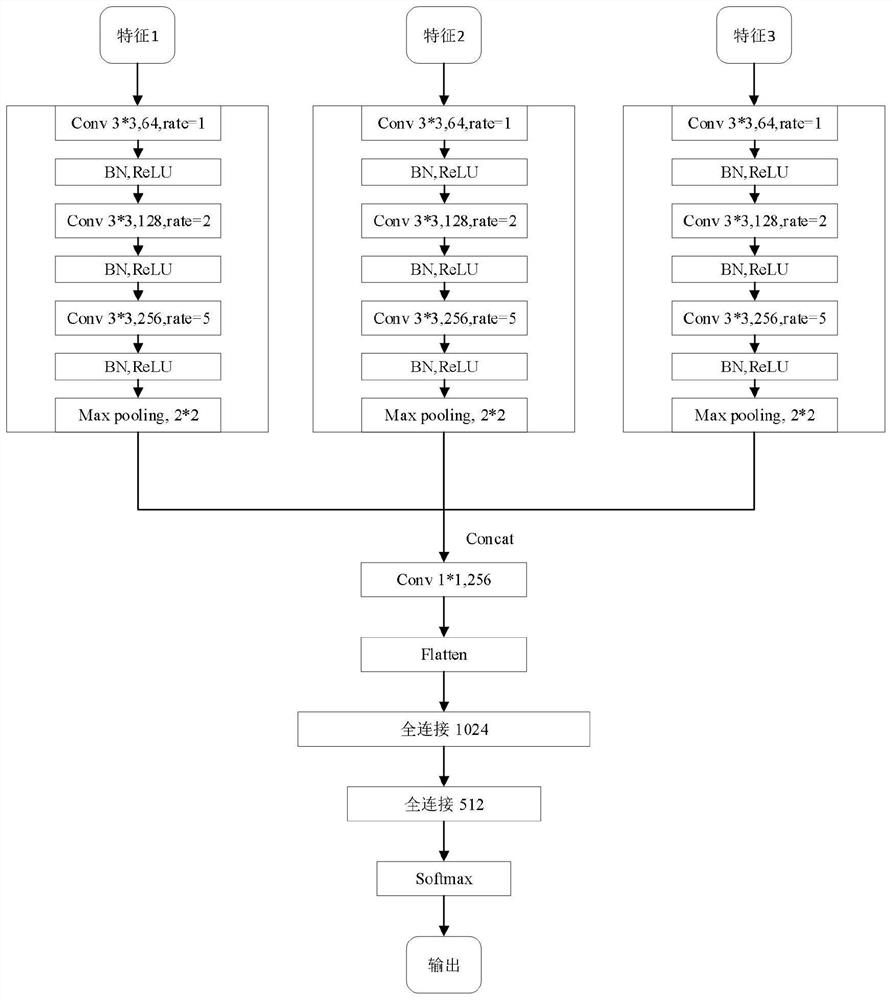
[0006] The main purpose of the present invention is to solve the problem of mutual influence between scattering models and feature redundancy in the process of PolSAR image classification, and use dilated convolution instead of ordinary convolution to reduce the information loss caused by downsampling, and provide a scattering mechanism-based PolSAR image object classification method based on multi-channel dilated convolutional neural network (DMCNN)

Method used

the structure of the environmentally friendly knitted fabric provided by the present invention; figure 2 Flow chart of the yarn wrapping machine for environmentally friendly knitted fabrics and storage devices; image 3 Is the parameter map of the yarn covering machine
View more

Image

Smart Image Click on the blue labels to locate them in the text.
Viewing Examples
Smart Image
  • Polarized SAR terrain classification method based on scattering mechanism multichannel expansion convolutional neural network
  • Polarized SAR terrain classification method based on scattering mechanism multichannel expansion convolutional neural network
  • Polarized SAR terrain classification method based on scattering mechanism multichannel expansion convolutional neural network

Examples

Experimental program
Comparison scheme
Effect test

Embodiment Construction

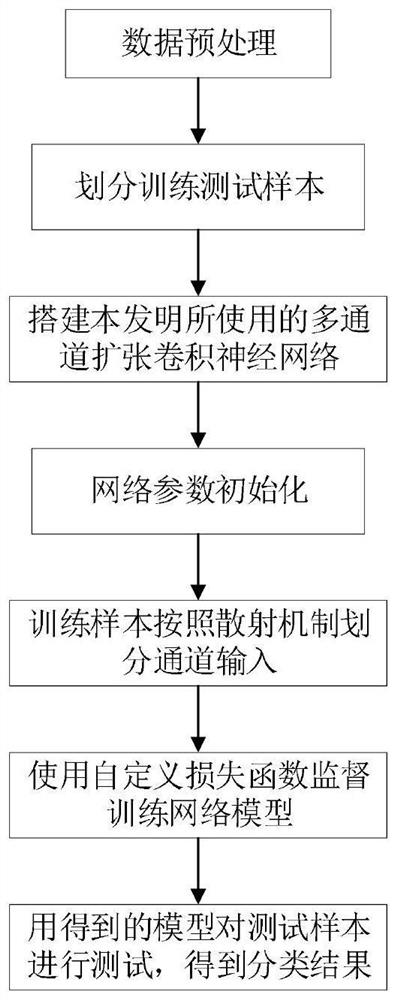
[0081] The basic process of the PolSAR image ground object classification of the present invention is as follows: image 3 As shown, it specifically includes the following steps:

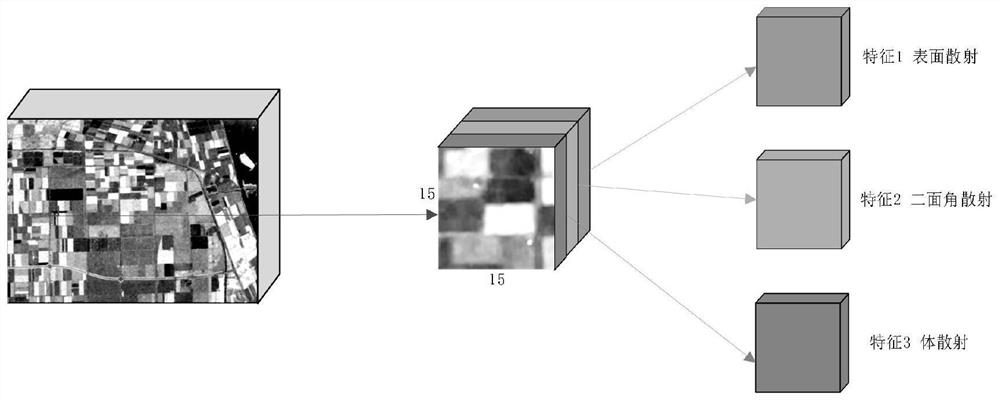
[0082] 1) Use PolSARpro software to filter the original PolSAR data for feature extraction. First, the original PolSAR data is filtered by 5×5 to reduce the influence of noise, and three polarization features are extracted by using the Freeman-Durden method, which represent three main scattering mechanisms: surface scattering, volume scattering and binary scattering. Face angle scattering, these three polarization features will be input into the multi-channel network according to the scattering mechanism in the following steps.

[0083]2) Data preprocessing and sample division. First, convert the three polarization characteristic binary .bin files obtained in the previous step into .mat type data, normalize all sample data by row, limit the data to the range of [0,1], and eliminate the singularity...

the structure of the environmentally friendly knitted fabric provided by the present invention; figure 2 Flow chart of the yarn wrapping machine for environmentally friendly knitted fabrics and storage devices; image 3 Is the parameter map of the yarn covering machine
Login to View More

PUM

No PUM Login to View More

Abstract

The invention discloses a polarimetric SAR terrain classification method based on a scattering mechanism multichannel expansion convolutional neural network. The implementation process of the method is as follows: step 1, performing data preprocessing; step 2, performing sample division; step 3, constructing a multichannel convolutional neural network based on a scattering mechanism; step 4, training a network model; step 5, carrying out PolSAR image surface feature classification. According to the method, the complexity in a feature extraction process is reduced, in order to avoid mutual interference among the features, three polarization features are respectively input into the three-channel convolutional neural network according to a scattering mechanism for feature extraction, and the network parameters of each channel are same. Therefore, it is ensured that each channel contributes the same to a final result, and the final classification result also achieves a relatively good effect.

Description

technical field [0001] The invention relates to a polarization SAR image object classification method based on a multi-channel expansion convolutional neural network based on a scattering mechanism, and belongs to the technical field of polarization synthetic aperture radar object classification. Background technique [0002] Full-polarization SAR can work under different transmission and reception polarization combinations, and has the characteristics of higher information content than single-polarization SAR. The measured polarization scattering matrix can completely characterize the polarization scattering characteristics of the target at a specific attitude and observation frequency, and the polarization combination of electromagnetic waves is sensitive to the shape, size, structure, material, etc. of the target, so the full polarization SAR can It has greatly improved the ability to acquire target information, and has been widely used in land cover classification, targe...

Claims

the structure of the environmentally friendly knitted fabric provided by the present invention; figure 2 Flow chart of the yarn wrapping machine for environmentally friendly knitted fabrics and storage devices; image 3 Is the parameter map of the yarn covering machine
Login to View More

Application Information

Patent Timeline
no application Login to View More
Patent Type & Authority Applications(China)
IPC IPC(8): G06K9/62G06K9/46G06N3/04G06N3/08
CPCG06N3/084G06N3/045G06F18/2414G06F18/2415
Inventor 周勇胜王亚楠程建达张帆尹嫱项德良马飞洪文
Owner BEIJING UNIV OF CHEM TECH
Features
  • R&D
  • Intellectual Property
  • Life Sciences
  • Materials
  • Tech Scout
Why Patsnap Eureka
  • Unparalleled Data Quality
  • Higher Quality Content
  • 60% Fewer Hallucinations
Social media
Patsnap Eureka Blog
Learn More