

A method for measuring traffic connection strength of urban agglomerations based on mobile phone signaling data
A technology of mobile phone signaling and urban agglomeration, applied in the field of data processing, can solve the problems of lagging timeliness of basic data and not covering multiple modes of transportation, etc., and achieve the effect of facilitating technical and scientific data research
- Summary
- Abstract
- Description
- Claims
- Application Information
AI Technical Summary
Problems solved by technology
Method used
Image



Examples
Embodiment 1
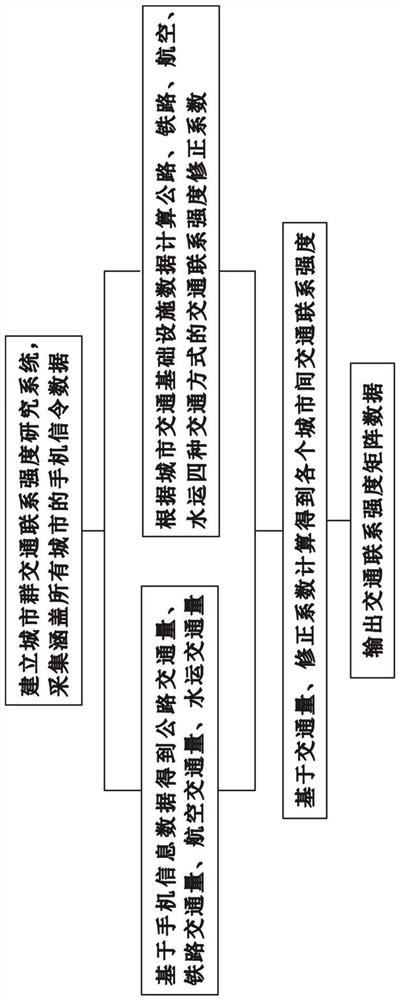
[0043] like figure 1 As shown, a method for measuring the traffic connection strength of urban agglomerations based on mobile phone signaling data is as follows:
[0044] A. Establish a research system for the intensity of urban agglomeration traffic linkages. The research system for the intensity of urban agglomeration traffic linkages includes urban traffic infrastructure data of several cities and all cities. Urban traffic infrastructure data includes road traffic data, railway traffic data, air traffic data, Water transport traffic data, real-time collection of mobile phone signaling data covering all cities; among them, road traffic data includes urban road entry and exit points, urban expressway entry and exit points, and road route data, railway traffic data includes railway stations and railway route data, aviation Traffic data includes air station and air route data, and water transport data includes waterway terminal site and waterway route data. The urban agglomera...
Embodiment 2
[0072] In this embodiment, the measurement method of traffic connection strength of urban agglomeration based on mobile phone signaling data is used in the research area of Beijing-Tianjin-Hebei urban agglomeration, and the road traffic connection strength based on road traffic mode is selected for calculation.
[0073] For the China Unicom mobile phone signaling data used in this example, the basic field information is shown in the table below, including: base station ID (cid column in the table), location grid number (grid_id column in the table), travel number of the day (move_id column in the table) , the travel number passed through the base station number (move_vp_id column in the table), province code (province column in the table), time stamp (stime column in the table), user number (uid column in the table), date (date column in the table), base station The longitude of the location (column lat in the table), the latitude of the base station location (column lon in t...
PUM
 Login to View More
 Abstract
Description
Claims
Application Information
 Login to View More