Dual-robot synchronous machining method and system based on model predictive impedance control

A dual-robot, impedance control technology, applied in the direction of program-controlled manipulators, manufacturing tools, manipulators, etc., can solve problems such as inability to meet multi-robot processing, and it is difficult to ensure the stability of dual-robot processing systems, so as to improve stability and quality, Improve processing efficiency and ensure the effect of processing quality

CN113664830BActive Publication Date: 2022-08-02HUAZHONG UNIV OF SCI & TECH
7 Cites 0 Cited by

Patent Information

Authority / Receiving Office
CN · China
Patent Type
Patents(China)
Current Assignee / Owner
Publication Date
2022-08-02

Smart Images

  • Figure 1
    Figure 1
  • Figure 2
    Figure 2
  • Figure 3
    Figure 3
Patent Text Reader

Abstract

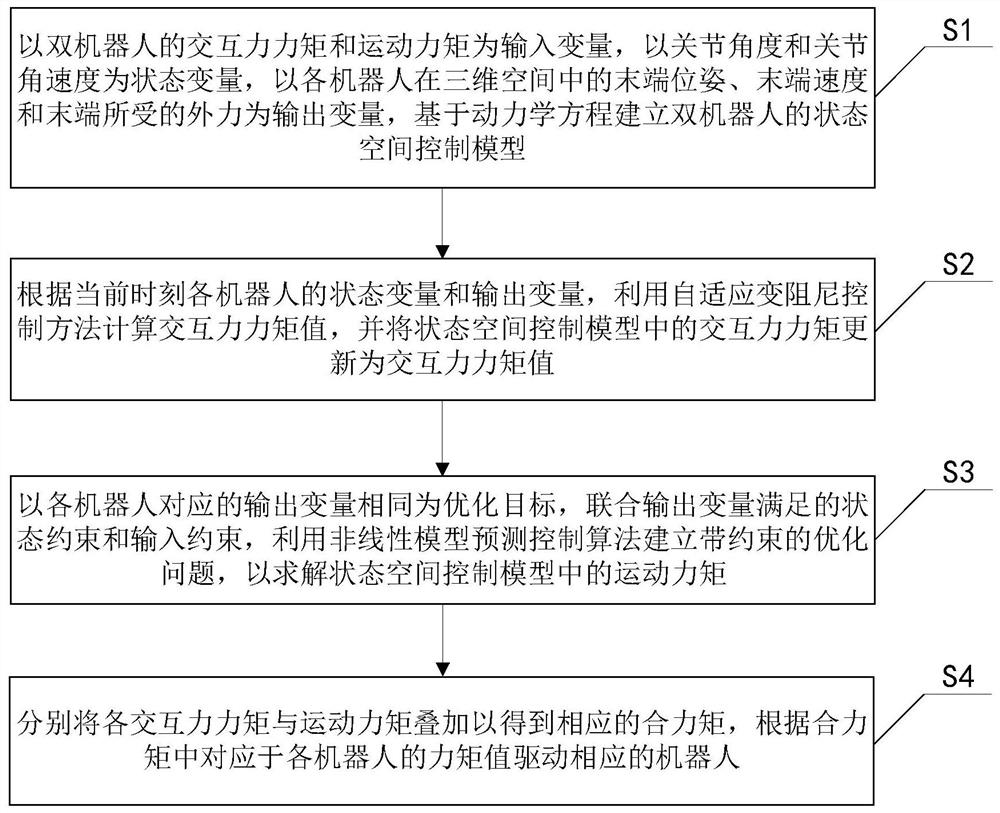
The invention discloses a dual-robot synchronous processing method and system based on model prediction impedance control, belonging to the field of robot control. The method includes: establishing a state space control model of dual robots based on dynamic equations; The output variables are calculated by the adaptive variable damping control method to calculate the interactive force and torque value to update the interactive force and torque terms in the state space control model. Taking the same output variables corresponding to each robot as the optimization goal, the joint output variables satisfy the state constraints and Input constraints, use the nonlinear model predictive control algorithm to establish an optimization problem with constraints to solve the motion torque in the state-space control model; respectively superimpose each interaction force torque and motion torque to obtain the corresponding resultant torque, according to the corresponding torque in the resultant torque The corresponding robot is driven according to the torque value of each robot. Realize dual-robot collaborative processing operations to ensure the stability of dual-robot simultaneous processing.
Need to check novelty before this filing date? Find Prior Art

Description

technical field

[0001] The invention belongs to the field of robot control, and more particularly, relates to a dual-robot synchronous processing method and system based on model predictive impedance control. Background technique

[0002] With the continuous development of robot technology, the traditional manufacturing mode is gradually developing in a more intelligent and efficient direction, and the processing method of replacing machine tools with robots is widely used in the industry. The processing efficiency of traditional machine tools is low, and the use of multi-robot and multi-station collaborative processing can effectively improve the processing efficiency. When multiple robots work at the same time, there is a certain geometric relationship and interactive force relationship between robots. Maintaining the relationship between the relative positions and relative forces between robots is the key to ensuring the quality of collaboration. By implementing the mult...

Examples

Embodiment Construction

[0040] In order to make the objectives, technical solutions and advantages of the present invention clearer, the present invention will be further described in detail below with reference to the accompanying drawings and embodiments. It should be understood that the specific embodiments described herein are only used to explain the present invention, but not to limit the present invention. In addition, the technical features involved in the various embodiments of the present invention described below can be combined with each other as long as there is no conflict with each other.

[0041] In the present invention, the terms "first", "second" and the like (if present) in the present invention and the accompanying drawings are used to distinguish similar objects and are not necessarily used to describe a specific order or sequence.

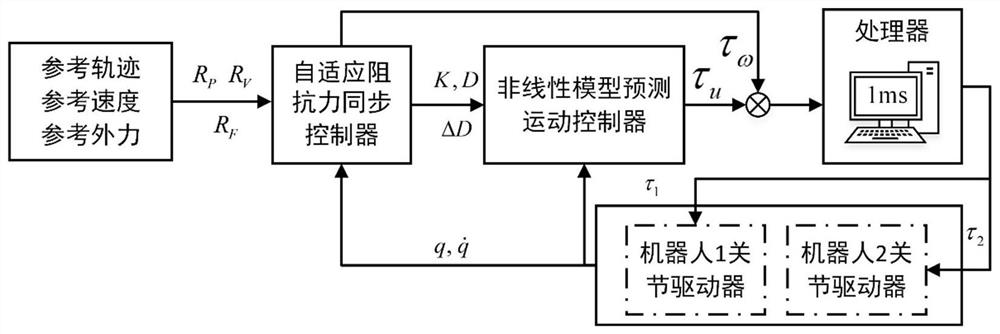
[0042] This embodiment provides a dual-robot synchronous processing method based on model predictive impedance control, such as figure 2 shown. ...