
Lithium ion battery safety coating slurry and dispersion method thereof
A lithium-ion battery and coating slurry technology, which is applied in battery electrodes, secondary batteries, chemical instruments and methods, etc., can solve the problems of inability to store for a long time, the overall performance of the battery is reduced, and it is difficult to dry out moisture. , to improve the overall performance of the battery, increase the suspension performance, and reduce the swelling phenomenon.
- Summary
- Abstract
- Description
- Claims
- Application Information
AI Technical Summary
Problems solved by technology
Method used
Image

Examples
Embodiment 1
[0032] The lithium-ion battery safety coating slurry in this embodiment consists of the following components in parts by mass:
[0033] Boehmite 90, polyvinylidene fluoride 10, alkoxy ammonium salt of acid group block copolymer 0.1, N-methyl-2-pyrrolidone 140, the dispersion method of the uniform and stable suspension is as follows;
[0034] (1) Preparation of pre-mixed glue: Sprinkle polyvinylidene fluoride evenly into weighed N-methyl-2-pyrrolidone, stir in a sealed container at 15 rpm and 1200 rpm for 6 hours, polyvinylidene fluoride Completely dissolved in N-methyl-2-pyrrolidone to obtain a premixed glue with a mass concentration of 10%;
[0035] (2) Preparation of anhydrous boehmite material: add boehmite into the grinding tank, and the grinding time is 0.5h; the particle size D50 of the boehmite after grinding is 100-3000nm, and keep the ground boehmite at -0.9~- 0.85MPa vacuum degree, keep high temperature 150℃±5℃ and bake for 4h;
[0036](3) Preparation of low-molecu...
Embodiment 2
[0042] The difference between Example 2 and Example 1 is that the lithium-ion battery safety coating slurry of this example is composed of the following components in parts by mass: boehmite 90, polyvinylidene fluoride 10, acid group block Alkoxyl ammonium salt of the copolymer 0.1, N-methyl-2-pyrrolidone 550; 15% N-methyl-2-pyrrolidone was added in step (5); the rest of the steps were the same as in Example 1.
Embodiment 3
[0050] The difference between embodiment 3 and comparative example 1 is to remedy the slurry with flocculation problem, and re-add 1% of acidic group block copolymer to the slurry in comparative example 1 that has been separated for 10d under the sealed state. Alkoxyl ammonium salts. First, stir and disperse for 4 hours according to the revolution of 25rpm and the rotation of 3500rpm; then transfer the mixed solution into the cone mill, with a flow rate of 10L / h and a linear velocity of 23m / s, and circulate 10 times;
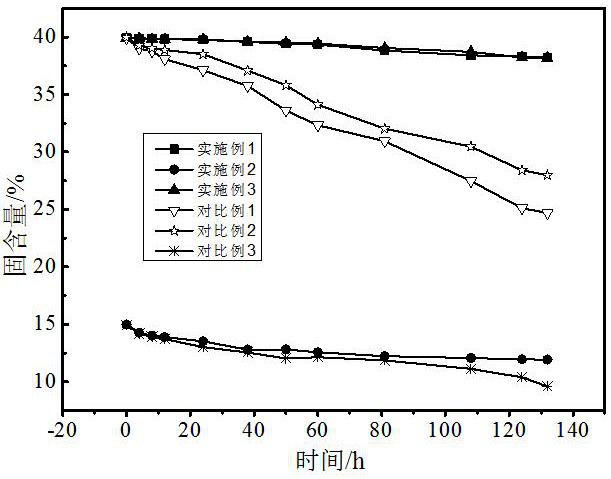
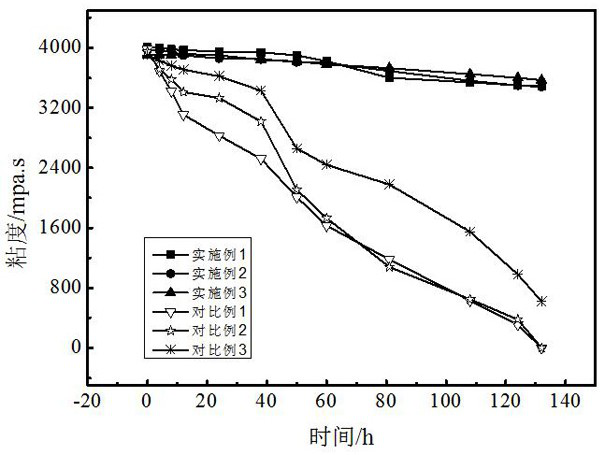
[0051] By the solid content of embodiment 1~3 and comparative example 1~3 and viscosity variation data figure 1 and figure 2 It can be seen from the comparison that the solid content of the ceramic slurry prepared in Comparative Example 1 without adding a wetting and dispersing agent, Comparative Example 2 with magnetic stirring, and Comparative Example 3 with ultrasonic and magnetic stirring cycles decreased rapidly, and the viscosity of the slurry decreased ...
PUM
| Property | Measurement | Unit |
|---|---|---|
| particle diameter | aaaaa | aaaaa |
| viscosity | aaaaa | aaaaa |
Abstract
Description
Claims
Application Information
 Login to View More