

Urine red blood cell classification method based on supervised comparative learning
A classification method and red blood cell technology, applied in the field of medical image processing, can solve the problems of difficulty in meeting the physical examination needs of kidney disease patients and long examination cycle
- Summary
- Abstract
- Description
- Claims
- Application Information
AI Technical Summary
Problems solved by technology
Method used
Image



Examples
Embodiment 1
[0062] A method for classifying urinary red blood cells based on supervised contrastive learning, comprising the following steps:
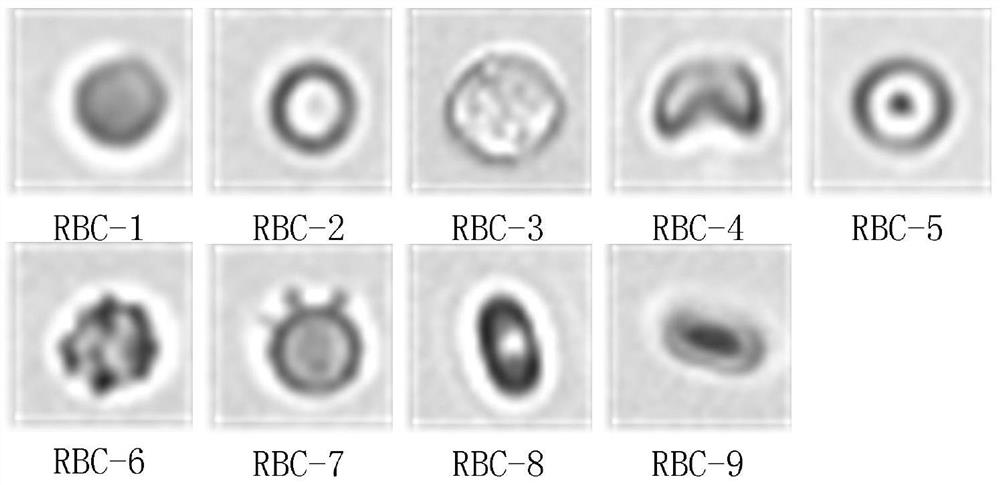
[0063] Step 1: Collect and expand the data set; collect urine erythrocyte images, perform category labeling, and divide the collected images into a training set and a test set according to a certain proportion; the collected urine erythrocyte images are divided into normal erythrocytes, Ring-shaped red blood cells, shadow-shaped red blood cells, crescent-shaped red blood cells, bagel-shaped red blood cells, shriveled red blood cells, acanthous red blood cells, lateral red blood cells, and erect red blood cells. Preprocessing for data enhancement is performed on the categories with less data in the training set Mainly including rotation and flipping to get a larger number of training images;
[0064] Step 2: Build a feature extraction network model; on the basis of the ResNet-50 convolutional neural network, in view of the low resolution of the uri...
Embodiment 2
[0078] The concrete steps of the method for classifying urine erythrocytes based on supervised contrastive learning of the present invention are:
[0079] Step 1: Use a microscope to collect the initial image of the urine sediment, collect the urine red blood cell data set, label the data category information according to the cell morphological characteristics, and divide the training set and the test set. The collected urine red blood cells are divided into nine categories: normal red blood cells, annular red blood cells, shadow red blood cells, crescent red blood cells, doughnut red blood cells, crumpled red blood cells, acanthocytes, lateral red blood cells, and erect red blood cells. like figure 1 shown. Due to the small number of crescent-shaped red blood cells, crescent-shaped red blood cells, and acanthocytes, data enhancement methods were used for these three types of red blood cells to expand the data set. Among them, horizontal flipping of crescent-shaped red bloo...
PUM
 Login to View More
 Abstract
Description
Claims
Application Information
 Login to View More