
Cooling apparatus
A cooling device and electronic device technology, applied in the direction of instruments, electrical digital data processing, electrical components, etc., can solve the problem of little contribution of the computer system and achieve the effect of stable operation
- Summary
- Abstract
- Description
- Claims
- Application Information
AI Technical Summary
Problems solved by technology
Method used
Image

Examples
Embodiment Construction
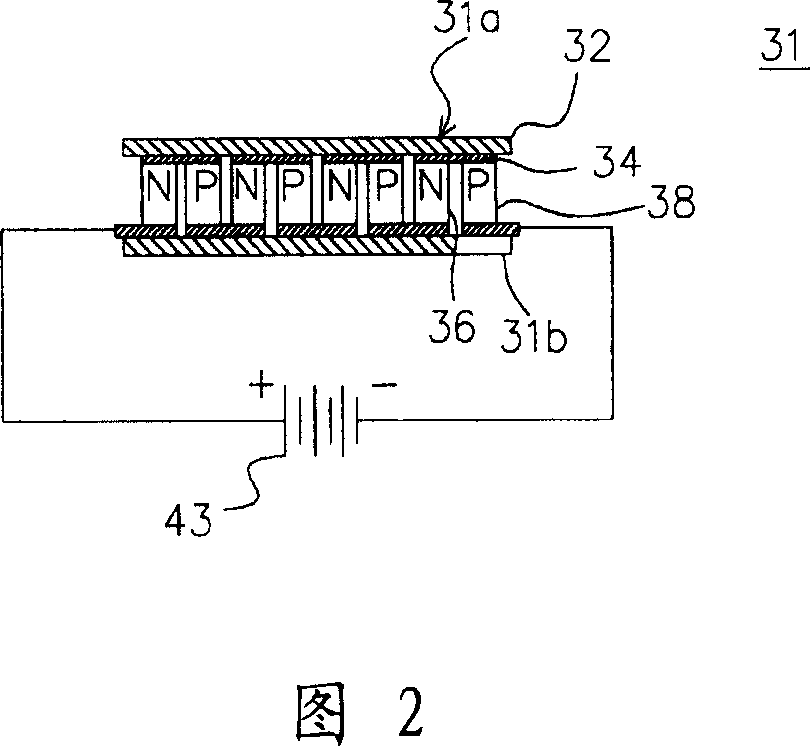
[0035] In order to enable those skilled in the art to better understand the spirit of the present invention, before describing various embodiments of the present invention, the principle of a thermoelectric cooler (TEC) is briefly introduced. Please refer to FIG. 2 , which shows a schematic structural diagram of a cooling chip that can be used in an embodiment of the present invention. The cooling chip 31 is composed of many semiconductor particles such as N-type semiconductor 36 and P-type semiconductor 38 arranged at intervals, and the material of these semiconductor particles is usually bismuth telluride. These semiconductor particles are connected by a metal conductor 34 to form a complete circuit, and the material of the conductor 34 is, for example, copper, aluminum or other metal conductors. Finally, two insulators 32 such as ceramic sheets sandwich the circuit formed by the entire semiconductor particle and the metal conductor 34 . The insulator 32 must be insulated an...
PUM
 Login to View More
 Abstract
Description
Claims
Application Information
 Login to View More