
Beet root kvass
A red beet and kvass technology, applied in the field of red beet kvass beverages, can solve problems such as incompatibility, complicated process, and difficulty in widely eating red beets, achieve high nutritional and health effects, and simplify the process
- Summary
- Abstract
- Description
- Claims
- Application Information
AI Technical Summary
Problems solved by technology
Method used
Image

Examples
Embodiment 1
[0020] Raw materials 40kg red beet, 20kg white sugar, 200kg water
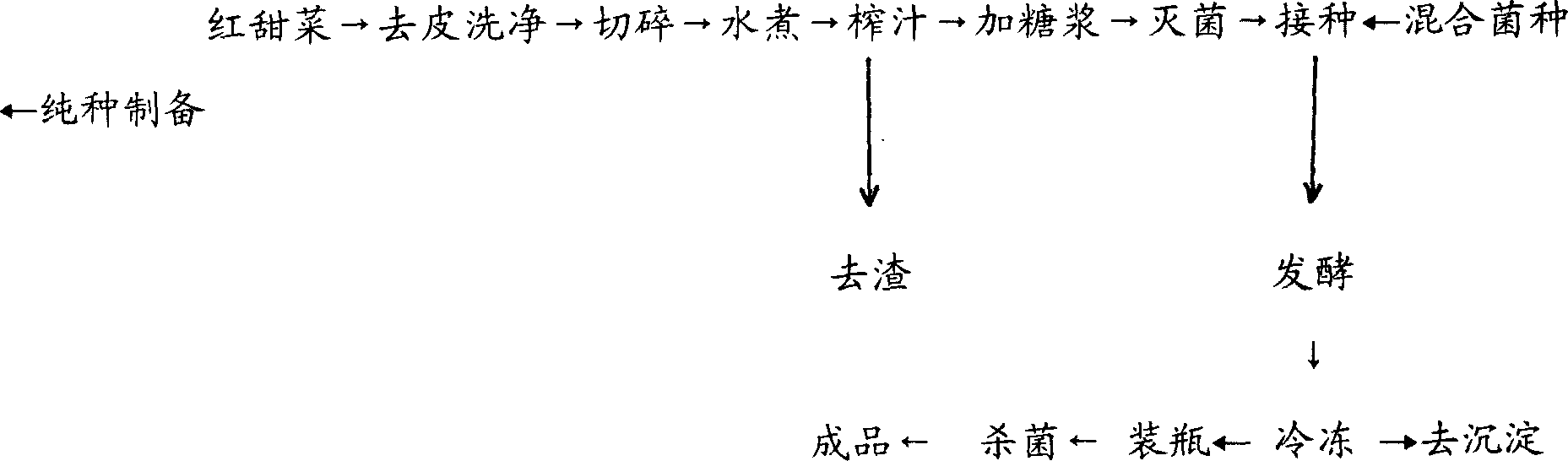
[0021] Production method: combined figure 1 process flow
[0022] 1. Syrup preparation: mix 20 kg of white sugar with water, dissolve for later use.
[0023] 2. Strain preparation: Leuconostoc enterocolitica and S.C.H.1468 cerevisiae cerevisiae were respectively subjected to pure tertiary culture, and then mixed at a ratio of 1:1 or 1.5:1 to cultivate and produce strains at normal temperature. After about 24 hours, the cell count should reach 1.5×10.*5-5×10*6 / ml
[0024] 3. Peel off the residual roots and bark of fresh red beets, and wash them well. Cut into fine grains (less than 3 mm) on a vegetable cutter, put them in a pot, add 60 kg of water, and cook at 65°C for 5 minutes. After decanting, add 60kg of water to the original dish and cook again; such three times of vegetable juice are poured into the fermenter in turn. (Vegetable dregs can be used as feed) Then inject syrup into the tank and stir well...
Embodiment 2
[0026] Raw materials: 50 kg of red beet, 10 kg of white sugar, 0.2 kg of sweetener, 230 kg of water, 12 liters of mixed strains
[0027] The preparation process is the same as Example 1.
PUM
 Login to View More
 Abstract
Description
Claims
Application Information
 Login to View More