Unlock instant, AI-driven research and patent intelligence for your innovation.

Scalable and persistent L2 adaptive replacement cache

a cache and adaptive replacement technology, applied in the direction of code conversion, memory address/allocation/relocation, instruments, etc., can solve the problems of network latency, data needs to be thrown out of the cache, and no more available to accelerate reads

Active Publication Date: 2018-08-28
INTELLIFLASH BY DDN INC
View PDF4 Cites 9 Cited by
  • Summary
  • Abstract
  • Description
  • Claims
  • Application Information

AI Technical Summary

Benefits of technology

This patent describes a method and system for managing file system memory. The method includes implementing a separate replacement policy and a separate index for a persistent second level file replacement cache. The system also includes clustering compressed chunks of data on multiple physical devices by aligning the clusters on a byte boundary basis. A storage pool allocator tracks the compressed and packed chunks on the multiple devices. The system de-clusters data collection independently in chunks away from the device used for writing the data. The system re-adds evicted data from the cache to an active page for writing again based on a configurable number of hits to data in the cache. The technical effects of this patent include improved file system performance and efficiency by optimizing data distribution and utilization across multiple devices.

Problems solved by technology

When RAM is full, data needs to be thrown out of the cache and is not available any more to accelerate reads.
Neither the solid-state array, nor the storage array administrator is the bottleneck anymore; but network latency has become the challenge.
Price and ownership programs translate into very competitive purchase prices for buyers, but vendors are faced with challenges to becoming profitable as incumbent vendors discount to avoid losing market share and new vendors discount to attract new customers.
Server vendors have used available building blocks to slash server prices dramatically, yet storage incumbents continue to overcharge customers for their storage servers.
Architectural complexity, non-integrated products, expensive proprietary networking protocols, cumbersome administration and licensing for every module of software are the norm and burden storage consumers with high prices and high maintenance.
However, storing the persistent-handle-info for long time-intervals can cause considerable memory consumption on the storage server.

Method used

the structure of the environmentally friendly knitted fabric provided by the present invention; figure 2 Flow chart of the yarn wrapping machine for environmentally friendly knitted fabrics and storage devices; image 3 Is the parameter map of the yarn covering machine
View more

Image

Smart Image Click on the blue labels to locate them in the text.
Viewing Examples
Smart Image
  • Scalable and persistent L2 adaptive replacement cache
  • Scalable and persistent L2 adaptive replacement cache
  • Scalable and persistent L2 adaptive replacement cache

Examples

Experimental program
Comparison scheme
Effect test

Embodiment Construction

[0027]Reference will now be made to exemplary embodiments illustrated in the drawings and specific language will be used herein to describe the same. It will nevertheless be understood that no limitation of the scope of the disclosure is thereby intended. Alterations and further modifications of the inventive features illustrated herein and additional applications of the principles of the inventions as illustrated herein, which would occur to one skilled in the relevant art and having possession of this disclosure, are to be considered within the scope of the invention.

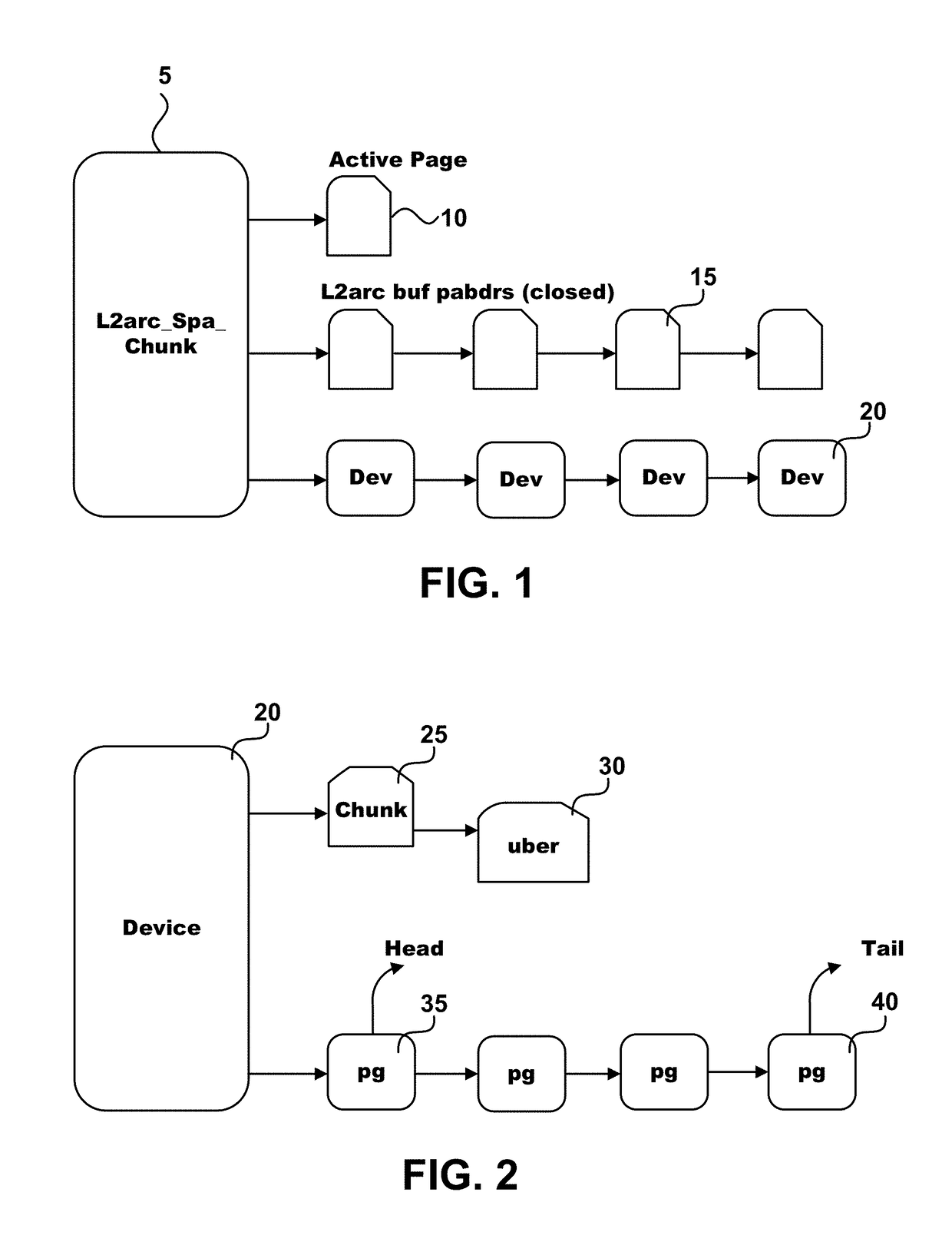
[0028]Throughout the present disclosure, the term ‘L2ARC’ refers to a second level adaptive replacement cache which stores both most frequently used (MFU) blocks of data and most recently used (MRU) blocks of data stored in RAM (random access memory). The term ‘uberblock’ refers to a root ZFS memory partition of a giant dynamic tree whose leaves contain data, similar to a superblock in other file systems. ARC improves...

the structure of the environmentally friendly knitted fabric provided by the present invention; figure 2 Flow chart of the yarn wrapping machine for environmentally friendly knitted fabrics and storage devices; image 3 Is the parameter map of the yarn covering machine
Login to View More

PUM

No PUM Login to View More

Abstract

A method, system and a computer program product for managing file system memory includes a module configured to implement a separate replacement policy and a separate index for a persistent second level adaptive replacement cache (L2ARC) logically part of a first level ARC. The system also includes a module configured to cluster compressed chunks of data on multiple physical devices via aligning the clusters of data chunks on a byte boundary basis on each of the devices. The method additionally includes a module configured to create a storage pool allocator (SPA) to track the compressed and packed chunks on the multiple devices via an attached active page and attached multiple closed pages. The method further includes re-adding an evicted data from the L2ARC to an active page to be written again thereto based on a configurable threshold number of hits to data in the L2ARC via an L2ARC hit counter.

Description

BACKGROUND OF THE INVENTION[0001]The ZetaByte File System (ZFS) uses a logging mechanism, the ZFS intent log (ZIL) to store synchronous writes, until they're safely written to the main data structure in the memory storage pool. The speed at which data can be written to the ZIL determines the speed at which synchronous write requests can be serviced: the faster the ZIL, the faster most databases, NFS and other important write operations become. Normally, the ZIL is part of the regular memory pool on storage disk. But ZFS offers the possibility to use a dedicated device for the ZIL. This is then called a “log device”.[0002]ZFS also has a sophisticated cache called the “Adaptive Replacement Cache” (ARC) where it stores both most frequently used blocks of data and most recently used ones. The ARC is stored in RAM, so each block of data that is found in the RAM can be delivered quickly to the application, instead of having to fetch it again from disk. When RAM is full, data needs to be t...

Claims

the structure of the environmentally friendly knitted fabric provided by the present invention; figure 2 Flow chart of the yarn wrapping machine for environmentally friendly knitted fabrics and storage devices; image 3 Is the parameter map of the yarn covering machine
Login to View More

Application Information

Patent Timeline
no application Login to View More
Patent Type & Authority Patents(United States)
IPC IPC(8): G06F12/00G06F17/30G06F12/122H03M7/30G06F12/127G06F12/123
CPCG06F17/30067G06F17/3061G06F17/30017G06F17/30244G06F17/3074G06F17/30781H03M7/30G06F12/127G06F12/123G06F12/122G06F2212/502G06F12/04G06F12/0897G06F2212/154G06F2212/222G06F2212/401G06F2212/163G06F16/10G06F16/30G06F16/40G06F16/50G06F16/60G06F16/70G06F11/00G06F16/53G06F16/63
Inventor TRIPATHI, SHAILENDRAMCGREGOR, DANIELTAN, ENYEW
Owner INTELLIFLASH BY DDN INC