Rifle scope with adjusting aid

a technology of adjusting aid and rifle scope, which is applied in the direction of sighting devices, weapon components, weapons, etc., can solve the problems of limited vision field, troublesome parallax-related deviation of target image plane from sighting plane, and limited vision field

US10330438B2Active Publication Date: 2019-06-25SCHMIDT & BENDER
26 Cites 2 Cited by

Patent Information

Authority / Receiving Office
US · United States
Patent Type
Patents(United States)
Current Assignee / Owner
Publication Date
2019-06-25

Smart Images

  • Figure 1
    Figure 1
  • Figure 2
    Figure 2
Patent Text Reader

Abstract

The invention concerns a rifle scope (1) with a housing (10), in which optical lenses (20, 21, 22, 23) are arranged along an optical path (OP), and with an adjusting wheel (11) for adjusting a function, wherein the adjusting wheel (11) is mounted so as to turn relative to the housing (10) about an axis of rotation (A), and wherein the adjusting wheel (11) has a first coupling means (13), on which an adjusting aid (30) which projects relative to the axis of rotation (A) radially about the outer circumference (12) of the adjusting wheel (11) is releasably secured to a second coupling means (31).
Need to check novelty before this filing date? Find Prior Art

Description

FIELD OF THE INVENTION

[0001] The invention concerns a rifle scope with an adjusting aid.BACKGROUND ART

[0002] Rifle scopes are used for hunting and in the military to sight weapons on targets at great distance. For this, they have a lens arrangement along an optical path inside a housing, by which a target object is magnified. In particular, the lens arrangement comprises at least one objective and one eyepiece. The objective is an optical collecting system for real optical imaging of the target object and the eyepiece is a lens system by which one can look into the lens arrangement with one eye.

[0003] An intermediate image projected by the objective in a first image plane at the objective side is magnified and projected into a second image plane at the eyepiece side. Large magnifications only allow limited fields of vision, which do not permit an overview of a larger image portion, especially at short range. In order to also effectively include these objects in the sight, there is a va...

Examples

Embodiment Construction

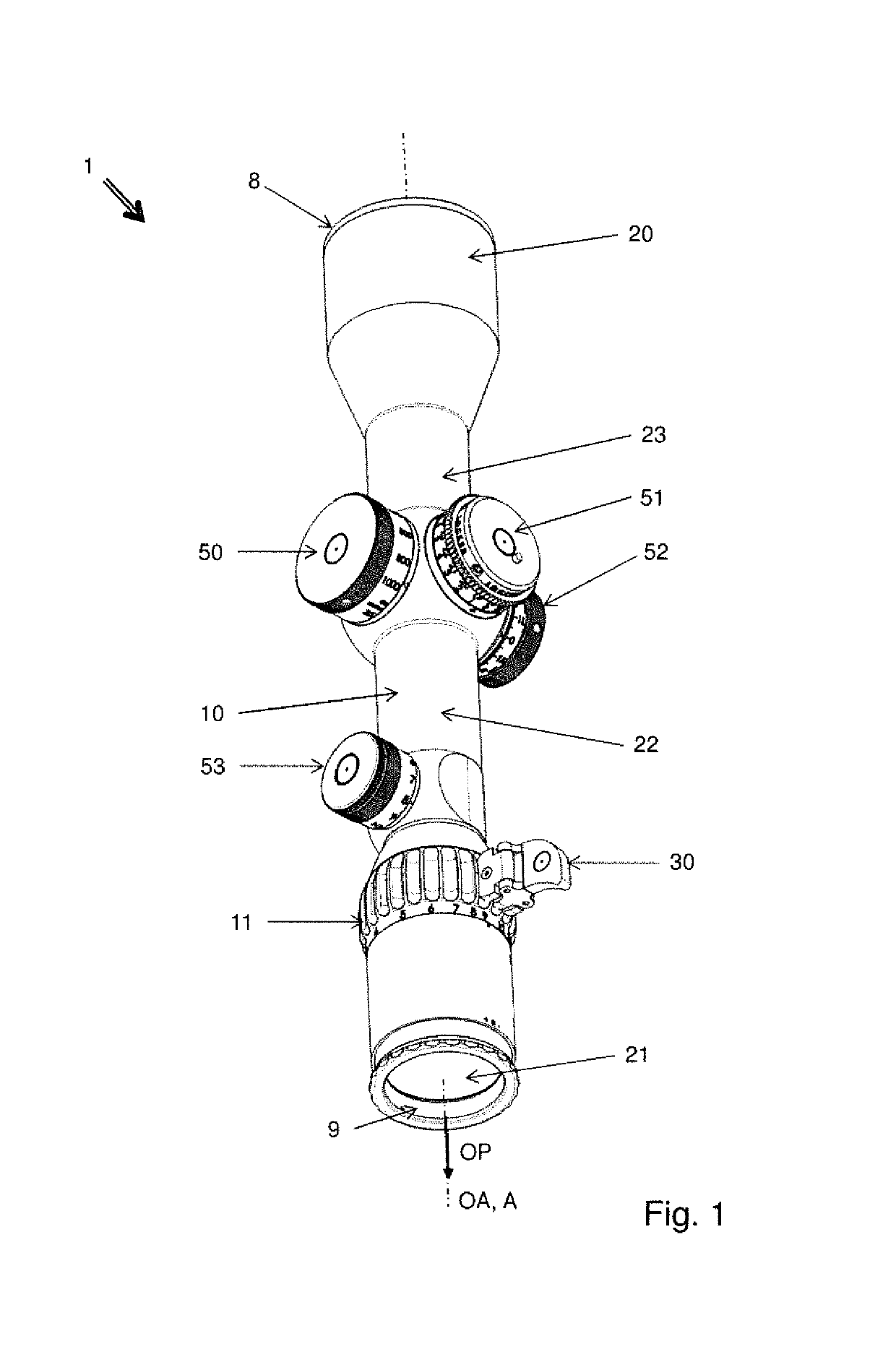
[0047]FIG. 1 shows a rifle scope 1 in a perspective view. This has a housing 10, in which optical lenses 20, 21, 22, 23 are arranged along an optical path OP. In particular, the housing 10 is tubular in design and the optical lenses 20, 21, 22, 23 are mounted in the housing 10. Some of the optical lenses 20 form an objective in the region of an entry opening 8 of the housing 10. Others of the optical lenses 21 form an eyepiece in the region of an exit opening 9 of the housing 10. In the middle portion of the tubular housing 10 there are arranged optical lenses 22, 23 which form an inversion system. With these lenses 22, 23, an optical magnification of a target object can also be carried out, since these optical lenses 22, 23 of the inversion system are each mounted movable along the optical path OP in the housing 10.

[0048]In the present case, the optical path OP and an optical axis OA of the rifle scope 1 outside of the latter are congruent or coaxial. Merely by adjustment functions...