Check patentability & draft patents in minutes with Patsnap Eureka AI!

Positive electrode and non-aqueous electrolyte secondary battery including the same

a technology of non-aqueous electrolyte and secondary batteries, which is applied in the direction of positive electrodes, active material electrodes, cell components, etc., can solve the problems of insufficient suppression of temperature rise, increase resistance of the end portion of the positive electrode, and low heat dissipation efficiency.

Active Publication Date: 2021-03-30
TOYOTA JIDOSHA KK
View PDF4 Cites 0 Cited by
  • Summary
  • Abstract
  • Description
  • Claims
  • Application Information

AI Technical Summary

Benefits of technology

[0005]As described in Japanese Patent Laying-Open No. 2016-127000, by providing a protective layer between the positive electrode current collector and the positive electrode composite material layer, it is possible to prevent the positive electrode current collector from being exposed in a nail penetration, which makes it possible to suppress the heat generation.
[0007]Accordingly, an object of the present disclosure is to provide a positive electrode capable of suppressing a temperature rise sufficiently even when a short circuit due to a nail penetration or the like occurs at an end portion of the positive electrode, and a non-aqueous electrolyte secondary battery including the positive electrode.
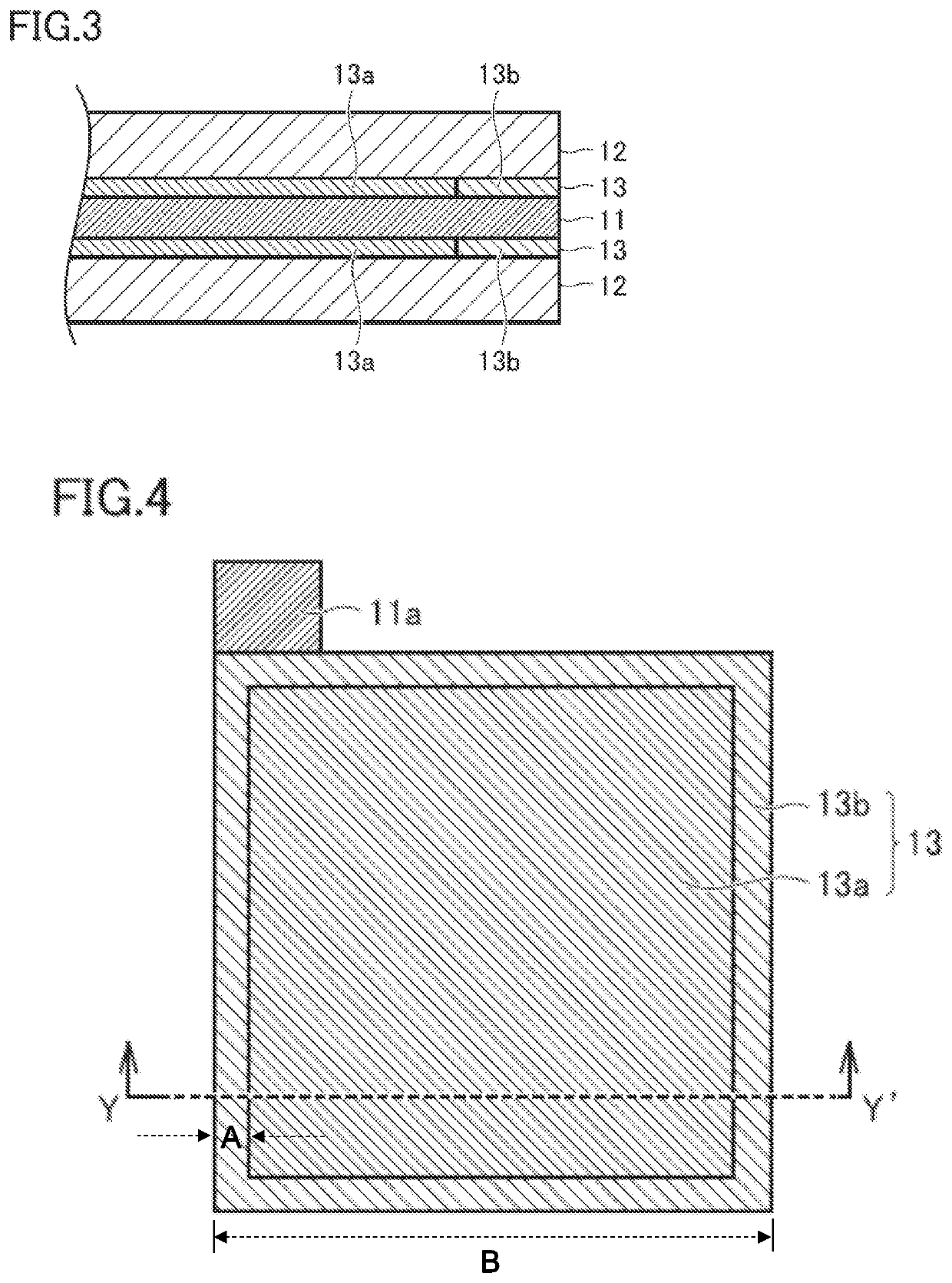
[0010]When heat is generated by an internal short circuit due to a nail penetration or the like at the end portion of the positive electrode (positive electrode composite material layer), since the heat dissipation area of the positive electrode current collector around the position of the short circuit is relatively small, the heat dissipation efficiency is low, which makes it easy for the temperature to become high. However, in the present disclosure, since the resistance of the end portion of the positive electrode is increased by reducing the ratio of the conductive material in the end portion of the protective layer smaller than that in the central portion, even when a short circuit occurs near the end portion of the positive electrode, the amount of short circuit current at the end is reduced. Therefore, it is possible to suppress the temperature rise at the end portion of the positive electrode due to the reason that the heat dissipation area of the positive electrode current collector around the position of the short circuit is relatively small, which makes it possible to prevent the temperature of the end portion of the positive electrode from going high. Since the resistance is increased only at the end of the positive electrode and the conductivity of the central portion is maintained, the conductivity of the entire positive electrode is maintained substantially, which makes it possible to guarantee the discharging ability of the battery.
[0011]Furthermore, after various investigations, the inventors of the present disclosure have found that by controlling the ratio Sc / S of the area Sc of the end portion of the protective layer to the total area S of the protective layer in plan view at 0.12 or more, it is possible to suppress the temperature rise when a short circuit due to a nail penetration or the like occurs at the end portion of the positive electrode.
[0012][2] The ratio Sc / S is preferably 0.45 or less, which makes it possible to suppress an increase in battery resistance.
[0013][3] The present disclosure also provides a non-aqueous electrolyte secondary battery including the positive electrode according to the above [1] or [2]. Since the non-aqueous electrolyte secondary battery of present disclosure includes the positive electrode, it is possible for it to sufficiently suppress the temperature rise even when a short circuit due to a nail penetration or the like occurs at the end portion of the positive electrode.

Problems solved by technology

However, the inventors of the present disclosure have found that by providing a protective layer as described in Japanese Patent Laying-Open No. 2016-127000, it is possible to suppress the temperature rise when a short circuit due to a nail penetration or the like occurs at a center portion of the positive electrode (positive electrode composite material layer), but when a short circuit due to a nail penetration or the like occurs at an end portion of the positive electrode, the temperature rise can not be suppressed sufficiently.

Method used

the structure of the environmentally friendly knitted fabric provided by the present invention; figure 2 Flow chart of the yarn wrapping machine for environmentally friendly knitted fabrics and storage devices; image 3 Is the parameter map of the yarn covering machine
View more

Image

Smart Image Click on the blue labels to locate them in the text.
Viewing Examples
Smart Image
  • Positive electrode and non-aqueous electrolyte secondary battery including the same
  • Positive electrode and non-aqueous electrolyte secondary battery including the same
  • Positive electrode and non-aqueous electrolyte secondary battery including the same

Examples

Experimental program
Comparison scheme
Effect test

example 1

[0074]“Manufacture of Positive Electrode”

[0075]The following materials were prepared.

[0076](Positive Electrode Current Collector)[0077]aluminum foil (thickness: 15 μm)

[0078](Materials for Protective Layer)[0079]insulating filler: alumina[0080]conductive material: acetylene black (AB)[0081]binder: polyvinylidene fluoride (PVDF)[0082]solvent: N-methyl-2-pyrrolidone (NMP)

[0083](Materials for Positive Electrode Composite Material Layer)[0084]positive electrode active material: LiNi0.5Co0.2Mn0.3O2 (NCM 523)[0085]conductive material: AB[0086]binder: PVDF[0087]solvent: NMP

[0088]93 parts by mass of alumina, 5 parts by mass of the conductive material (AB) and 2 parts by mass of the binder (PVDF) were mixed in the solvent to prepare a protective layer (central portion) paste. 96 parts by mass of alumina, 2 parts by mass of the conductive material (AB) and 2 parts by mass of the binder (PVDF) were mixed in the solvent to prepare a protective layer (end portion) paste.

[0089]The protective layer...

example 6

[0093]The positive electrode of Example 6 was manufactured in the same manner as Example 1 except that the ratio of the conductive material in the end portion of the protective layer was modified to 3 mass % (i.e., alumina:conductive material:binder 95:3:2 (mass %)).

example 7

[0094]The positive electrode of Example 7 was manufactured in the same manner as Example 1 except that the ratio of the conductive material in the end portion of the protective layer was modified to 1 mass % (i.e., alumina:conductive material:binder=97:1:2 (mass %)).

the structure of the environmentally friendly knitted fabric provided by the present invention; figure 2 Flow chart of the yarn wrapping machine for environmentally friendly knitted fabrics and storage devices; image 3 Is the parameter map of the yarn covering machine
Login to View More

PUM

PropertyMeasurementUnit
thicknessaaaaaaaaaa
thicknessaaaaaaaaaa
thicknessaaaaaaaaaa
Login to View More

Abstract

A positive electrode for a non-aqueous electrolyte secondary battery includes a positive electrode current collector, a protective layer provided on a surface of the positive electrode current collector, and a positive electrode composite material layer containing a positive electrode active material provided on a surface of the protective layer. The protective layer includes an insulating filler, a binder, and a conductive material. The protective layer is composed of a central portion and an end portion in a plan view as seen from the stacking direction. The ratio of the conductive material in the end portion of the protective layer is smaller than the ratio of the conductive material in the central portion of the protective layer. The ratio Sc / S of the area Sc of the end portion of the protective layer to the total area S of the protective layer in plan view is 0.12 or more.

Description

[0001]This non-provisional application is based on Japanese Patent Application No. 2017-206208 filed on Oct. 25, 2017 with the Japan Patent Office, the entire contents of which are hereby incorporated by reference.BACKGROUNDField[0002]The present disclosure relates to a positive electrode and a non-aqueous electrolyte secondary battery including the same.Description of the Background Art[0003]Japanese Patent Laying-Open No. 2016-127000 discloses a positive electrode including a positive electrode current collector, a positive electrode composite material layer, and a protective layer provided therebetween. Japanese Patent Laying-Open No. 2016-127000 describes that this positive electrode is capable of maintaining favorable current collecting performance, and owing to the protection layer, capable of preventing an oxidation-reduction reaction from occurring between the positive electrode active material and the positive electrode current collector (aluminum) when an internal short ci...

Claims

the structure of the environmentally friendly knitted fabric provided by the present invention; figure 2 Flow chart of the yarn wrapping machine for environmentally friendly knitted fabrics and storage devices; image 3 Is the parameter map of the yarn covering machine
Login to View More

Application Information

Patent Timeline
no application Login to View More
Patent Type & Authority Patents(United States)
IPC IPC(8): H01M4/00H01M4/62H01M10/0525H01M4/36H01M4/02
CPCH01M4/628H01M4/366H01M4/624H01M10/0525H01M2004/028Y02E60/10
Inventor TORITA, KOJITSUTSUMI, SHUJIFUKUMOTO, YUSUKE
Owner TOYOTA JIDOSHA KK
Features
  • R&D
  • Intellectual Property
  • Life Sciences
  • Materials
  • Tech Scout
Why Patsnap Eureka
  • Unparalleled Data Quality
  • Higher Quality Content
  • 60% Fewer Hallucinations
Social media
Patsnap Eureka Blog
Learn More