
Pluggable join framework for stream processing
a join framework and stream processing technology, applied in the field of stream processing, can solve the problems of slow lambda pipelines, inability to process data in real-time, duplication of processing logic, etc., and achieve the effect of reducing data processing and certification times, no risk of variation in processing between pipelines, and rapid changes in data processing
- Summary
- Abstract
- Description
- Claims
- Application Information
AI Technical Summary
Benefits of technology
Problems solved by technology
Method used
Image

Examples
Embodiment Construction
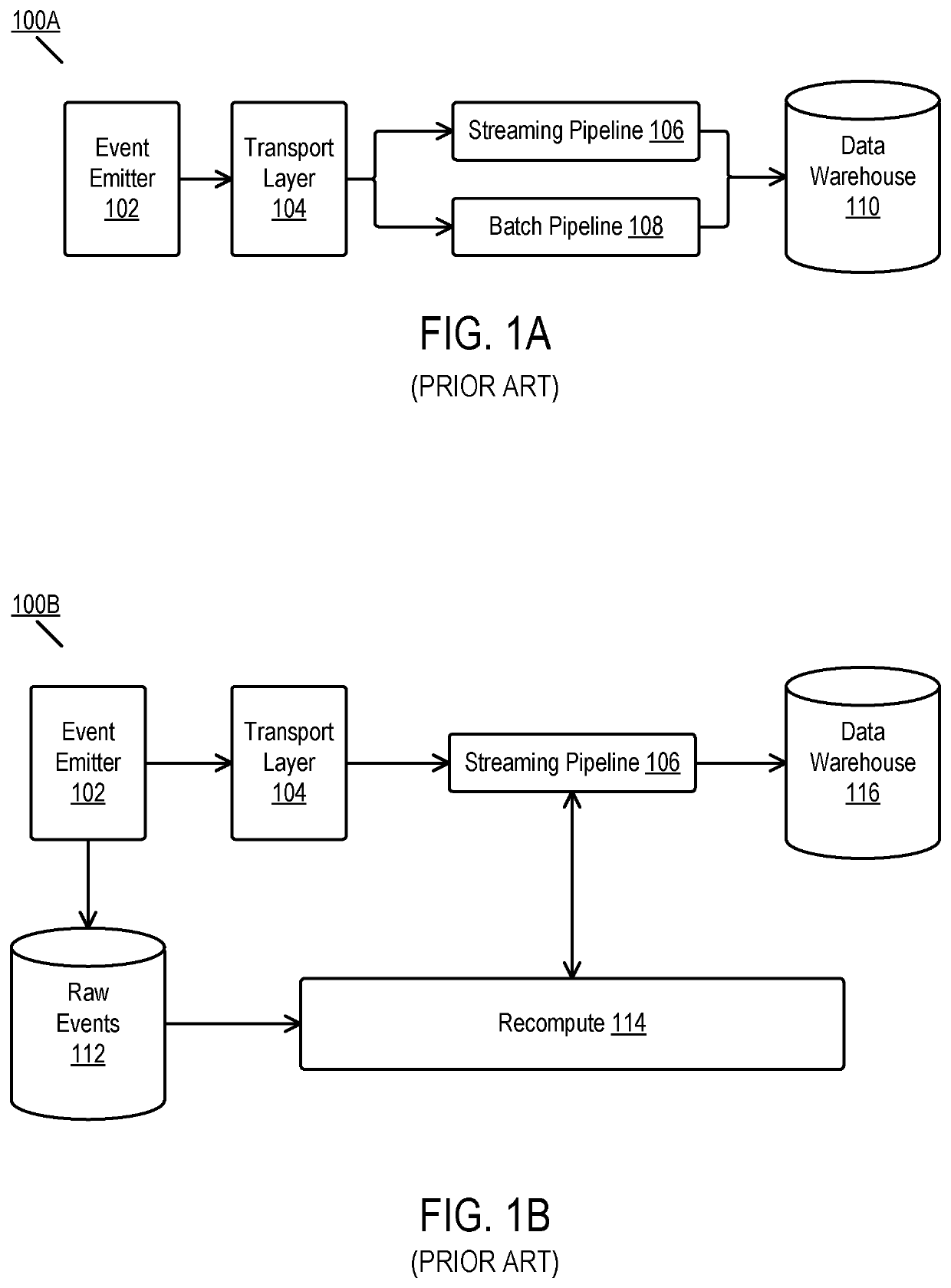
[0021]FIG. 1A is a block diagram illustrating a processing system employing a Lambda architecture.
[0022]In the illustrated embodiment, events in the system (100a) originate from one or more event emitters (102). As used herein, an event refers to any type of data generated by a computing system. Generally, most events include arbitrary data as well as a timestamp indicating when the event emitter (102) generated the data. Alternatively, or in conjunction with the preceding, the system (100a) adds a timestamp representing the time the pipelines (106, 108) receive the event. In some embodiments, the timestamp comprises a standard time (e.g., based on a 24-hour clock). In some embodiments, the timestamp comprises a numerical value (e.g., time since UNIX epoch). In other embodiments, the timestamp may comprise a sequence number or other incrementing (or otherwise changing) value. In some embodiments, events further include nonce values to ensure uniqueness.
[0023]The event emitters (102)...
PUM
 Login to View More
 Abstract
Description
Claims
Application Information
 Login to View More