
Underwater detection apparatus
a technology of underwater detection and underwater equipment, which is applied in the direction of transducer details, electrical transducers, instruments, etc., can solve the problems of increasing equipment cost and mechanical size of fish finders, and achieve the effect of simplifying manufacture and inventory control
- Summary
- Abstract
- Description
- Claims
- Application Information
AI Technical Summary
Benefits of technology
Problems solved by technology
Method used
Image

Examples
first embodiment
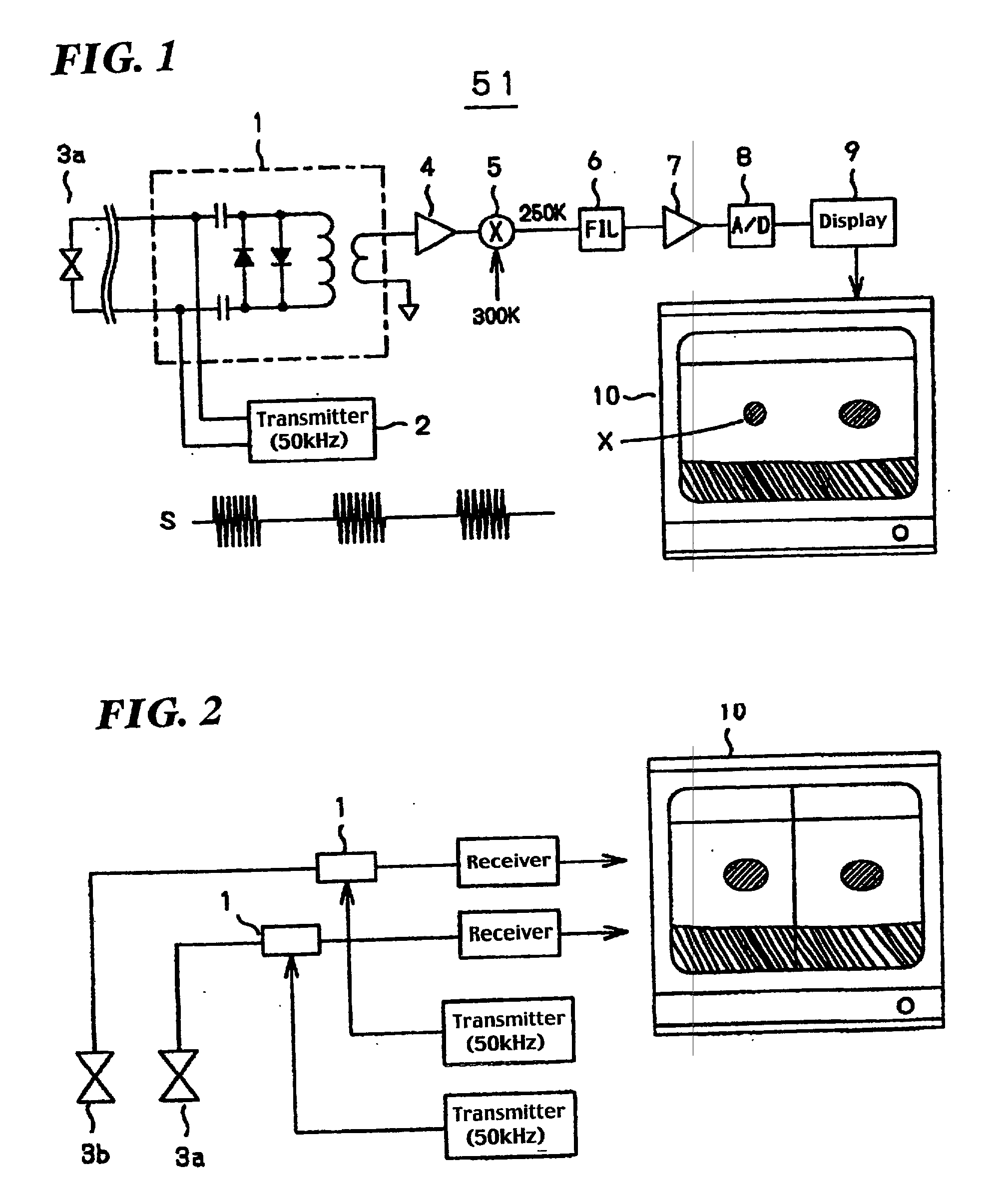
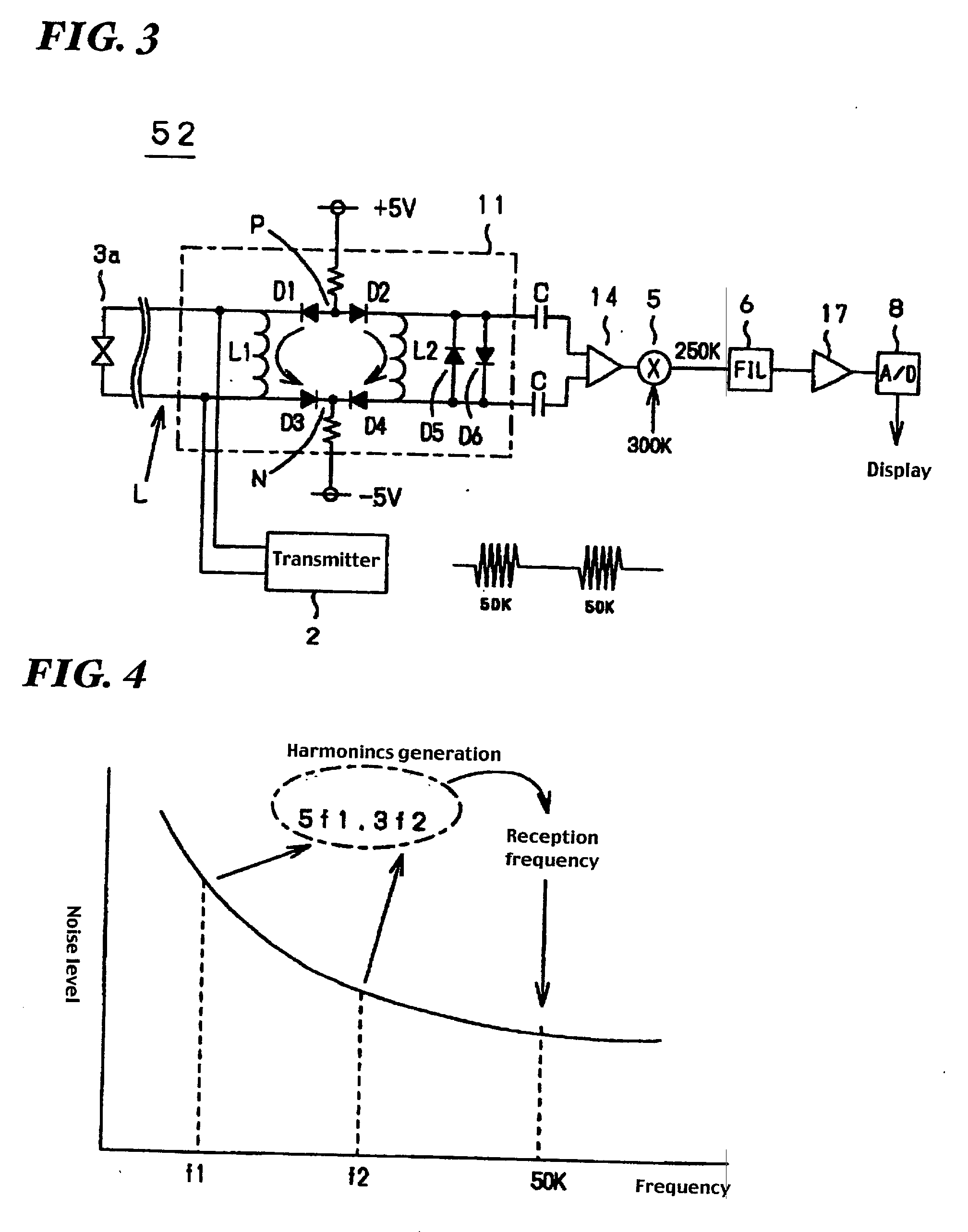
[0038] FIG. 3 is a block diagram of a fish finder 52 according to the invention, in which elements equivalent to those shown in FIG. 1 are designated by the same reference numerals. The fish finder 52 employs a trap circuit 11 having connecting points P, N on two lines L. Anodes of diodes D1, D2 are connected to the connecting point P while cathodes of diodes D3, D4 are connected to the connecting point N.
[0039] A coil L1 is connected between a cathode of the diode D1 and an anode of the diode D3, and a transducer 3a is connected between both ends of the coil L1. Also, a coil L2, as well as two diodes D5, D6 connected in parallel but in opposite directions, are connected between a cathode of the diode D2 and an anode of the diode D4.
[0040] The cathode of the diode D2 and the anode of the diode D4 are connected to input terminals of a preamplifier 14 in a succeeding stage through respective capacitors C. It is to be noted that the cathode of the diode D2 and the anode of the diode D4...
second embodiment
[0051] FIG. 6 is a block diagram of a fish finder 53 according to the invention, in which elements equivalent to those shown in FIG. 3 are designated by the same reference numerals. Two transducers 3b, 3a having operating frequencies of 15 kHz and 50 kHz, for example, arranged in parallel are connected to a broadband trap circuit 11 through a low-pass filter 21 and a high-pass filter 22, respectively. The low-pass filter 21 and the high-pass filter 22 constitute typical inductance-capacitance (LC) circuits as shown in FIG. 7.
[0052] A transmitting signal S output from a transmitter 23 contains 15 kHz and 50 kHz components. This is because 15 kHz and 50 kHz signals are alternately supplied from oscillators 25b and 25a, respectively, to the transmitter 23 via a switch 24. The 15 kHz and 50 kHz components are separated from each other by the low-pass filter 21 and the high-pass filter 22 and, as a consequence, a 15 kHz transmitting signal is fed into the 15 kHz transducer 3b while a 50 ...
third embodiment
[0055] FIG. 8 is a block diagram of a fish finder 54 according to the invention, in which elements equivalent to those shown in FIG. 6 are designated by the same reference numerals. Unlike the fish finder 53 of FIG. 6, this fish finder 54 does not incorporate the low-pass filter 21 or the high-pass filter 22. Instead, a 15 kHz transducer 3c and a 50 kHz transducer 3d arranged in parallel are connected directly to a broadband trap circuit 11.
[0056] In this embodiment, the transducer 3c has a low impedance at its operating frequency of 15 kHz and a high impedance at 50 kHz, whereas the transducer 3d has a low impedance at its operating frequency of 50 kHz and a high impedance at 15 kHz.
[0057] As is the case with the fish finder 53 of FIG. 6, transmission signals containing 15 kHz and 50 kHz components occurring in successive turns are supplied from a transmitter 23 to the broadband trap circuit 11. While both the 15 kHz and 50 kHz signal components are delivered to the transducers 3c ...
PUM
 Login to View More
 Abstract
Description
Claims
Application Information
 Login to View More