[0019] That is, generally, initial tension working on a belt splits into a tight side tension and a slack side tension by rotational torque that is input to a driving pulley, and
power transmission from the driving pulley to a driven pulley is carried out by the difference between these tensions. However, belt pressing forces at the pulleys become approximately the same in a static state in which the pulleys do not rotate and in a
light load state in which the transmission load is small even when the pulleys are rotating. On the contrary, when the transmission load increases, the belt pressing force on the driving pulley side becomes greater than that on the driven pulley side at all times by the change in tension distribution in the belt, therefore producing a difference therebetween. In accordance with the present invention, the
cam mechanism is disposed on the rear face side of the movable sheave of each pulley so that the movable sheave travels in the shaft direction by the relative rotation between the rotary and stationary cams. Belt pressing forces occurring in the pulleys are offset, and by application of a force greater than such a pressing force difference, it becomes possible to perform variable speed operation. Accordingly, as described above, it is sufficient that the variable speed operation force is one in excess of the difference between belt pressing forces occurring in the pulleys. Therefore, the variable speed operation force is reduced considerably not only during
low load but also during
high load, thereby making it possible to make the control motor small in output and in size.
[0020] Additionally, at that time, it is arranged such that transmitting a belt pressing force occurring in one of the pulleys as a belt pressing force occurring in the other pulley is carried out by the
cam mechanisms disposed on the rear face side of the movable sheaves of the pulleys, so that the belt pressing force of each pulley can efficiently be converted into a torque for causing the cams of the cam mechanisms to rotate relatively with each other, and further its
power transmission line is short and the sliding resistance becomes extremely small. Therefore, the variable speed operation force can be reduced to a further extent.
[0021] Furthermore, the shift
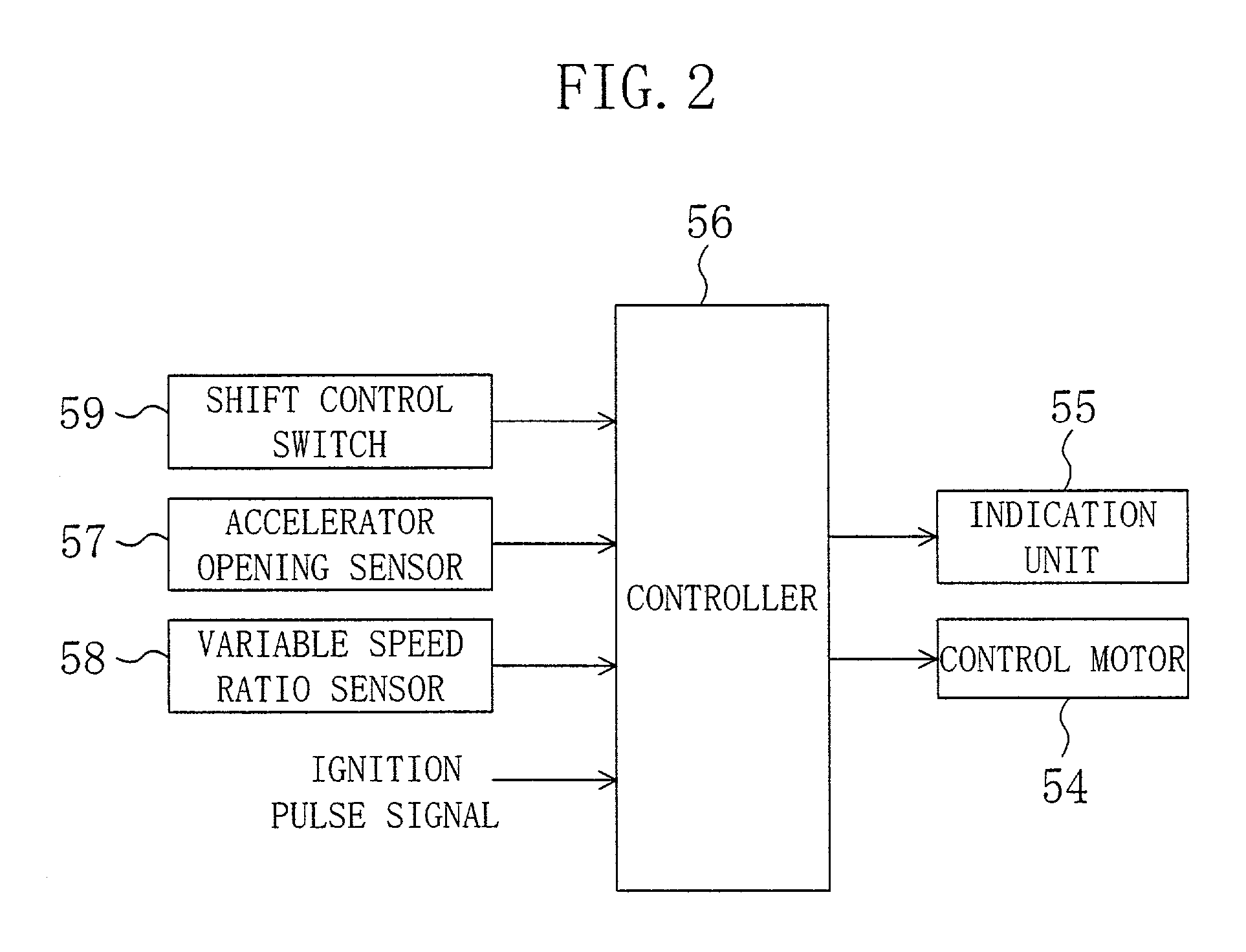
control switch is operated by a vehicle driver, and based on a
control signal from the shift
control switch, the variable speed mode by the infinitely variable speed transmission is shifted between two
modes, i.e., the semi- and full-automatic
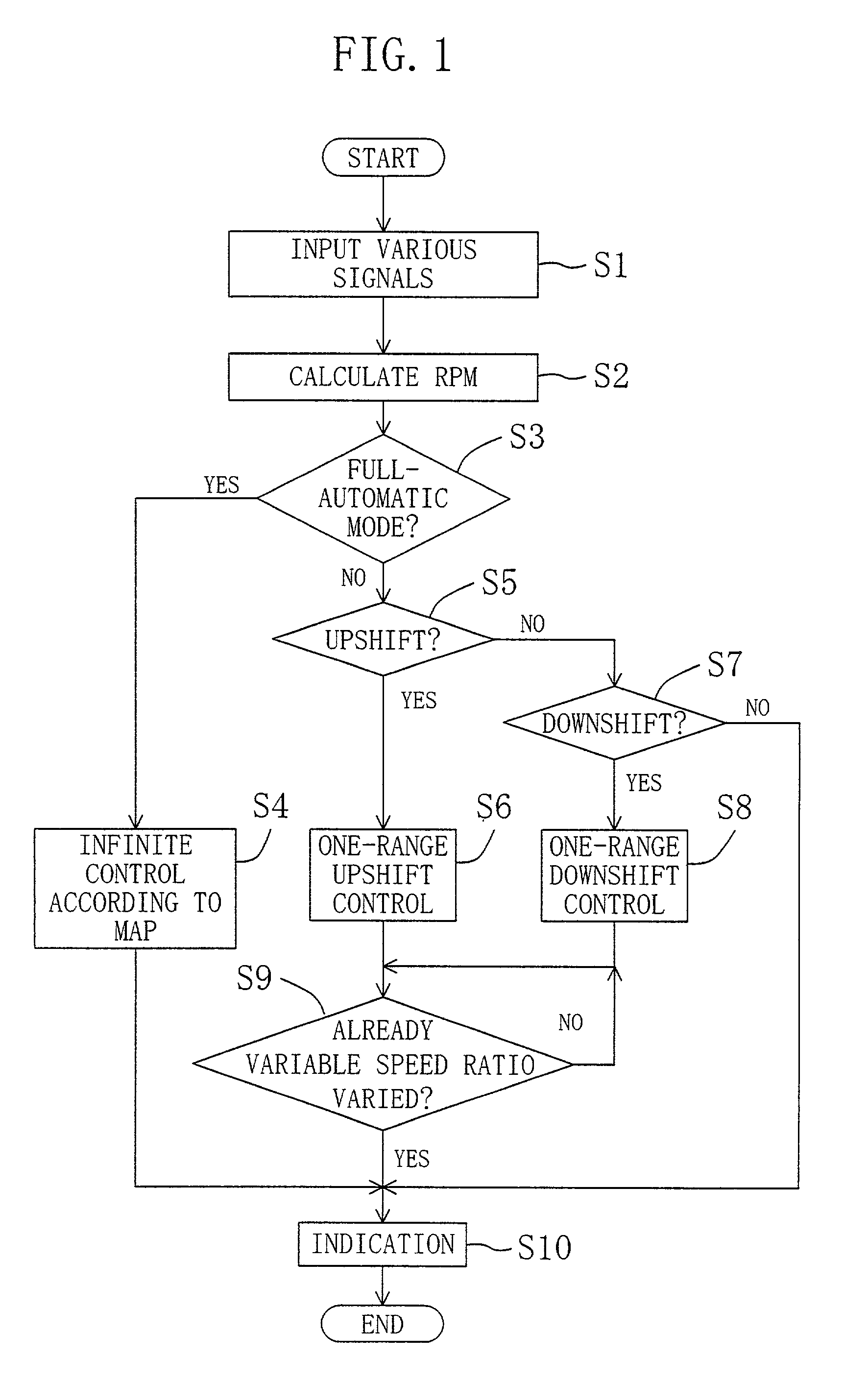
modes. When shifted to the semi-automatic mode, the variable speed ratio of the infinitely variable speed transmission is shifted to a selected one of a plurality of preset variable speed ratios, whereas, when shifted to the full-automatic mode, the variable speed ratio of the infinitely variable speed transmission is controlled so as to vary infinitely. As described above, the variable speed mode is shifted between the two modes (the semi- and full-automatic modes). This makes it possible to perform control so that the variable speed ratio of the infinitely variable speed transmission can be varied automatically infinitely. Besides, it is possible to use the infinitely variable speed transmission as if it were a finitely variable transmission. This provides better driving convenience for vehicle sports traveling et cetera, thereby satisfying the likes of a vehicle driver.
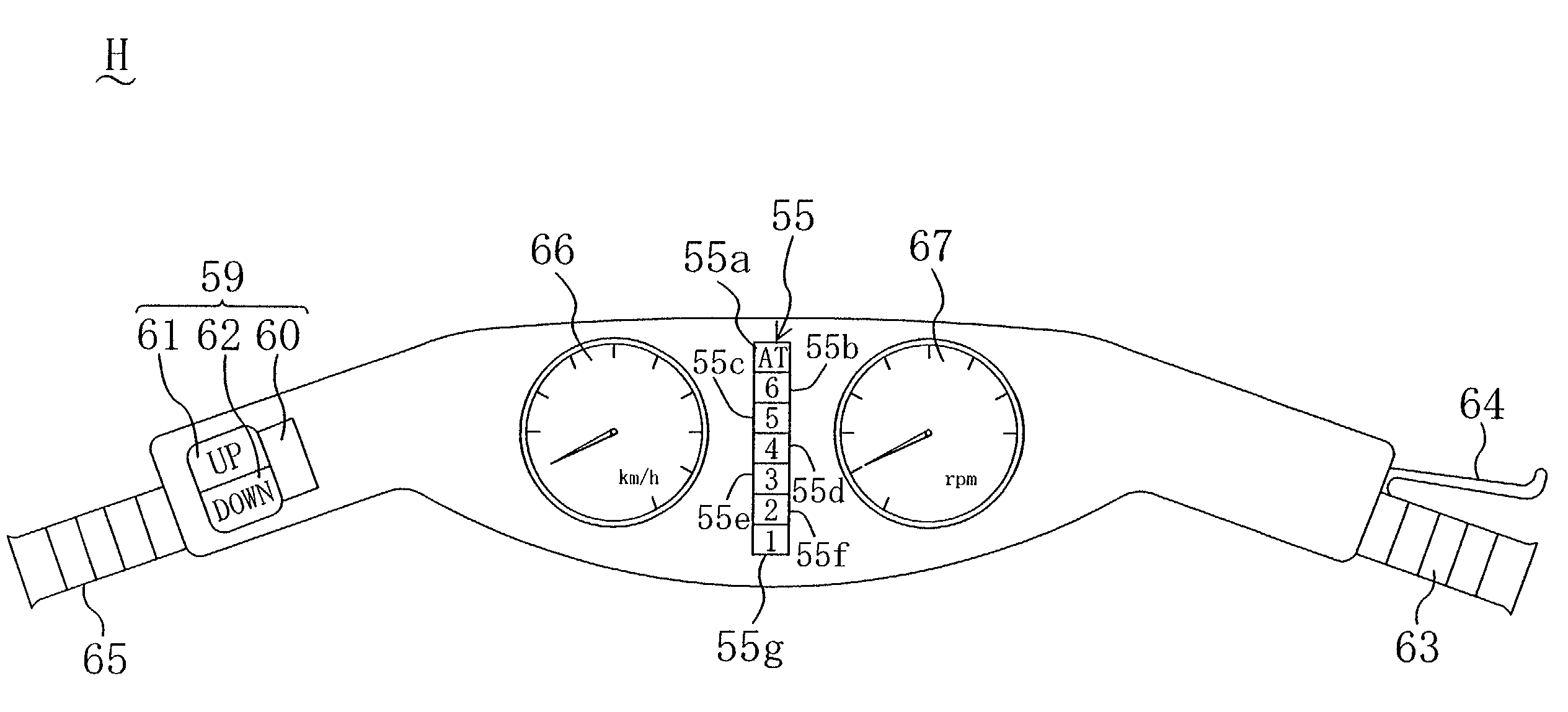
[0023] In such a case, it may be arranged such that the shift control switch is positioned at one end of a
handle of the vehicle opposite to the other end at which an accelerator grip is provided and the shift control switch is operated by one of hands of a driver of the vehicle opposite to the other hand which performs accelerator operations. As a result of such arrangement, the shift control switch is operated by a hand different from the hand for acceleration operations, therefore ensuring that the occurrence of shift control switch maloperation is avoided.
[0024] An indicator means for indicating variable speed positions in the full- and semi-automatic modes by the control means may be provided. Such arrangement allows the driver to easily identify a shift of the variable speed mode, and a variable speed position in the semi-automatic mode, thereby improving driving convenience.


 Login to View More
  Login to View More