Historically the biggest single issue involved in the usage, construction and architecture of
knowledge based systems has been the question of how to extract the knowledge, expertise and
human decision making capability from one or more humans, in a
data format which enables the knowledge, expertise and
decision making capability to be computable in a
machine.
The elicitation of knowledge from human beings has proved to be a profoundly difficult problem for the
information technology industry, to the extent that although great ideas have been produced for computer programs, which embody reasoning capability, the data over which they reason, that is to say the knowledge bases, have been very difficult to construct.
However, the way in which humans think and consider problems does not apparently or clearly follow rigid logical processes.
The problem of extracting human knowledge, which often appears to be unstructured and intuitive, into a computable form of data suitable for a conventional computer to process is a difficult technical problem.
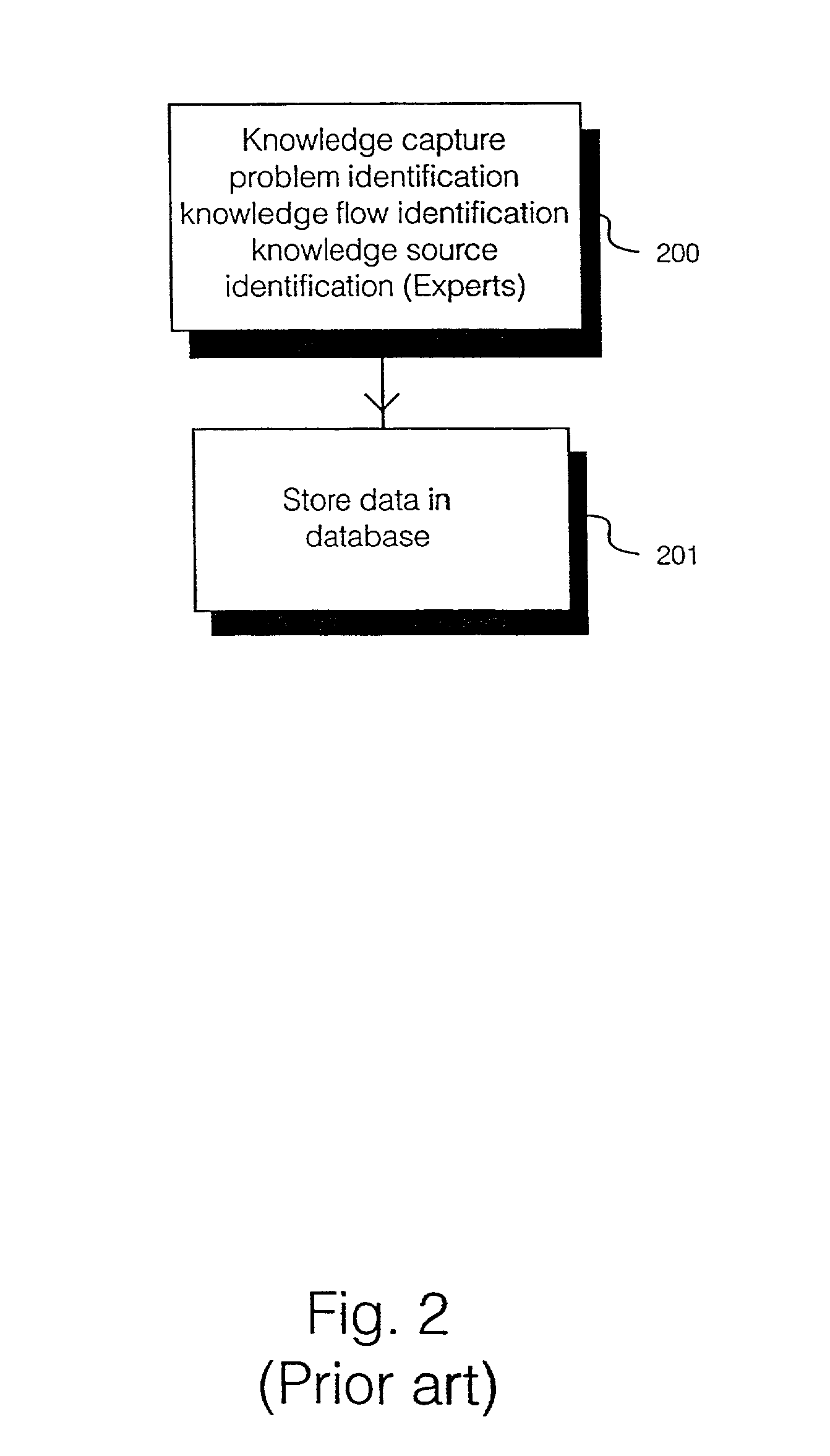
Problems occur in the knowledge capture process 200, in that complete and full knowledge may not be extracted by prior art questioning process.
Problems also occur in the arrangement of data into a form suitable for input into a prior art data base architecture, because the data base architecture may not be flexible enough to contain all the complex inter relationships between facts and statements comprising the knowledge.
The inventors have realized that whilst a psychology based approach results in a rich conceptual map of how an expert is thinking in a knowledge domain, it does not actually give a rule base, and the knowledge elicited from a human expert using prior art logic and psychology based methods does not result in directly computable data.
In prior art methods there needs to be applied much heavy thought about the unstructured text, information, matrices and grids, in order to try and derive some rules from them, and input them into a computer
system, typically finding that this does not work fully, and then having to run known consistency checks because the rule base does not work, followed by a return to the expert for further questioning and re-eliciting knowledge from the expert, repeatedly manipulating the elicited data (sometimes including the application of statistical methods), in a potentially endless iterative loop (although most practical knowledge elicitation processes do stop somewhere).
Prior art knowledge elicitation processes are unable to guarantee consistency or completeness of rule bases determined from those processes, and can result in hundreds or thousands of rules in a
knowledge base, which need to be checked for internal
self consistency.
Prior art systems may result in rule bases where mutually incompatible rules exist within the rule base.
Consequently, prior art knowledge elicitation processes have the major
disadvantage that because of the deficiencies of the prior art elicitation processes, the persons carrying out the elicitation of knowledge from human experts, in order to be sufficiently effective, tend to need to become experts themselves.
These knowledge engineers would typically require a long training process in order to know what questions to ask a knowledge expert, thus resulting in a large requirement in time, cost and resources for creating knowledge based systems and expert systems.
Problems with the prior art approaches include the fact that often only the result of the rules is elicited, not the rules themselves, and additionally the human expert only recites their conscious knowledge.
Consequently, the inventors have realized that prior art logic and psychology based knowledge elicitation processes singularly fail, to a greater or lesser extent, to address sub-conscious knowledge, internal consistency, interrelations, dependencies, or the cognitive explanation of these, and consequently do not overcome the knowledge elicitation
bottleneck.
The inventors have rejected prior art logic and psychology based approaches and realized that prior art methods of identifying cognitive maps will not yield directly computable or consistent knowledge data, but instead, have taken an approach of questioning what it is which human beings are attempting to do when making decisions.
However, a
hypothesis is only as good as the absence of something which undermines that
hypothesis, and much of western
scientific method is based upon finding facts which undermine hypotheses and can therefore prove them to be false.



 Login to View More
  Login to View More