
Thermal interface material characterizing system
a thermal interface and characterizing system technology, applied in the field of material testing, can solve the problems of limiting performance, shortening the life of components, and confusing end-users
- Summary
- Abstract
- Description
- Claims
- Application Information
AI Technical Summary
Benefits of technology
Problems solved by technology
Method used
Image

Examples
Embodiment Construction
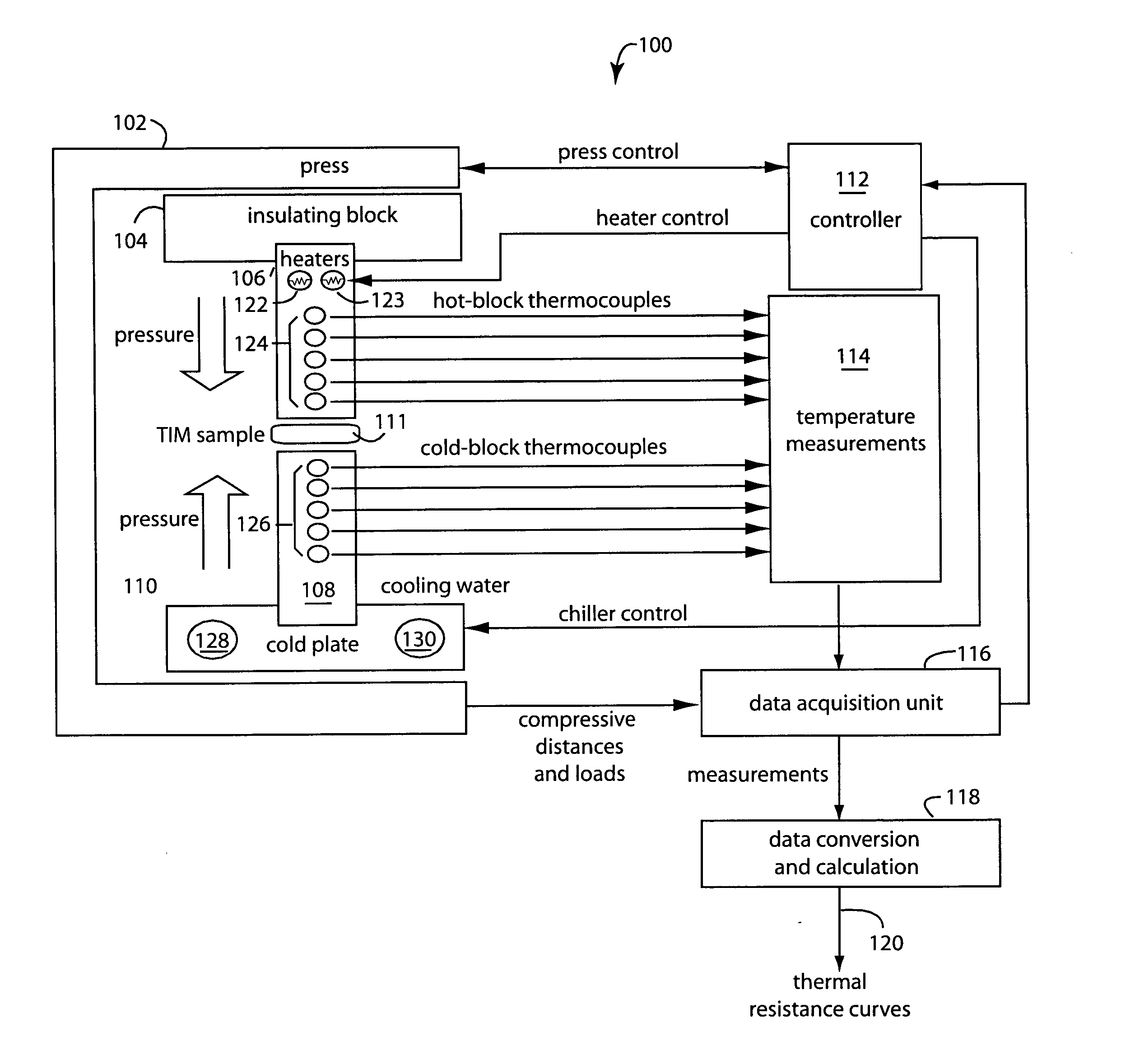
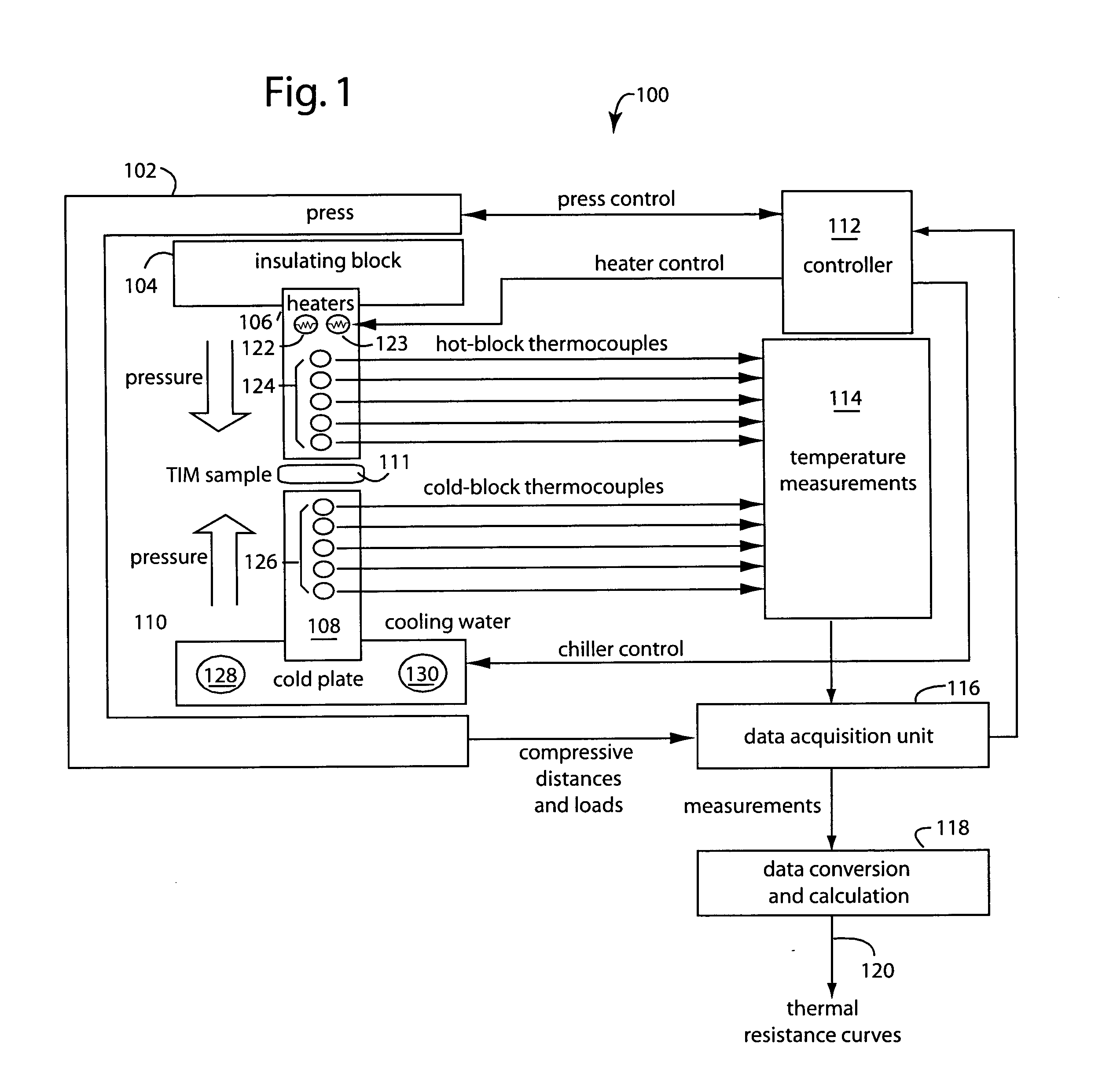
FIG. 1 illustrates a thermal interface material (TIM) test system embodiment of the present invention, and is referred to herein by the general reference numeral 100. The system 100 comprises a programmable press 102 in which are mounted a heat insulating block 104, a hot block 106, a cold block 108, and a cold plate 110. A “sample” TIM 111 is squeezed between the hot and cold blocks 106 and 108 during characterization. It is important that the pressure being applied remains constant even while TIM 111 expands and contracts over its programmed temperature excursions. An INSTRON 5566 can be used, as marketed by Instron Corporation, 100 Royall Street, Canton, Mass., 02021, USA. A gauge is useful for measuring the thickness of the TIM 111 at room temperature and at a test temperature.
A controller 112 manages how the programmable press 102 will operate during tests of the TIM, e.g., the pressures and durations applied. The controller 112 further adjusts the heat being applied and the c...
PUM
 Login to View More
 Abstract
Description
Claims
Application Information
 Login to View More