Vehicle torque coordination

a technology of torque coordination and vehicle, which is applied in the direction of braking system, jet propulsion mounting, instruments, etc., to achieve the effects of improving driveability, fuel economy and exhaust emissions, and being less prone to failur

US20050060079A1Inactive Publication Date: 2005-03-17FORD GLOBAL TECH LLC
16 Cites 104 Cited by

Patent Information

Authority / Receiving Office
US · United States
Patent Type
Applications(United States)
Current Assignee / Owner
Publication Date
2005-03-17
Estimated Expiration
Not applicable · inactive patent

Smart Images

  • Figure 1
    Figure 1
  • Figure 2
    Figure 2
  • Figure 3
    Figure 3
Patent Text Reader

Abstract

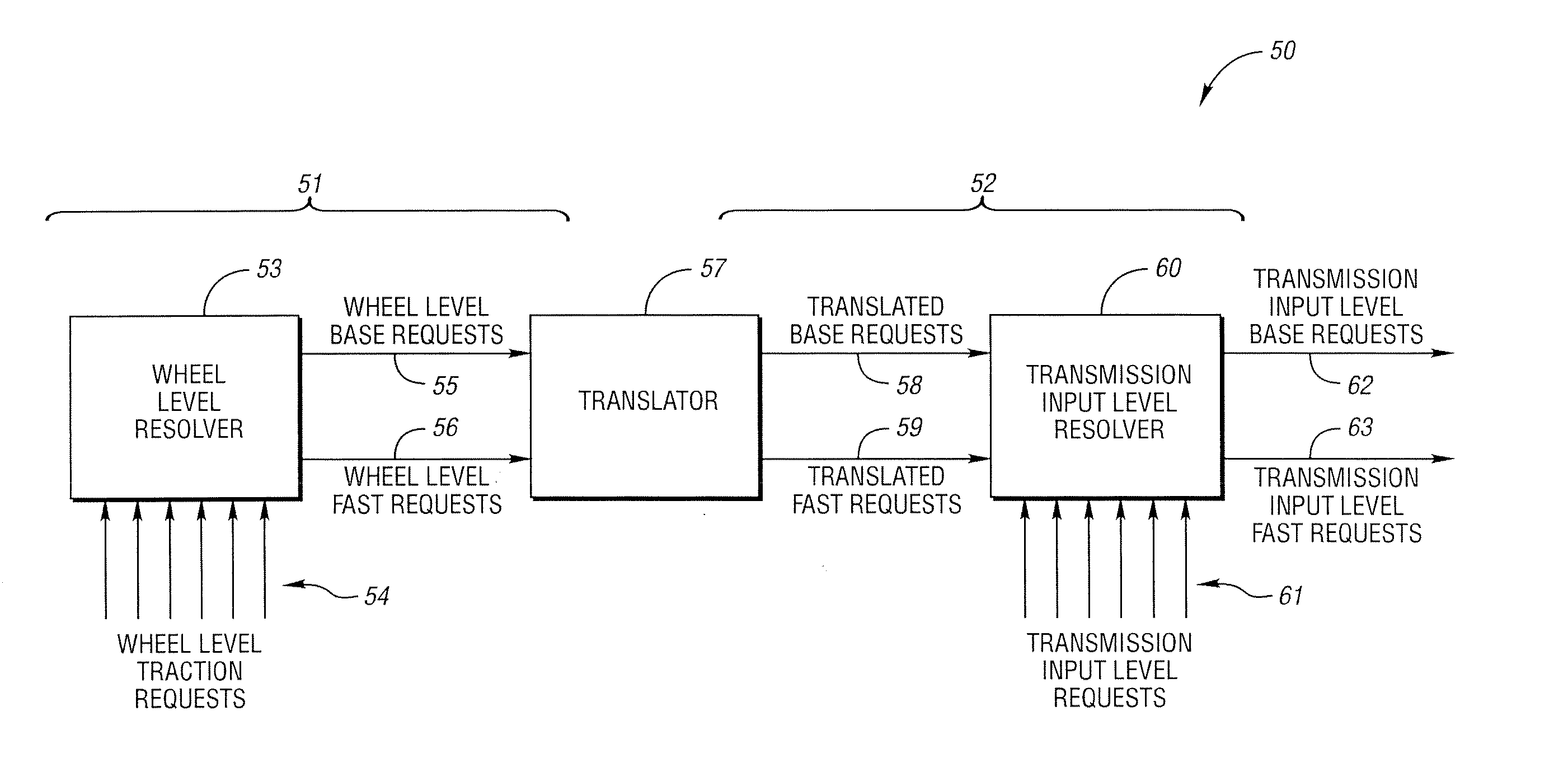
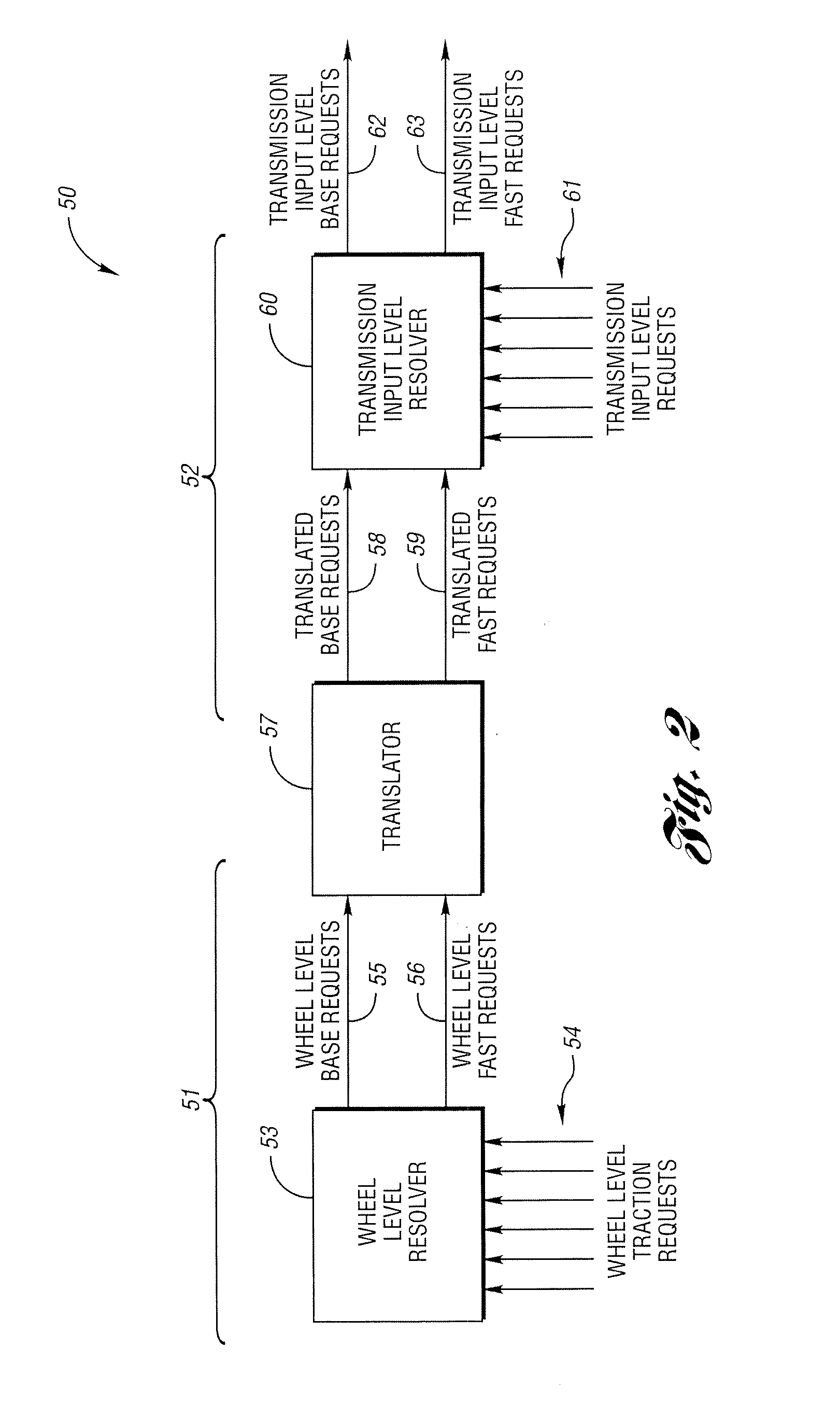
Torque demand is coordinated in a vehicle. Information defining at least one torque production limitation for a first torque producing device is received. A request for torque is compared with the first torque producing device torque production limitation. If the comparison does not result in the request for torque exceeding a limitation, a first coordinated torque request is determined as the request for torque and a null torque is determined as a second coordinated torque request. Otherwise, a first excess requested torque is determined as the difference between the request for torque and the exceeded limitation, the first coordinated torque request is determined as the exceeded limitation, and the second coordinated torque request is determined as the first excess requested torque.
Need to check novelty before this filing date? Find Prior Art

Description

BACKGROUND OF INVENTION 1. Field of the Invention The present invention relates to the control of torque in a vehicle. More particularly, the present invention relates to coordinating torque demands amongst a plurality of vehicular torque producing devices. 2. Background Art Vehicle control systems accept requests from the vehicle driver and various vehicle components as well as output from vehicle parameter sensors. Vehicle controllers use these inputs to generate control signals for vehicle equipment. Conventional control systems applied to automotive vehicle applications were used to improve engine operation in order to reduce vehicle emissions. Since these early attempts, engine controls have continued to grow in complexity as opportunities are identified to make further improvements in performance, emissions, fuel economy, and the like. Since the engine controller is still typically the most complex control system on the vehicle, it remains the primary repository for most n...

Examples

Embodiment Construction

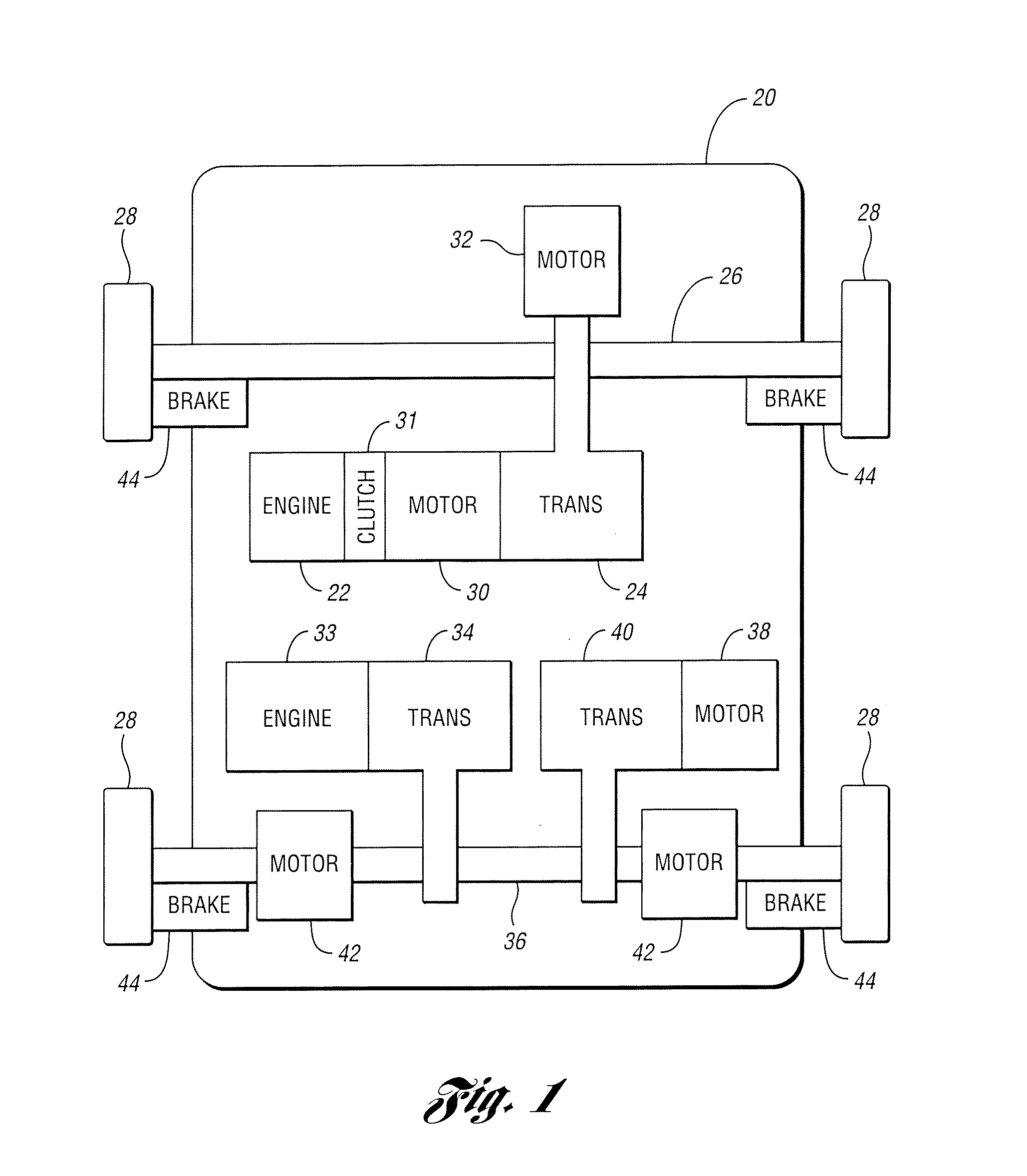
Referring to FIG. 1, a schematic diagram illustrating torque producing devices according to an embodiment of the present invention is shown. Vehicle 20 may include a plurality of torque producing devices. Torque producing devices include any of a wide variety of internal combustion engines (ICE). Various types of motors may also be employed, including those powered by energy storage devices such as batteries, accumulators and the like; powered by power generating devices, such as engines, fuel cell systems, solar cell systems, and the like; or powered by any combination of these.

For example, engine 22 transmits torque through engine transmission 24 to front axle 26 thereby driving wheels 28. Engine transmission 24 is controlled to convert torque from engine 22 to axle 26 using various mechanisms such as torque converters, gears, and the like. Transmission 24 may be manual, automatic, continuously variable, composed of one or more planetary gear sets, or of any other suitable cons...