The present invention provides a system, method and apparatus for developing software that is relatively inexpensive, easy to use and does not introduce new problems in the software. Moreover, the present invention represents a breakthrough in productivity, component
reusability and collaborative development, through a holistic approach to the software life cycle. The present invention not only dramatically accelerates a
software development schedule, but the developed components will be robust, flexible, and above all, reusable. The present invention separates conceptually between overall system design and concrete implementation, so that changes in practical details have no
impact on the whole—to the extent that components can be removed or replaced in a system with as much ease as ejecting a DVD from its player and inserting another. The present invention integrates with Microsoft Visual
Studio .NET. As a result, all the power and features of the .
NET framework and toolset can be used, while rapidly accelerating the new software through the present invention's development experience.
The present invention (sembleWare™ Visual Welder™) can save the user a tremendous amount of time and energy in developing a system, by automating the most commonly performed tasks, encapsulating best practices, and leaving the user to do only the intelligent work of coding business rules. The present invention includes at least three features that create this productivity benefit: Instant Databases, Projects and Prototypes, Ready Made Parts, and
Automatic Control Binding.
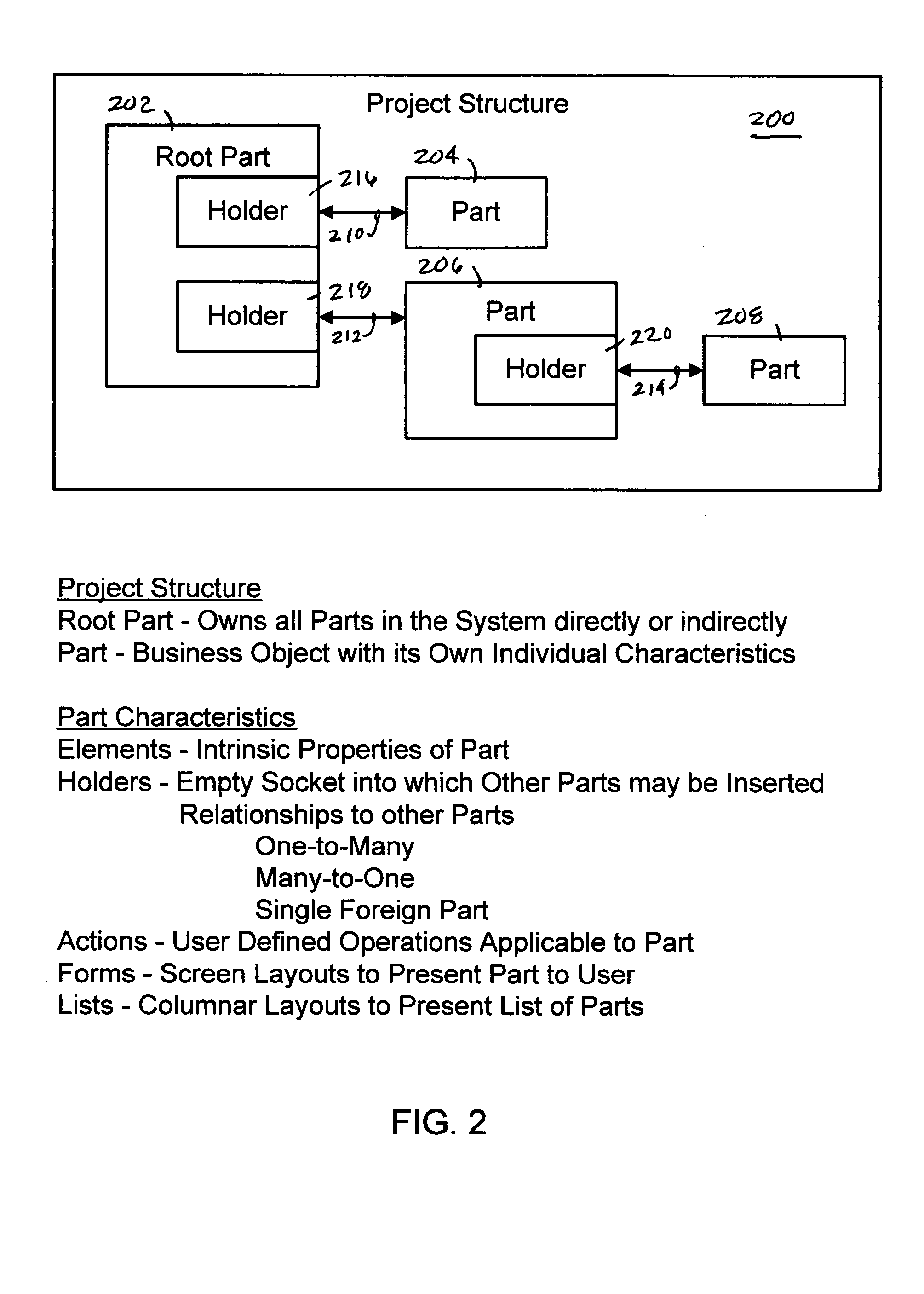
The present invention uses a “Part” based
design pattern to provide drag-and-drop
assembly of applications. “Parts” are composed using one-sided relationships, making them highly reusable in other contexts and applications. The user can
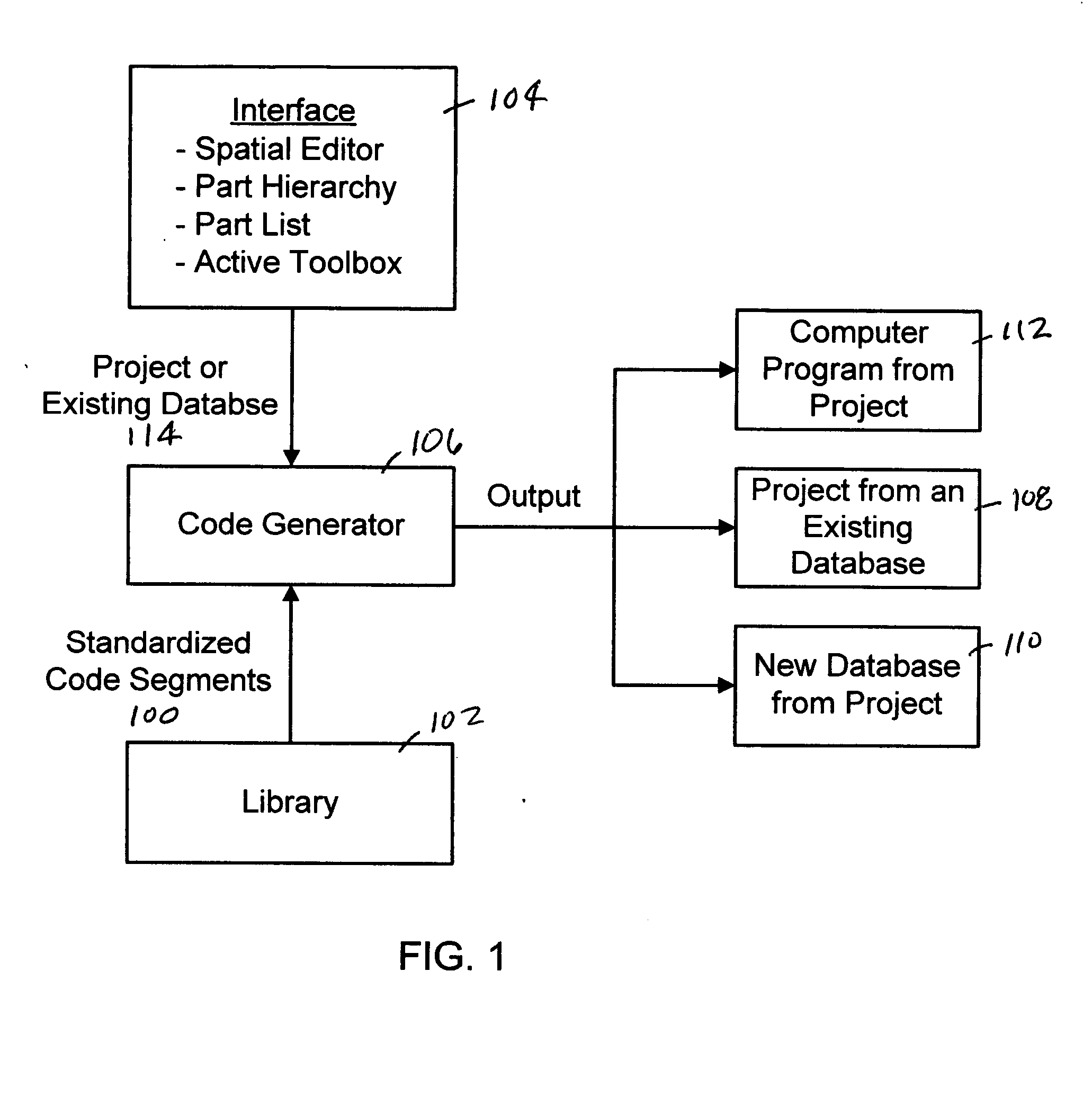
package his or her own Parts for later re-use, or download and plug-in parts from an Online Part Catalog, potentially saving countless hours of development time. The user can also use the present invention's three-dimensional Spatial Editor to “opens up” the insides of the system being designed to see how the inner “parts” fit together. The system or application can be shaped by manipulating the 3D model, or using the Active
Toolbox, tailor
list and grids using the
List Designer. As the user works, the present invention dynamically generates all the VS.NET code needed to get a working application. Working applications can be created without writing a
single line of code. Or the user can introduce as much code as is needed. The choice is up to the user. The user can prioritize his or her efforts and produce more system in less time.
In addition, the present invention can generate complex web forms, complete with working drop-down combos, header-detail support,
SQL queries with joins, navigation buttons and more, which are driven by an easy-to-customize
html template. The user can even apply a new template to a form that was previously created, whether it was generated or painted by hand, to get a whole new look-and-feel. In addition, web forms can be crafted by dragging-and-dropping from the Active
Toolbox. The present invention tracks the “parts” on the form, and can determine when a textbox,
checkbox, option button, dropdown combo or nested grid is needed. The present invention will “wire” the code-behind the user, including
SQL joins, as the user drags and drops. The user can create cascading combos, user grid-limiters, and even combos with related fields that auto-update, without writing a line of code.
The present invention can also be used to reverse-engineer a
database to provide a working application complete with screens. An entire
database or selected tables can be imported. Additional tables can even be imported into an existing application. As a result, the user can build running applications from legacy systems with a few clicks of a mouse.
Any system built using the present invention is scalable. The runtime environment is optimized for a stateless
web environment. The system uses libraries containing best-practice usage of the
NET framework, so the QA cycle can be reduced.



 Login to View More
  Login to View More