Hybrid vehicle

a hybrid vehicle and vehicle technology, applied in the direction of motor/generator/converter stopper, multiple dynamo-motor starters, braking components, etc., can solve the problems of deteriorating and affecting the efficiency of energy use. , to achieve the effect of improving the conversion efficiency of vehicular kinetic energy and improving the energy use efficiency

a hybrid vehicle and vehicle technology, applied in the direction of motor/generator/converter stopper, multiple dynamo-motor starters, braking components, etc., can solve the problems of deteriorating and affecting the efficiency of energy use. , to achieve the effect of improving the conversion efficiency of vehicular kinetic energy and improving the energy use efficiency

US20050099146A1Active Publication Date: 2005-05-12HONDA MOTOR CO LTD

Image

Smart Image Click on the blue labels to locate them in the text.
Viewing Examples
Smart Image
  • Hybrid vehicle
  • Hybrid vehicle
  • Hybrid vehicle

Examples

Experimental program
Comparison scheme
Effect test

first embodiment

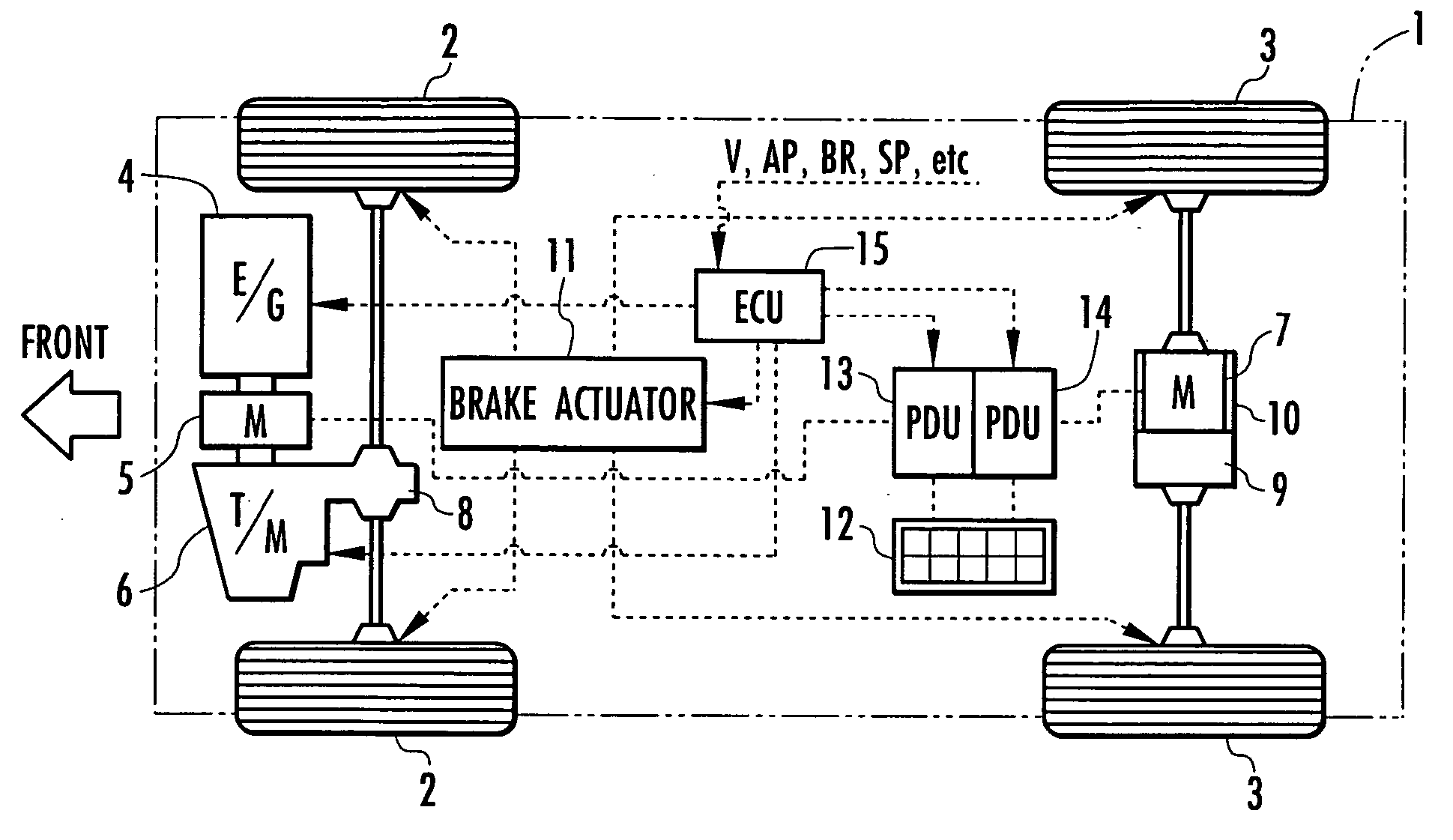
[0053] A first embodiment according to the present invention will be described with reference to FIG. 1 to FIG. 11. FIG. 1 is a block diagram schematically showing a general construction of a hybrid vehicle in accordance with the present embodiment. As shown in the figure, a hybrid vehicle 1 has a pair of front wheels 2 and a pair of rear wheels 3. An engine 4, a first generator-motor 5, and a transmission 6 are provided adjacently to the front wheels 2 and 2, while a second generator-motor 7 is provided adjacently to the rear wheels 3 and 3. The first generator-motor 5 is disposed between the engine 4 and the transmission 6, and its rotor is coaxially connected with an output shaft 4a of the engine 4 and an input shaft 6a of the transmission 6 so that the rotor can be rotated together as one piece with the output shaft 4a and the input shaft 6a. An output end of the transmission 6 is joined to the front wheels 2 and 2 through the intermediary of a differential gear unit 8 so as to ...

second embodiment

[0124] A second embodiment according to the present invention will now be described with reference to FIG. 12 and FIG. 13. The present embodiment differs from the first embodiment only in a portion of control processing; therefore, the like components as those in the first embodiment will use the like reference numerals and drawings as those in the first embodiment, and detailed explanation will not be repeated.

[0125] The present embodiment differs from the first embodiment in that, when the control processing in the rear-based regenerative mode or the standard regenerative mode explained in the first embodiment is carried out, the wheels 2 and 3 are checked for slippage. If no slippage is detected, then the control processing in the rear-based regenerative mode is carried out. If slippage is detected, then the control processing in the standard regenerative mode is carried out.

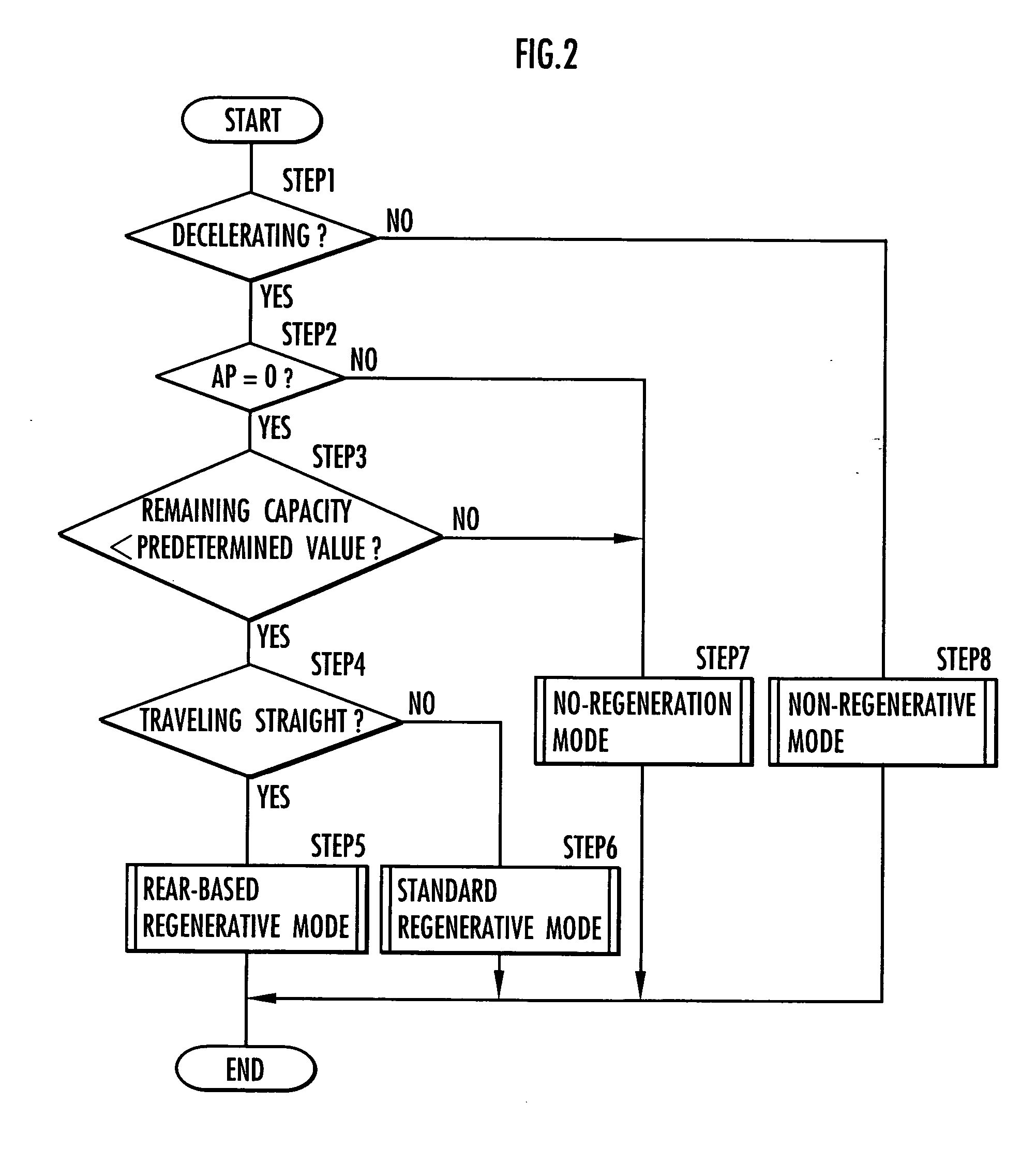
[0126] More specifically in the present embodiment, the control processing illustrated by the flowchart o...

the structure of the environmentally friendly knitted fabric provided by the present invention; figure 2 Flow chart of the yarn wrapping machine for environmentally friendly knitted fabrics and storage devices; image 3 Is the parameter map of the yarn covering machine
Login to View More

PUM

No PUM Login to View More

Abstract

A hybrid vehicle is capable of performing regenerative operations of generator-motors disposed adjacently to front wheels and / or rear wheels of the vehicle so as to achieve efficient conversion of kinetic energy of the vehicle into electric energy as much as possible when the vehicle slows down, thereby permitting higher use efficiency of energy. When the vehicle decelerates, a target deceleration force or a target deceleration torque of the vehicle is set, and a permissible maximum value of the braking torque to be imparted to rear wheels from a second generator-motor is set, and the permissible maximum value and the target deceleration torque of the vehicle, whichever is smaller, is set as a target braking torque to be imparted from the second generator-motor to the rear wheels. Furthermore, with the remaining torque of the target deceleration torque being set as an upper limit, a target braking torque to be imparted to front wheels from a first generator-motor is determined, and a friction type braking mechanism compensates a shortfall torque of a total sum of the target braking torques of the two generator-motors to reach the target deceleration torque.

Description

BACKGROUND OF THE INVENTION [0001] 1. Field of the Invention [0002] The present invention relates to a hybrid vehicle and, more particularly, to a hybrid vehicle provided with a generator-motor capable of imparting torque to front wheels of the vehicle and another generator-motor capable of imparting torque to rear wheels thereof. [0003] 2. Description of the Related Art [0004] A hybrid vehicle (so-called parallel hybrid vehicle) having an engine and a generator-motor, which is a motor capable of acting as a generator and also as a motor, as a driving source of the vehicle, normally performs regenerative operation of the generator-motor when the vehicle is slowing down so as to operate the generator-motor as a generator and to charge a battery (secondary battery) with the generated energy, the battery serving as a power source of the generator-motor. Thus, a part of the kinetic energy of the vehicle is converted into electric energy to be collected or absorbed by the battery. As a t...

Claims

the structure of the environmentally friendly knitted fabric provided by the present invention; figure 2 Flow chart of the yarn wrapping machine for environmentally friendly knitted fabrics and storage devices; image 3 Is the parameter map of the yarn covering machine
Login to View More

Application Information

Patent Timeline
12 May 2005
Publication
US20050099146A1
IPC
B60K1/02; B60K6/22; B60K6/44; B60K6/485; B60K6/52; B60K6/54; B60L7/18; B60L50/16; B60W10/08; B60W10/10; B60W10/18; B60W10/26; B60W20/00; H02P3/00
CPC
B60K1/02; Y02T10/642; B60K6/52; B60L7/18; B60L2240/423; B60L2240/486; B60T2270/602; B60W10/08
Inventors
NISHIKAWA, RYO; AMANUMA, HIROKATSU