Carotenoid ether analogs or derivatives for controlling connexin 43 expression
Inactive Publication Date: 2005-07-07
CARDAX PHARMA
View PDF99 Cites 37 Cited by
Summary
Abstract
Description
Claims
Application Information
AI Technical Summary
This helps you quickly interpret patents by identifying the three key elements:
Problems solved by technology
Method used
Benefits of technology
Benefits of technology
[0054] In an embodiment, the administration of water soluble analogs or derivatives of carotenoids to a subject may inhibit and / or ameliorate some types of cardiovascular disease associated with cardiac arrhythmia. In some embodiments, water soluble analogs or derivatives of carotenoids may be administered to a subject alone or in combination with other carotenoid analogs or derivatives. Carotenoid analogs or derivatives may assist in the maintenance of electrical stability in cardiac tissue. Assistance in the maintenance of electrical stability in cardiac tissue may inhibit and / or ameliorate some types of cardiovascular disease, including in particular sudden cardiac death attributable to lethal cardiac arrhythmia.
[0056] In an embodiment, the administration of water soluble analogs or derivatives of carotenoids to a subject may inhibit and / or ameliorate the proliferation and propagation of initiated, transformed and / or cancerous or pre-cancerous cell(s). In some embodiments, water soluble analogs or derivatives of carotenoids may be administered to a subject alone or in combination with other carotenoid analogs or derivatives. Carotenoid analogs or derivatives may inhibit the proliferation rate of carcinogen-initiated cells. Carotenoid analogs or derivatives may increase connexin 43 expression. Increase of connexin 43 expression may increase, maintain, or restore gap junctional intercellular communication and thus inhibit the growth of carcinogen-initiated cells.
Problems solved by technology
CVD is a leading cause of mortality and morbidity in the world.
The absolute number of deaths due to CVD has fallen since 1996; however, it remains the single largest cause of death in the United States, with a total annual healthcare burden of greater than $300 billion (including heart attack and stroke).
Ischemia is the lack of an adequate oxygenated blood supply to a particular tissue.
However, surgical reperfusion is available at only 15 to 20 percent of care centers in the United States, and much fewer worldwide.
Thrombolytic therapy is unsuccessful in reperfusion of about 20% of infarcted arteries.
Recombinant tissue-type plasminogen activator administered within 3 hours of ischemic stroke significantly improves clinical outcome, but increases the risk of hemorrhage.
Method used
the structure of the environmentally friendly knitted fabric provided by the present invention; figure 2 Flow chart of the yarn wrapping machine for environmentally friendly knitted fabrics and storage devices; image 3 Is the parameter map of the yarn covering machine
View more
Image
Smart Image Click on the blue labels to locate them in the text.
Viewing Examples
Smart Image
Click on the blue label to locate the original text in one second.
Reading with bidirectional positioning of images and text.
Smart Image
Examples
Experimental program
Comparison scheme
Effect test
example 1
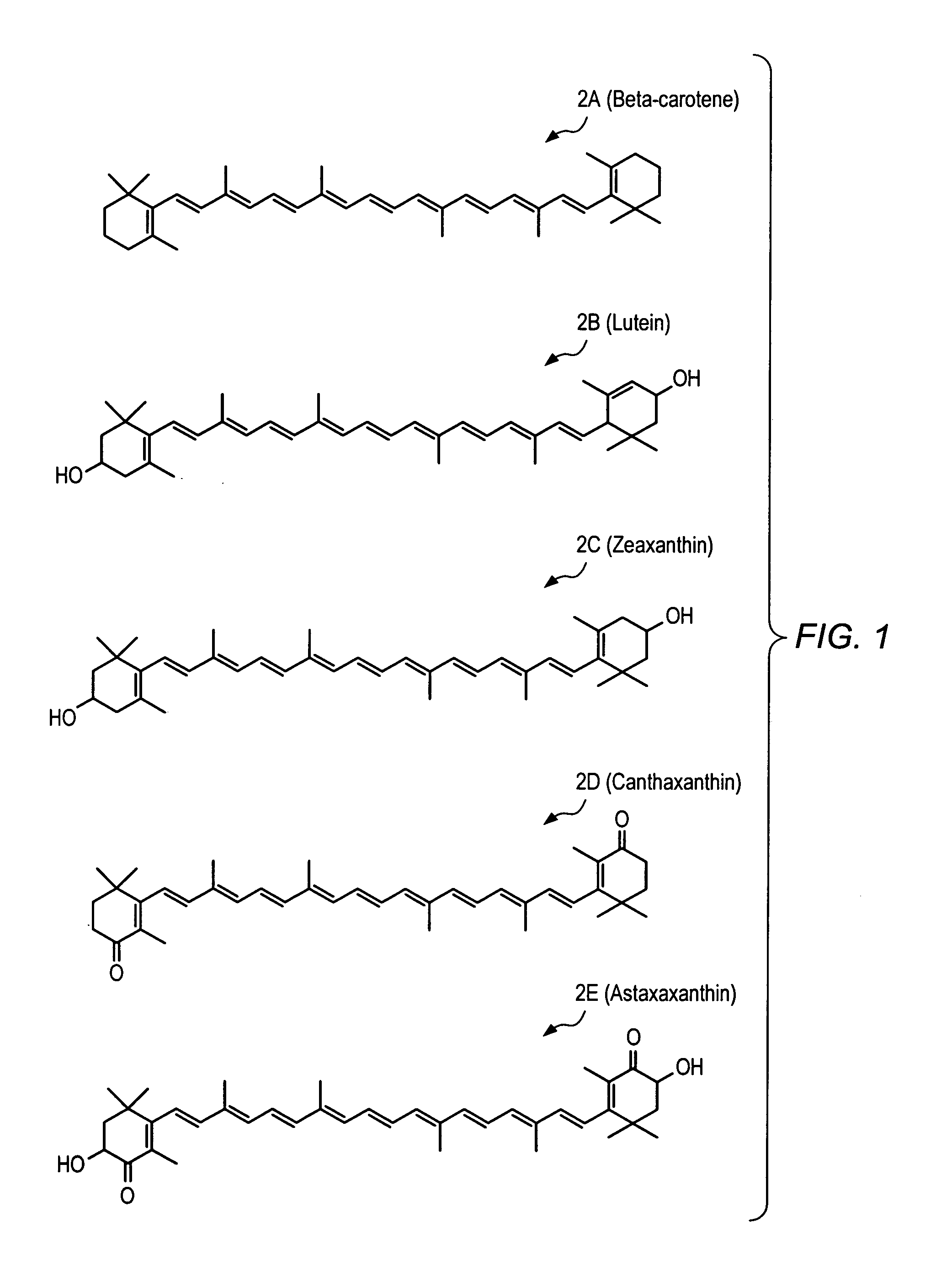
Synthesis of XV (the Disuccinic Acid ester of Astaxanthin (Succinic acid mono-(4-{18-[4-(3-carboxy-propionyloxy)-2,6,6-trimethyl-3-oxo-cyclohex-1-enyl]-3,7,12,16-tetramethyl-octadeca-1,3,5,7,9,11,13,15,17-nonaenyl}-3,5,5-trimethyl-2-oxo-cyclohex-3-enyl) ester))
[0250]
[0251] To a solution of astaxanthin 2E (6.0 g, 10.05 mmol) in DCM (“dichloromethane”) (50 mL) at room temperature was added DIPEA (“N,N-diisopropylethylamine”) (35.012 mL, 201 mmol), succinic anhydride (10.057 g, 100.5 mmol), and DMAP (“4-(dimethylamino)pyridine”) (0.6145 g, 5.03 mmol). The reaction mixture was stirred at room temperature for 48 hours, at which time the reaction was diluted with DCM, quenched with brine / 1M HCl (60 mV 10 mL), and then extracted with DCM. The combined organic layers were dried over Na2SO4 and concentrated to yield astaxanthin disuccinate (XV) (100%) HPLC retention time: 10.031 min., 82.57% (AUC); LRMS (ESI) mlz (relative intensity): 798 (M++2H) (52), 797 (M++H) (100); HPLC retention time:...
example 2
Synthesis of XVI (the Disodium Salt of the Disuccinic Acid ester of Astaxanthin (Succinic acid mono-(4-{18-[4-(3-carboxy-propionyloxy)-2,6,6-trimethyl-3-oxo-cyclohex-1-enyl]-3,7,12,16-tetramethyl-octadeca-1,3,5,7,9,11,13,15,17-nonaenyl}-3,5,5-trimethyl-2-oxo-cyclohex-3-enyl) ester))
[0252]
[0253] Disuccinic acid ester of astaxanthin XV (2 g, 2.509 mmol) and 200 mL ethanol were stirred at room temperature under nitrogen in a 500 mL round-bottom flask. Sodium ethoxide (340 mg, 5.019 mmol, Acros #A012556101) was added as a solid in a single portion and the solution was allowed to stir overnight. The following day, the precipitate was filtered off and washed with ethanol followed by methylenechloride to afford a purple solid, the disodium salt of the disuccinic acid ester of astaxanthin, XVI [1.41 g, 67%] and was placed on a high vacuum line to dry. 1H-NMR (Methanol-d4) δ 6.77-6.28 (14 H, m), 5.53 (2 H, dd, J=12.6, 6.8), 2.68-2.47 (8 H, m), 2.08-1.88 (22 H, m), 1.37 (6 H, s), 1.24 (6H, ...
example 3
Synthesis of the BocLys(Boc)OH ester of Astaxanthin (XXI)
[0254]
“HPLC: Column: Waters Symmetry C18 3.5 micron 4.6 mm×150 mm; Temperature: 25° C.; Mobile phase: (A=0.025 % TFA in H2O; B=0.025% TFA in MeCN), 95% A / 5% B (start); linear gradient to 100% B over 12 min, hold for 4 min; linear gradient to 95% B / 5% A over 2 min; linear gradient to 95% A / 5% B over 4 min; Flow rate: 2.5 mL / min; Detectorwavelength: 474 nm.
[0255] To a mixture of astaxanthin 2E (11.5 g, 19.3 mmol) and BocLys(Boc)OH (20.0 g, 57.7 mmol) in methylenechloride (500 mL) were added 4-dimethylaminopyridine (DMAP) (10.6 g, 86.6 mmol) and 1,3-diisopropylcarbodiimide (“DIC”) (13.4 g, 86.7 mmol). The round-bottomed flask was covered with aluminum foil and the mixture was stirred at ambient temperature under nitrogen overnight. After 16 hours, the reaction was incomplete by HPLC and TLC. An additional 1.5 equivalents of DMAP and DIC were added to the reaction and after 2 hours, the reaction was complete by HPLC. The mixtu...
the structure of the environmentally friendly knitted fabric provided by the present invention; figure 2 Flow chart of the yarn wrapping machine for environmentally friendly knitted fabrics and storage devices; image 3 Is the parameter map of the yarn covering machine
Login to View More
PUM
Property
Measurement
Unit
Mass
aaaaa
aaaaa
Mass
aaaaa
aaaaa
Mass
aaaaa
aaaaa
Login to View More
Abstract
A method of controlling (e.g., influencing or affecting) connexin 43 expression in a subject may include administering to the subject an effective amount of a pharmaceutically acceptable formulation. In some embodiments, controlling connexin 43 expression in a subject may effectively treat cardiac arrhythmia and / or cancerous and pre-cancerous cells in a subject. The pharmaceutically acceptable formulation may include a synthetic analog or derivative of a carotenoid. The subject may be administered a carotenoid analog or derivative, either alone or in combination with another carotenoid analog or derivative, or co-antioxidant formulation. The carotenoid analog may include a conjugated polyene with between 7 to 14 double bonds. The conjugated polyene may include a cyclic ring including at least one substituent. In some embodiments, a cyclic ring of a carotenoid analog or derivative may include at least one substituent. The substituent may be coupled to the cyclic ring with an ether functionality.
Description
PRIORITY CLAIM [0001] This application is a continuation in part of patent application Ser. No. 10 / 629,538 entitled “Structural Carotenoid Analogs for the Inhibition and Amelioration of Disease” filed on Jul. 29, 2003 which claims priority to Provisional Patent Application No. 60 / 399,194 entitled “Structural Carotenoid Analogs for the Inhibition and Amelioration of Reperfusion Injury” filed on Jul. 29, 2002; Provisional Patent Application No. 60 / 467,973 entitled “Structural Carotenoid Analogs for the Inhibition and Amelioration of Disease” filed on May 5, 2003; Provisional Patent Application No. 60 / 472,831 entitled “Structural Carotenoid Analogs for the Inhibition and Amelioration of Disease” filed on May 22, 2003; Provisional Patent Application No. 60 / 473,741 entitled “Structural Carotenoid Analogs for the Inhibition and Amelioration of Disease” filed on May 28, 2003; and Provisional Patent Application No. 60 / 485,304 entitled “Structural Carotenoid Analogs for the Inhibition and Am...
Claims
the structure of the environmentally friendly knitted fabric provided by the present invention; figure 2 Flow chart of the yarn wrapping machine for environmentally friendly knitted fabrics and storage devices; image 3 Is the parameter map of the yarn covering machine
Login to View More
Application Information
Patent Timeline
Application Date:The date an application was filed.
Publication Date:The date a patent or application was officially published.
First Publication Date:The earliest publication date of a patent with the same application number.
Issue Date:Publication date of the patent grant document.
PCT Entry Date:The Entry date of PCT National Phase.
Estimated Expiry Date:The statutory expiry date of a patent right according to the Patent Law, and it is the longest term of protection that the patent right can achieve without the termination of the patent right due to other reasons(Term extension factor has been taken into account ).
Invalid Date:Actual expiry date is based on effective date or publication date of legal transaction data of invalid patent.


 Login to View More