[0009] The aforesaid object is achieved by the claims. The meta information assigned to an object describes, for example, which data and functions an object contains, but meta information can also include descriptions for implementation and operation or user
documentation. In markup languages such as
HTML or
XML, meta information can be described by means of what are termed tags or by means of attributes and assigned to the objects. Meta information can also be provided with a hierarchical structure. One
advantage of the invention is that no explicit
code generation is necessary in order to allow a software application to execute.
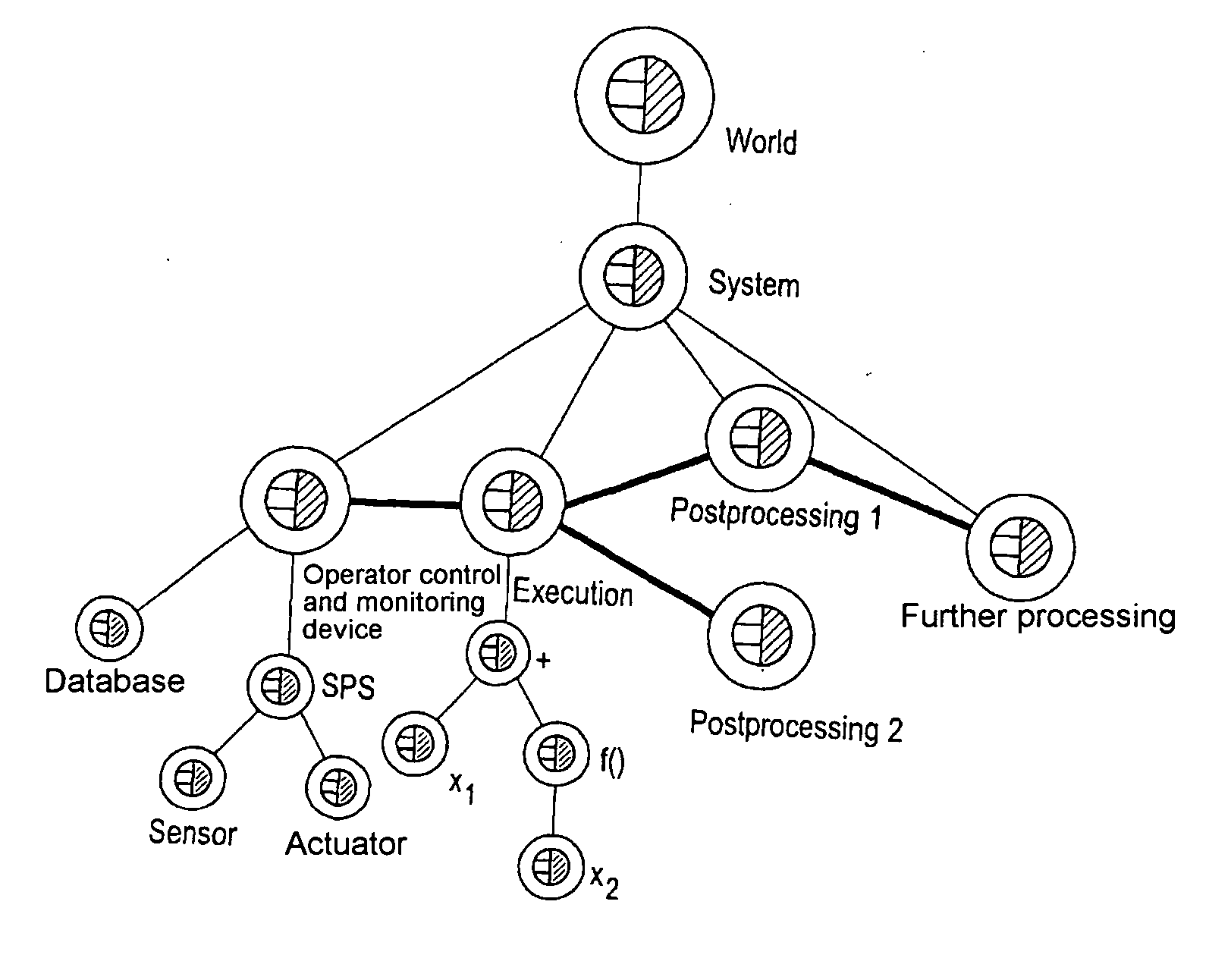
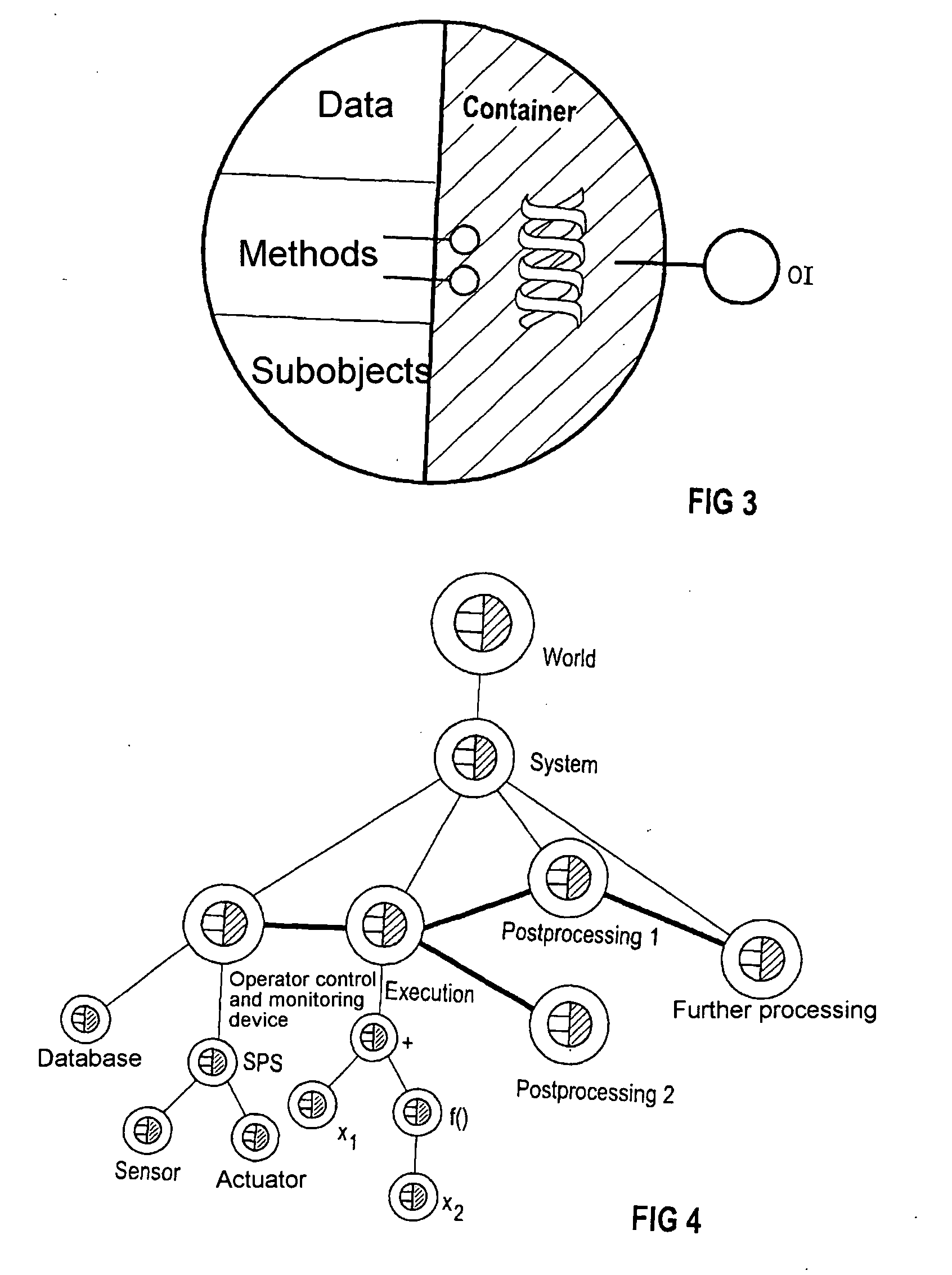
[0010] The objects are black boxes with appropriate access mechanisms for reading the meta data. The runtime logic and the runtime execution sequence of the software application represented by the tree are specified from the structure of the tree and from the way it is networked. The structure of the tree, which can be modified manually or automatically at runtime, and the networking of the tree elements determine which operands are supplied to functions and whether functions are executed sequentially or in parallel. In industrial installations the structure of the tree and the networking of the tree elements are used to determine, for example, which input variables are to be supplied to equipment and how the output values generated by the equipment are to be further processed. Graphical editing of the tree and the networking is performed by a user in a
software development environment. The form of representation of the trees can vary and can be freely selected by the user or to suit a specific application. The networking or pointer cross-referencing of the tree elements can be achieved by the hierarchical arrangement in the tree. However, networking or pointer cross-referencing of the tree elements can also be accomplished by means of references edited by the user or by lateral networking links to elements of other subtrees. The inputs to create the tree and to establish networking links can be made using input masks, drag&drop mechanisms or voice input.
[0011] The individual objects are assigned their implementation, i.e. their code and meta information. Because the software application is assembled from prefabricated objects at runtime (e.g. automatically on the basis of the meta data relating to the application process), an explicit
compiler phase for generating the code of the software application to be produced can be dispensed with.
Compiler runs can take a very long time. The fact that explicit
compiler runs are not required means that the time taken to produce, test and commission the software application is reduced to a minimum.
[0012] A further significant
advantage is that programs and data are handled in a uniform manner. Data are object trees without functions; programs are object trees with functions. All the mechanisms present in a
runtime system for assembling, networking, versioning, storing, transporting etc. data and programs only need to be implemented once and not once each for data and for programs. This also facilitates their handling for software developers, commissioning engineers and administrators, since they only have to familiarize themselves once with these mechanisms.
[0013] A further
advantage is that changes can be implemented very easily. Subtrees can be added, modified or removed at any time without the entire
tree structure needing to be changed. This increases the agility of an enterprise, since the enterprise can react more quickly to changed market requirements. This is important most especially when the software applications are used for controlling
automation systems, production equipment or MES systems. The software applications according to the invention can also be advantageously deployed in the office environment, however.
[0014] The networking, pointer cross-referencing or referencing between the objects can take place using different degrees of
granularity. Thus, networking can be achieved for example by reference to physical addresses (using pointers), thereby achieving a high level of efficiency (e.g. within the execution of a process). Other-networking mechanisms include, for example, electronic messages (e.g. e-mail), telephone or fax. The user can choose a suitable networking mechanism according to the requirements of the underlying application.



 Login to View More
  Login to View More