System and method for characterizing voiced excitations of speech and acoustic signals, removing acoustic noise from speech, and synthesizing speech

a voice excitation and voice technology, applied in the field of automatic description of human speech, can solve the problems of inadequate information of existing acoustic speech recognition systems for recognizing words and sentences with high probability, and the performance of such systems also drops rapidly, so as to remove unwanted acoustic noise

a voice excitation and voice technology, applied in the field of automatic description of human speech, can solve the problems of inadequate information of existing acoustic speech recognition systems for recognizing words and sentences with high probability, and the performance of such systems also drops rapidly, so as to remove unwanted acoustic noise

US20050278167A1Inactive Publication Date: 2005-12-15LAWRENCE LIVERMORE NAT SECURITY LLC

Image

Smart Image Click on the blue labels to locate them in the text.
Viewing Examples
Smart Image
  • System and method for characterizing voiced excitations of speech and acoustic signals, removing acoustic noise from speech, and synthesizing speech
  • System and method for characterizing voiced excitations of speech and acoustic signals, removing acoustic noise from speech, and synthesizing speech
  • System and method for characterizing voiced excitations of speech and acoustic signals, removing acoustic noise from speech, and synthesizing speech

Examples

Experimental program
Comparison scheme
Effect test

Embodiment Construction

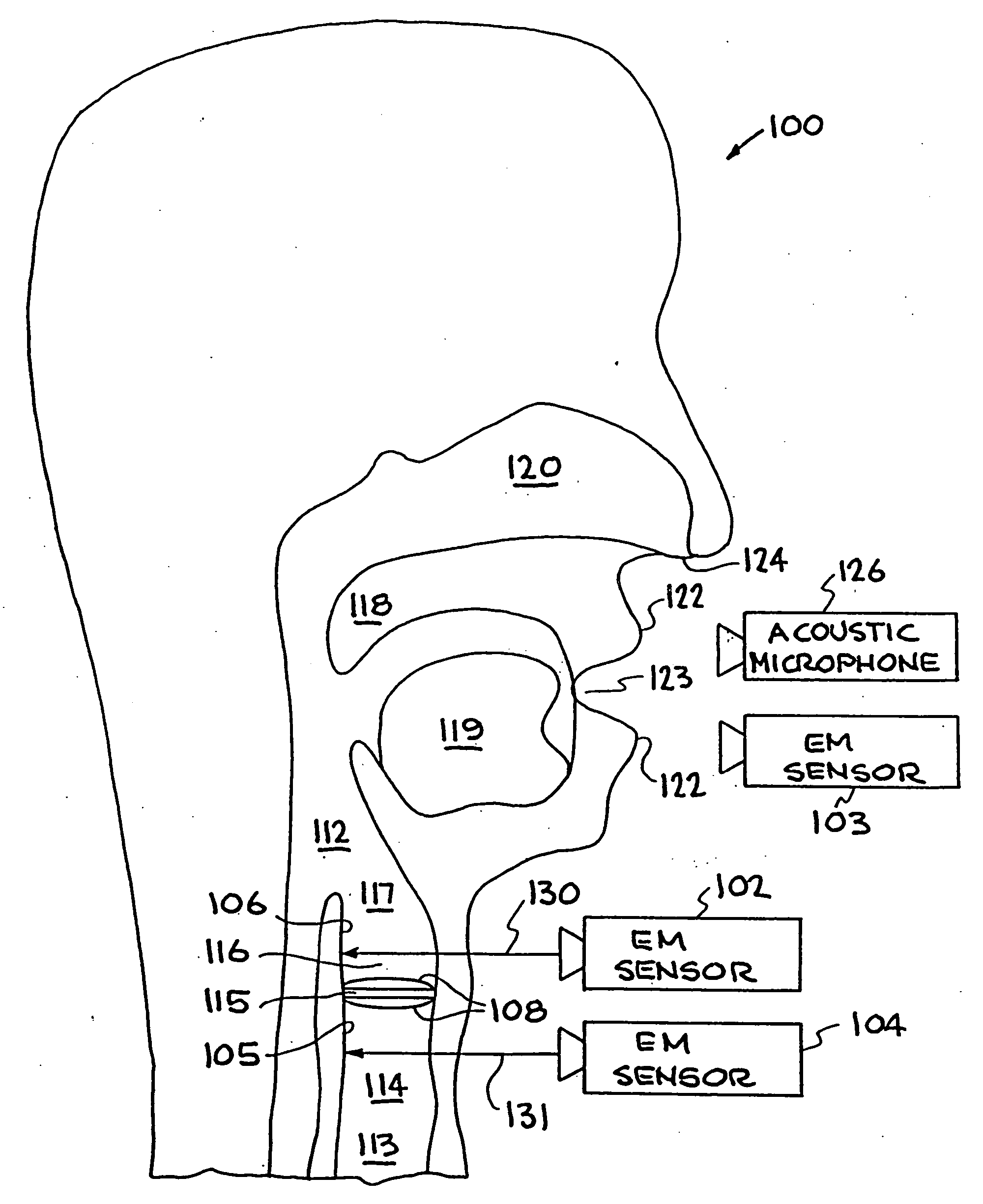
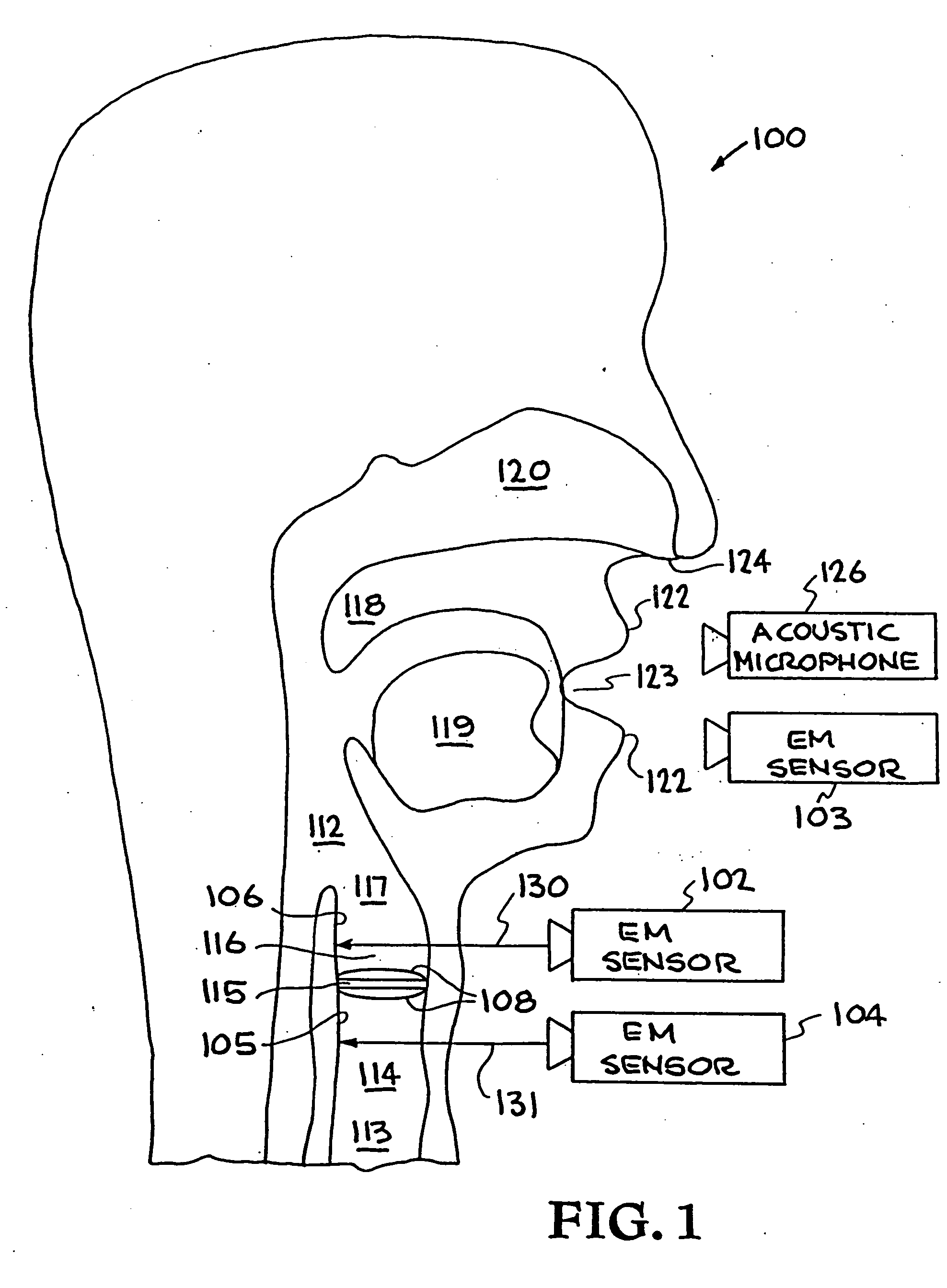
[0038]FIG. 1 is a pictorial diagram 100 of positioning of EM sensors 102 and 104 for measuring motions of a rear trachea wall 105 and a rear supra-glottal wall 106. These walls 105, 106 are also called windpipe walls within this specification. A first EM sensor 102 measures a position versus time (herein defined as motions) of the rear supra-glottal wall 106 and a second EM sensor 104 measures a position versus time of the rear tracheal wall 105 of a human as voiced speech is produced. Together or separately these sensors 102 and 104 form a micro-power EM sensor system. During voiced speech, vocal folds 108 open and close causing airflow and air pressure variations in a lower windpipe 113 and vocal tract 112, as air exits a set of lungs (not shown) and travels the lower windpipe 113 and vocal tract 112. Herein this process of vocal fold 108 opening and closing, whereby impulses of airflow and impulses of pressure excite the vocal tract 112, is called phonation. Air travels through t...

the structure of the environmentally friendly knitted fabric provided by the present invention; figure 2 Flow chart of the yarn wrapping machine for environmentally friendly knitted fabrics and storage devices; image 3 Is the parameter map of the yarn covering machine
Login to View More

PUM

No PUM Login to View More

Abstract

The present invention is a system and method for characterizing human (or animate) speech voiced excitation functions and acoustic signals, for removing unwanted acoustic noise which often occurs when a speaker uses a microphone in common environments, and for synthesizing personalized or modified human (or other animate) speech upon command from a controller. A low power EM sensor is used to detect the motions of windpipe tissues in the glottal region of the human speech system before, during, and after voiced speech is produced by a user. From these tissue motion measurements, a voiced excitation function can be derived. Further, the excitation function provides speech production information to enhance noise removal from human speech and it enables accurate transfer functions of speech to be obtained. Previously stored excitation and transfer functions can be used for synthesizing personalized or modified human speech. Configurations of EM sensor and acoustic microphone systems are described to enhance noise cancellation and to enable multiple articulator measurements.

Description

CROSS-REFERENCE TO RELATED APPLICATIONS [0001] This application is a continuation of application Ser. No. 10 / 194,832 filed Jul. 11, 2002 by Greg C. Burnett, John H. Holzrichter, and Lawrence C. Ng which was a continuation of U.S. patent application Ser. No. 09 / 851,550, filed May 8, 2001, titled “System and Method for Characterizing Voiced Excitations of Speech and Acoustic Signals, Removing Acoustic Noise from Speech, and Synthesizing Speech;” which was a divisional of co-pending U.S. patent application Ser. No. 09 / 433,453, filed Nov. 4, 1999, entitled “System and Method for Characterizing Voiced Excitations of Speech and Acoustic Signals, Removing Acoustic Noise from Speech, and Synthesizing Speech, now U.S. Pat. No. 6,377,919;” which was a continuation-in-part of application Ser. No. 08 / 597,596, filed on Feb. 6, 1996, now U.S. Pat. No. 6,006,175. The related applications are commonly assigned to The Regents of the University of California.[0002] The United States Government has ri...

Claims

the structure of the environmentally friendly knitted fabric provided by the present invention; figure 2 Flow chart of the yarn wrapping machine for environmentally friendly knitted fabrics and storage devices; image 3 Is the parameter map of the yarn covering machine
Login to View More

Application Information

Patent Timeline
15 Dec 2005
Publication
US20050278167A1
IPC
G06K9/62; G06K9/68; G10L15/24; G10L25/90
CPC
A61B5/0507; A61B5/7257; G01N2291/02491; G10L15/24; G06K9/00885; G06K9/6293; G10L13/04; G01N2291/02872
Inventors
BURNETT, GREG C.; HOLZRICHTER, JOHN F.