

Control system for electrochromic devices
a control system and electrochromic technology, applied in the field of electrochromic devices, can solve the problems of voltages exceeding 2.5v that damage the electrochromic device, and achieve the effect of effective control of the electrochromic devi
- Summary
- Abstract
- Description
- Claims
- Application Information
AI Technical Summary
Benefits of technology
Problems solved by technology
Method used
Image

Examples
Embodiment Construction
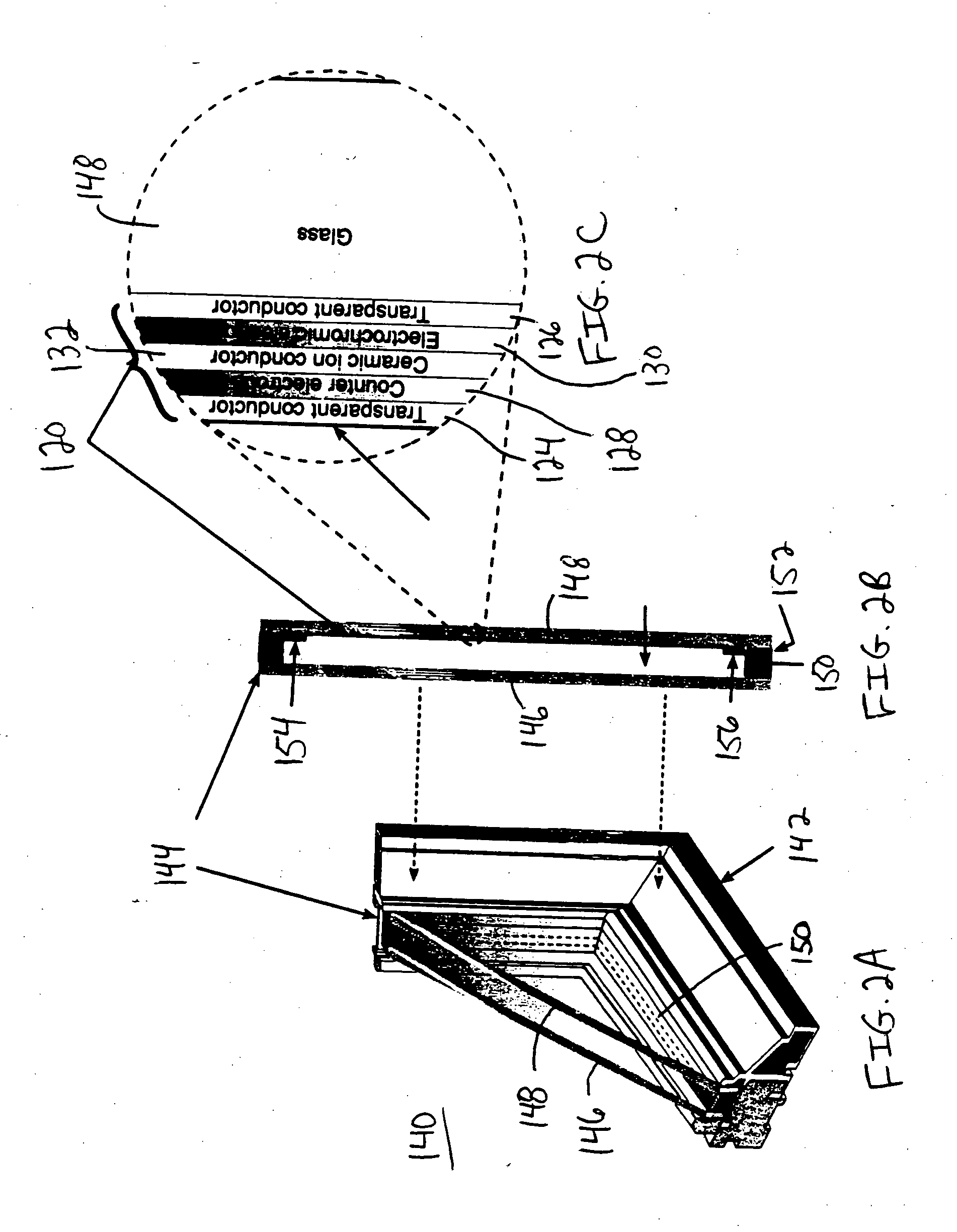
[0055]FIGS. 2A and 2B show an electrochromic window 140, in accordance with certain preferred embodiments of the present invention. The electrochromic window 140 includes a window frame 142 securing an insulated glass unit 144 comprising a first glass pane 146 and a second glass pane 148. The insulated glass unit 144 also includes a spacer 150 and a seal 152 for forming an air-tight compartment between the first and second glass panes 146, 148. The interior space between the first and second glass panes 146, 148 is filled with an inert gas, such as air or argon.
[0056] Referring to FIGS. 2B and 2C, an electrochromic device 120 is secured over the second glass pane 148 of the insulated glass unit 144. The electrochromic device 120 includes a first transparent conductor 124 and the second transparent conductor 126 in contact with second glass pane 148. The electrochromic device 120 also includes a counter electrode 128 in contact with the first transparent conductor 124, an electrochr...
PUM
 Login to View More
 Abstract
Description
Claims
Application Information
 Login to View More