Unlock instant, AI-driven research and patent intelligence for your innovation.

Magnetic motion sensor

Inactive Publication Date: 2006-03-02
HITACHI METALS LTD
View PDF7 Cites 32 Cited by
  • Summary
  • Abstract
  • Description
  • Claims
  • Application Information

AI Technical Summary

Benefits of technology

[0040] The status production means may detect high peaks and low peaks of output signals of the magnetic sensors, calculates the moving average deviations with respect to the respective peaks to produce statuses indicating a degree of appropriateness in positions of installation for magnetic sensors by numerical values in response to a difference between a moving average deviation of high peaks and a moving average peaks of low peaks, produces such a status that there is a weak magnetic field, when the moving average deviation of the high peaks is less than a predetermined value for the high peaks, while produces such a status that there is a sufficient magnetic field, when the moving average deviation of the high peaks is more than a predetermined value for the high peaks, and produces such a status that there is a high reliability in detection for the changes in a magnetic field, when the magnetic field is sufficient and the degree of appropriateness in positions of installation for the magnetic sensors is higher than a predetermined value for the degree of appropriateness.

Problems solved by technology

In this respect, however, there is no effective means for judging the fact that the gap has a suitable size at the time of installing the Hall IC.
In this respect, however, there is no means for determining differences in intensities of the magnetic field at the time of installing the magnet.
It makes a processing for rotating velocity and accelerated velocity in a device in the subsequent stage by which outputs from the Hall IC are received difficult.
A detection of rotation or a communication with superior machinery is adversely affected by these noises.
However, a pulse width or a pulse interval becomes broadened in case of a comparatively low-speed rotation, so that a waiting time for detecting rotations in the subsequent device is lengthened.
Moreover, in either a case of a remarkably low-speed rotation or a case of stopping rotation, no pulse is obtained, and in such case, it cannot be discriminated even whether the Hall element is active or inactive in the subsequent device.
In addition, a part of the Hall IC (magnetic motion sensor) is provided as a separate part from a rotor as mentioned above, so that it is difficult to decide that where is a cause for the above enumerated problems and failures accompanied therewith in an assembled rotation sensor.
As a result, a reliability of a rotation sensor cannot be assured.

Method used

the structure of the environmentally friendly knitted fabric provided by the present invention; figure 2 Flow chart of the yarn wrapping machine for environmentally friendly knitted fabrics and storage devices; image 3 Is the parameter map of the yarn covering machine
View more

Image

Smart Image Click on the blue labels to locate them in the text.
Viewing Examples
Smart Image
  • Magnetic motion sensor
  • Magnetic motion sensor
  • Magnetic motion sensor

Examples

Experimental program
Comparison scheme
Effect test

first embodiment

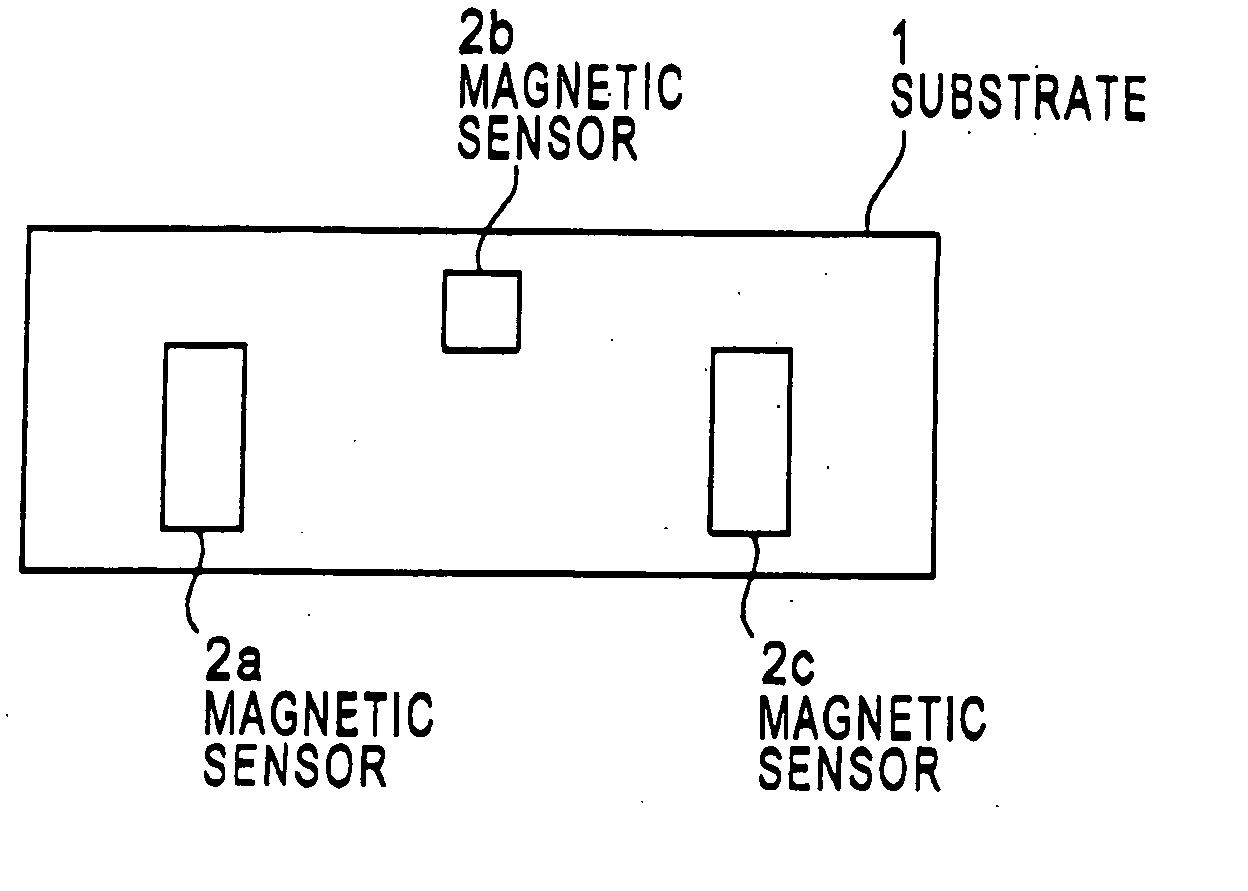
[0068]FIG. 1A shows a magnetic motion sensor in a first preferred embodiment according to the invention. The magnetic motion sensor is provided with two magnetic sensors 2a and 2c arranged in parallel along the longitudinal direction of a substrate 1 on the surface thereof, an auxiliary magnetic sensor 2b disposed in between the magnetic sensors 2a and 2c wherein the auxiliary magnetic sensor 2b is positioned out of the alignment of the magnetic sensors 2a and 2c, and a circuit (not shown) disposed in an area where the magnetic sensors 2a, 2b, and 2c do not exist in the surface of the substrate 1. The magnetic sensors 2a, 2b, and 2c are, for example, Hall elements wherein the two magnetic sensors 2a and 2c have the same shapes and the same dimensions, and sensitivities with respect to magnetism are the same, as a matter of course. On one hand, since the magnetic sensor 2b has different functions from that of the magnetic sensors 2a and 2c as mentioned hereunder, the magnetic sensor ...

second embodiment

[0070]FIG. 1B shows a magnetic motion sensor in a second preferred embodiment according to the invention. The magnetic motion sensor is provided with three magnetic sensors 4a, 4b, and 4c aligned in parallel along the longitudinal direction of a substrate 3 on the surface thereof, and a circuit (not shown) disposed in an area where the magnetic sensors 4a, 4b, and 4c do not exist in the surface of the substrate 3. The magnetic sensors 4a, 4b, and 4c are, for example, Hall elements. The three magnetic sensors 4a, 4b, and 4c have the same shapes and dimensions, and their orientations, sensitivities, and temperature characteristics are the same, respectively, as a matter of course. This magnetic motion sensor may be applied to the rotation sensor shown in FIG. 19 or FIG. 20 as in the case of FIG. 1A.

[0071] A circuit constitution suitable for the magnetic motion sensor of FIG. 1A is shown in FIG. 2B, while a circuit constitution suitable for the magnetic motion sensor of FIG. 1B is sho...

the structure of the environmentally friendly knitted fabric provided by the present invention; figure 2 Flow chart of the yarn wrapping machine for environmentally friendly knitted fabrics and storage devices; image 3 Is the parameter map of the yarn covering machine
Login to View More

PUM

No PUM Login to View More

Abstract

A magnetic motion sensor has: two magnetic sensors aligned in a direction along which changes in a magnetic field shift for detecting an appearance of the changes; a differential means for taking out a differential signal of output signals from these two magnetic sensors; and a timing detection means for generating a pulse, indicating a timing at which the changes in a magnetic field pass through either of the magnetic sensors, when an output signal of the magnetic sensor in question strides over a threshold value, while generating a pulse, indicating a timing at which the changes in a magnetic field pass through in between the magnetic sensors, when the differential signal strides over the threshold value.

Description

[0001] The present application is based on Japanese patent application No. 2004-247126, the entire contents of which are incorporated herein by reference. BACKGROUND OF THE INVENTION [0002] 1. Field of the Invention [0003] The present invention relates to a magnetic motion sensor used as a rotation sensor in combination with a rotor and, more particularly, to a magnetic motion sensor with enhanced reliability. [0004] 2. Description of the Related Art [0005] Heretofore, a noncontact rotation sensor to detect rotation of a rotor is known in which a change in magnetic field generated when a magnetic material rotates together with the rotor is detected by a magnetic sensor to output a pulse signal relating to the rotation. [0006] Rotation sensors as shown in FIGS. 19 and 20 are used to detect a rotation of tire in ABS (=antilock brake system), which is a brake control system for automobiles. [0007] The rotation sensor as shown in FIG. 19 is constructed such that a gear (rotor) 201 made ...

Claims

the structure of the environmentally friendly knitted fabric provided by the present invention; figure 2 Flow chart of the yarn wrapping machine for environmentally friendly knitted fabrics and storage devices; image 3 Is the parameter map of the yarn covering machine
Login to View More

Application Information

Patent Timeline
no application Login to View More
IPC IPC(8): G01P3/66
CPCG01D3/036G01D5/145G01P3/66G01D5/2451G01D5/147
Inventor KANEYASU, MASAYOSHIKOMATSUZAKI, KAZUHIROHIGUCHI, KEIICHIONIMOTO, TAKASHI
Owner HITACHI METALS LTD