

Chemical microreactor and method thereof
- Summary
- Abstract
- Description
- Claims
- Application Information
AI Technical Summary
Problems solved by technology
Method used
Image

Examples
first embodiment
[0024] Two distinct embodiment styles are effective. The first embodiment employs a packed catalyst capillary microchannel and at least one porous membrane. In this embodiment, the primary purpose of the porous membrane is to prevent large particles or molecules flowing through the microchannel to pass through the membrane. The porous membrane may or may not contain catalyst materials.
second embodiment
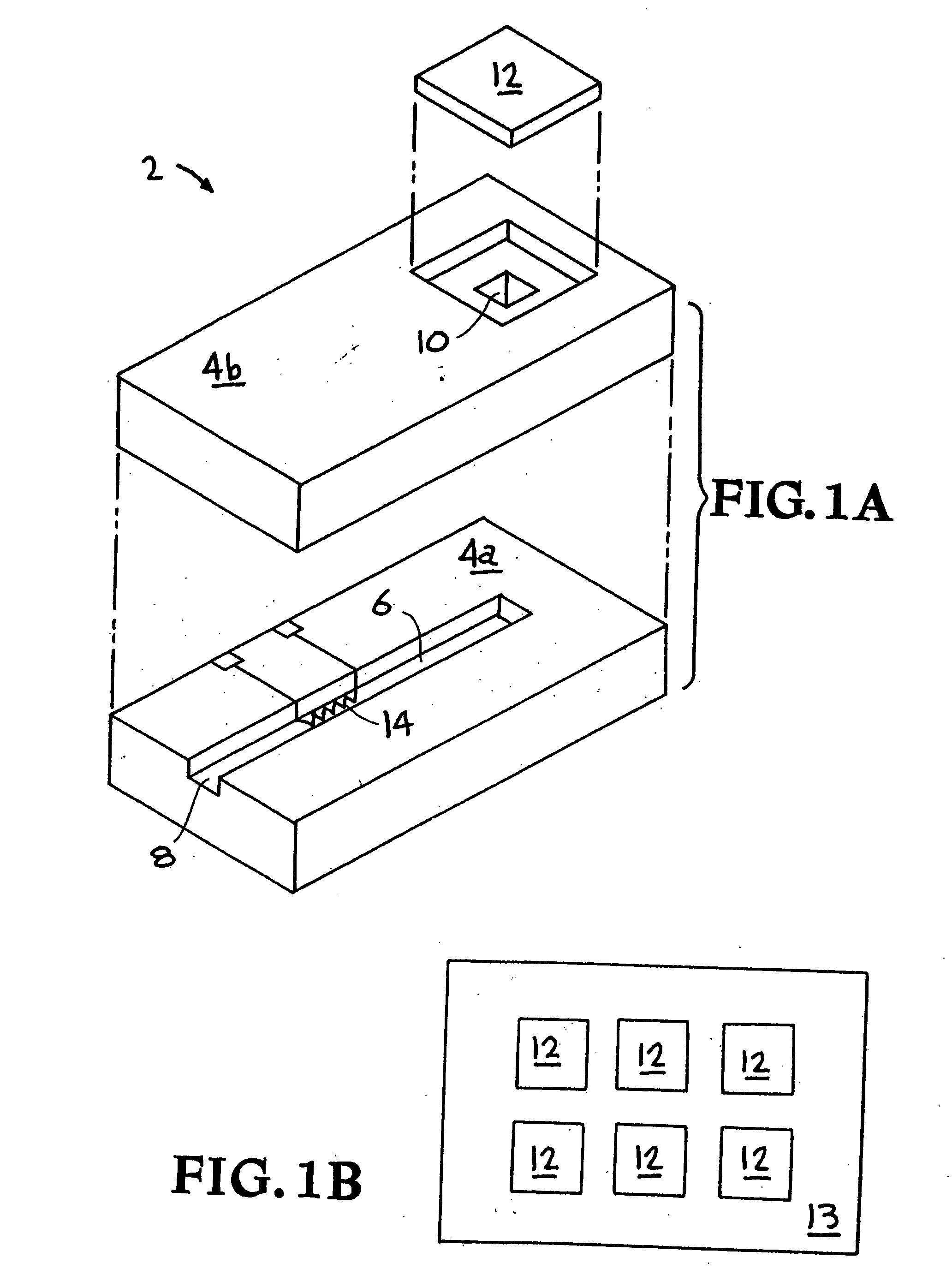
[0025] The second embodiment style employs a porous membrane with a large surface area or a porous membrane support structure containing a plurality of porous membranes having a large surface area in the aggregate, i.e., greater than about 1 m2 / cm3. Surface areas on the order of about 1 m2 / cm3 to about 100 m2 / cm3 are effective. In this embodiment, a catalyst material is imbedded within the porous membrane(s) and the primary purpose of the porous membrane(s) is to facilitate the occurrence of catalytic steam reforming reactions. Packed catalyst capillary microchannels may or may not be used with this embodiment style. This embodiment style can reduce the size and length requirements of microchannel 6. For example, referring to FIGS. 1A and 1B, positioning porous membrane support structure 13 which contains a plurality of porous membranes 12 at outlet 10 of microchannel 6 provides a high surface area catalytic reaction. Minimizing the size of the microchannel region in this manner mak...
PUM
| Property | Measurement | Unit |
|---|---|---|
| temperature | aaaaa | aaaaa |
| temperature | aaaaa | aaaaa |
| temperatures | aaaaa | aaaaa |
Abstract
Description
Claims
Application Information
 Login to View More