Data and system security with failwords
- Summary
- Abstract
- Description
- Claims
- Application Information
AI Technical Summary
Benefits of technology
Problems solved by technology
Method used
Image

Examples
Embodiment Construction
[0025] 4.1 Basic Theory
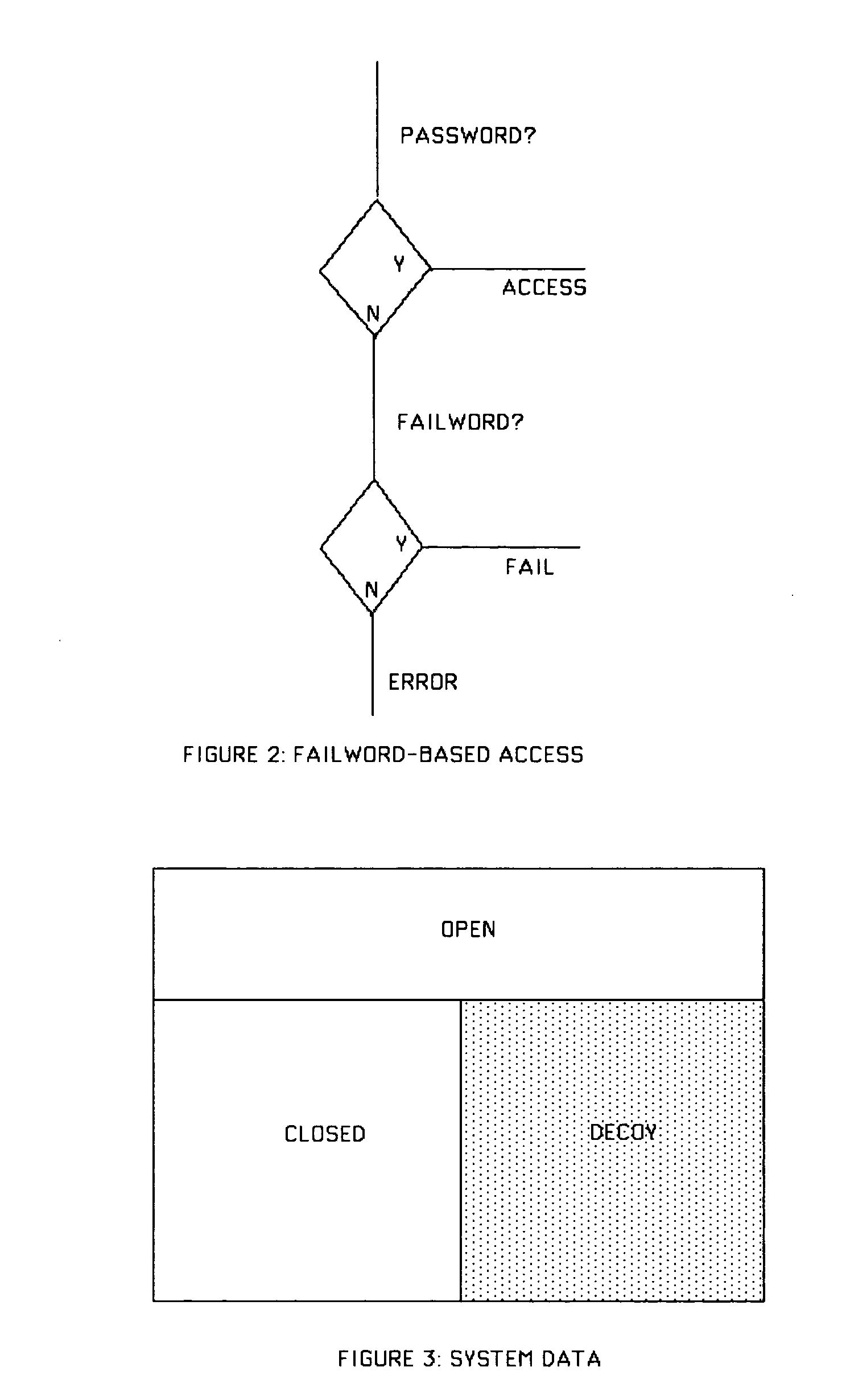
[0026] Let Σ be some suitable alphabet from which passwords and failwords are chosen. A string is a finite-length sequence of characters from Σ. Following convention, Σ* is the set of all finite-length strings from Σ. Let P be a set of passwords, and F be a set of failwords, with the restriction that P∩F=Ø (i.e., no string is both a password and a failword). We need two functions app and util, respectively called the “appearance” and “utility” functions, with the following mathematical properties.
app, util: Σ*→R Definition 1
[0027] Intuitively, the app and util functions set the apparent and actual value of any candidate string (password or failword), with the apparent value being the value expected by the user, and the actual value being the value delivered by the system to the user.
[0028] Furthermore, the following properties are taken to hold in respect of these two functions.
∀p∈P, ∀f∈F: Definition 2 [0029] (1) app(p)=util(p)=app(f). [0030] (2) util(p...
PUM
 Login to View More
 Abstract
Description
Claims
Application Information
 Login to View More