Software piracy, the unlicensed
copying and use of software, is a serious concern today worldwide.
Among the many problems that it presents are economic, moral, legal, and governmental ones that increasingly beg a solution.
To most software product manufactures, software piracy represents a huge economic loss that they must unfairly pass on to honest customers.
At a higher level of leadership, software piracy represents a breakdown in the very structure of law that our governments create and strive to maintain.
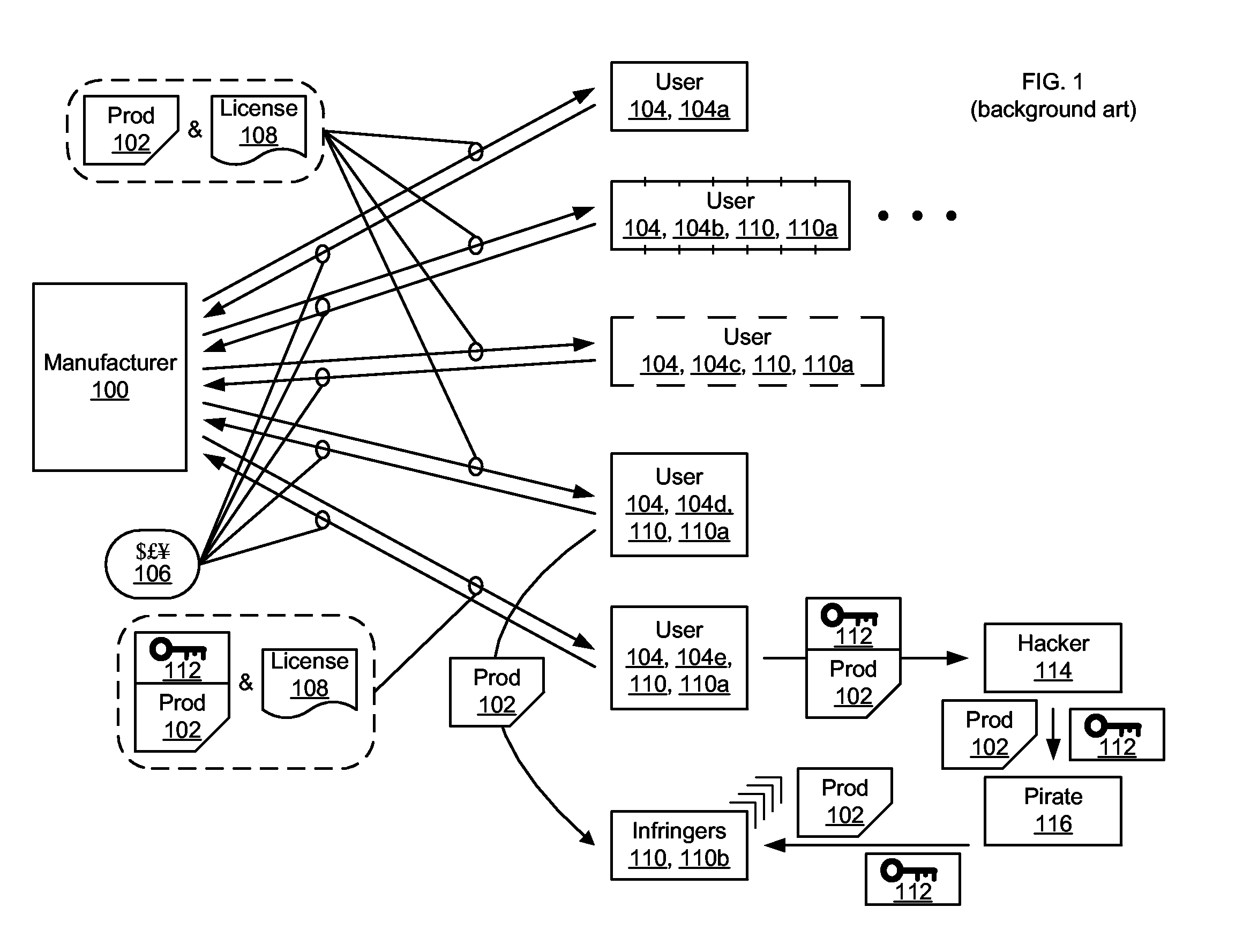
Upon discovering this, a government may then take action against the previously unknowing and well-intended manufacturer 100, such as imposing odious reporting requirements on all future sales.
The well-intended manufacturer 100 can then, unexpectedly, find themselves embroiled in expensive litigation involving the
medical systems and the injuries or deaths of sympathetic parties.
Terming this form of software piracy a “fraud” against the manufacturer 100 is semantically awkward, but it nonetheless is such and it often is serious and needs to be detected and stopped.
As discussed presently, however, such mechanisms 112 are not perfect and a
hacker 114 can often circumvent them.
Considering the possible motivations of all of the various parties engaged in all of the possible variations of software piracy is far too much to cover in this discussion, and is simply not
germane.
What is important for here is that the unlicensed
copying and usage of software, i.e., software piracy, is occurring widely and in the current scheme of things there has until now been no effective way to remedy that.
If the software determines that it is being run in violation (breach) of the
license, it may take various actions.
However, all of this seemingly sophisticated technology is still frequently insufficient to stop piracy.
Such reverse-
engineering of key-generation and key-
verification schemes is possible because there often are flaws in even the most rigorous schemes attempted.
Similarly, the “secret” algorithms used for encoding and decoding of license keys often cannot be kept secret, because the software runs on non-secure computers and this facilitates determining the algorithms.
Thus, it often takes less time today to reverse-engineer most such algorithms than it takes to create them in the first place.
Also similarly, symmetric cryptosystems cannot viably be used to sign license keys, because the keys can then easily be found out.
Another point of
vulnerability often exists at key-
verification, since only one check for a valid license key is usually ever performed.
This use of only a one-time check also poses another problem when confronted with malicious adversaries who attempt to modify the code of a software product to subvert any license checking functions that it contains.
However, by simply creating a crack key with an effectively unlimited licensed lifespan parameter, the usage-monitoring code is circumvented and rendered useless.
Containing usage information for the license key itself also has a more subtle
disadvantage.
Because the code used to interpret this information and to compare it to actual usage must be packaged with the software product, it is usually difficult to ensure that the software can accurately account for the broad range of situations that licensees will encounter.
Thus, a particular customer might actually be using the software legally, but in a fashion that triggers the usage limitations.
Since computers running
medical software are effectively identical to computers not running
medical software, there is no way for the software product to determine whether or not the user is violating this exclusion.
As a result, key-generation and key-
verification has a
high incidence rate of failure—either inconveniencing a legitimate customer or allowing an illegitimate user to execute the software product.


 Login to View More
  Login to View More