[0009] An
advantage of the present invention is that by detecting a stalling event in the execution pipeline and flushing the instruction from the execution pipeline to enable instructions of other threads to be dispatched to and executed in the execution pipeline, the processor may advantageously make more efficient use of the execution pipeline by avoiding wasted
clock cycles due to execution pipeline stalls.
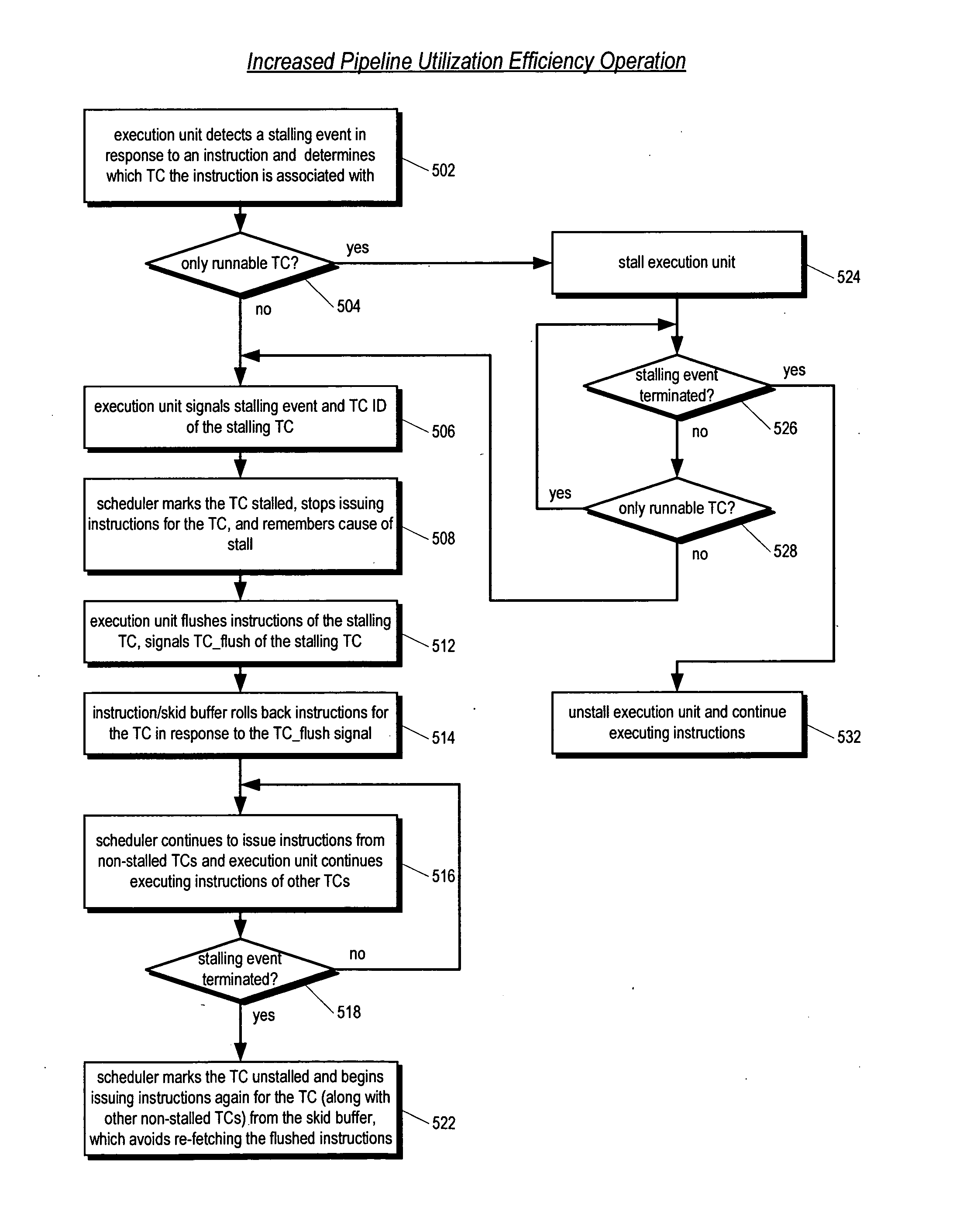
[0010] In one aspect, the execution pipeline distinguishes between instructions of the stalling thread and the other threads and flushes only the stalling thread, rather than all the threads in the execution pipeline. Only the stalling thread need be flushed to enable the execution pipeline to continue executing instructions, i.e., to avoid stalling; and by flushing only the stalling thread, instructions from other threads may still be present in the execution pipeline to execute, which means fewer pipeline bubbles will be introduced in most cases, and in some cases only a single pipeline bubble is introduced by flushing the instruction that caused the stalling event. Thus, advantageously more efficient use of the execution pipeline may be made.
[0011] In one aspect, the execution pipeline stalls, rather than flushing the stalling thread, if the stalling thread is the only runnable thread. Once the stalling event terminates, the execution pipeline begins executing the instruction again. This may be more efficient than flushing the only runnable thread and re-dispatching the flushed instructions. In another aspect, while the only runnable thread is stalled, if another thread becomes runnable, the execution pipeline goes ahead and flushes the stalling thread.
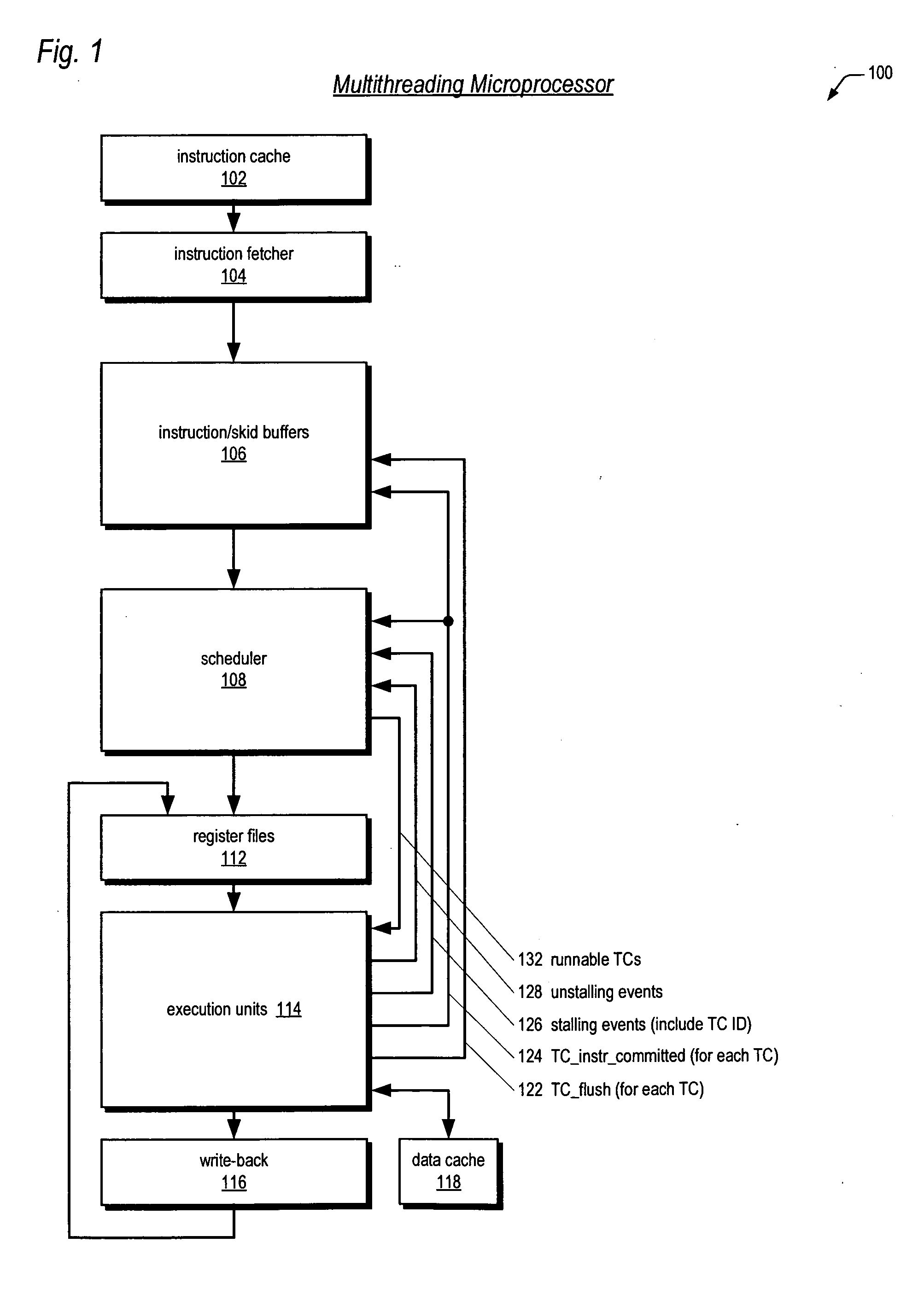
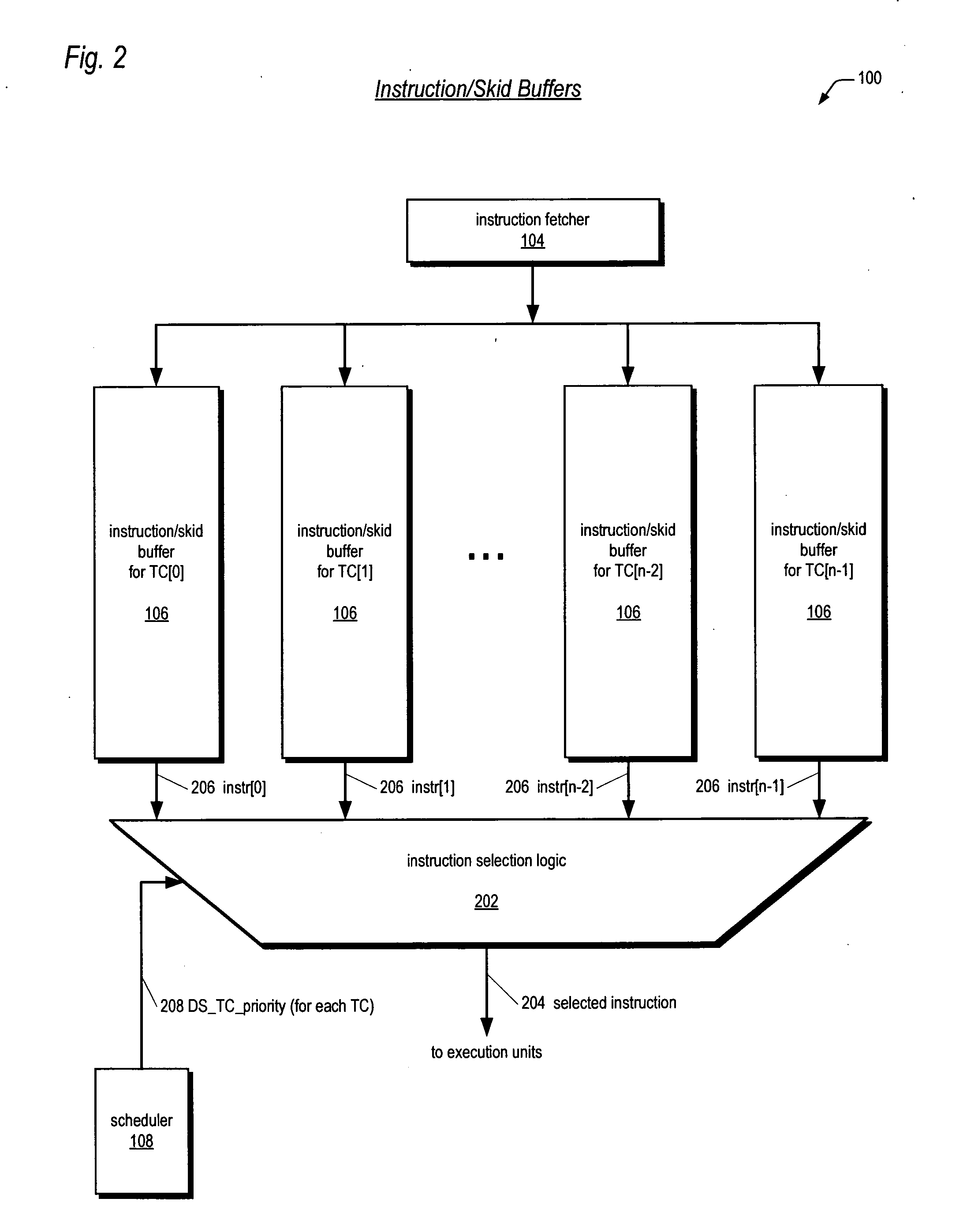
[0012] In one aspect, the processor also includes skid buffers to which the flushed instructions are rolled back so that the instruction fetch portion of the processor pipeline need not be flushed in response to the stalling event, but instead only the execution pipeline needs to be flushed. Thus, when the stalling event terminates, the scheduler can immediately begin dispatching instructions for the thread rather than having to re-fetch the flushed instructions.
[0013] In another aspect, the present invention provides a method, in a
multithreading processor having an execution pipeline and a thread scheduler for scheduling dispatch of instructions of a plurality of threads concurrently executing on the processor, for increasing the utilization efficiency of the execution pipeline. The method includes detecting a stalling event, in response to an instruction dispatched to the execution pipeline and indicating the stalling event and a stalling thread, in response to detecting the stalling event. The instruction is included in one of the plurality of threads defined as the stalling thread. Because of the stalling event, the execution pipeline cannot continue executing the instruction without incorrectly executing the stalling thread. The method also includes flushing the execution pipeline, in response to detecting the stalling event and continuing to execute instructions, in response to the flushing. The method also includes dispatching to the execution pipeline instructions of the plurality of threads other than the stalling thread, in response to the execution pipeline indicating the stalling thread.
[0014] In another aspect, the present invention provides a
computer program product for use with a computing device, the
computer program product comprising a computer
usable medium, having computer readable
program code embodied in the medium, for causing a
multithreading processor configured to concurrently execute a plurality of threads of execution. The computer readable
program code includes first and second
program code. The first program code provides an execution pipeline, for executing instructions of the plurality of threads. The execution pipeline detects a stalling event in response to an instruction issued to the execution pipeline. The instruction is included in one of the plurality of threads defined as the stalling thread. Because of the stalling event, the execution pipeline cannot continue executing the instruction without incorrectly executing the stalling thread. The execution pipeline also indicates the stalling event and the stalling thread. The execution pipeline also flushes the execution pipeline, in response to detecting the stalling event. This enables the execution pipeline to continue executing instructions after the flushing. The second program code provides a thread scheduler, coupled to the execution pipeline, which issues to the execution pipeline instructions of the plurality of threads other than the stalling thread, in response to the execution pipeline indicating the stalling thread.


 Login to View More
  Login to View More