Method and apparatus for region-based moving image encoding and decoding
a technology of moving image and region, applied in the field of method and apparatus for region-based moving image encoding and decoding, can solve the problems of natural limit in encoding which can be adapted to the scene structure or features of images, limit each region to a rectangular shape, etc., and achieve the effect of facilitating more accurate region partitioning and accurate decoding
- Summary
- Abstract
- Description
- Claims
- Application Information
AI Technical Summary
Benefits of technology
Problems solved by technology
Method used
Image



Examples
second embodiment
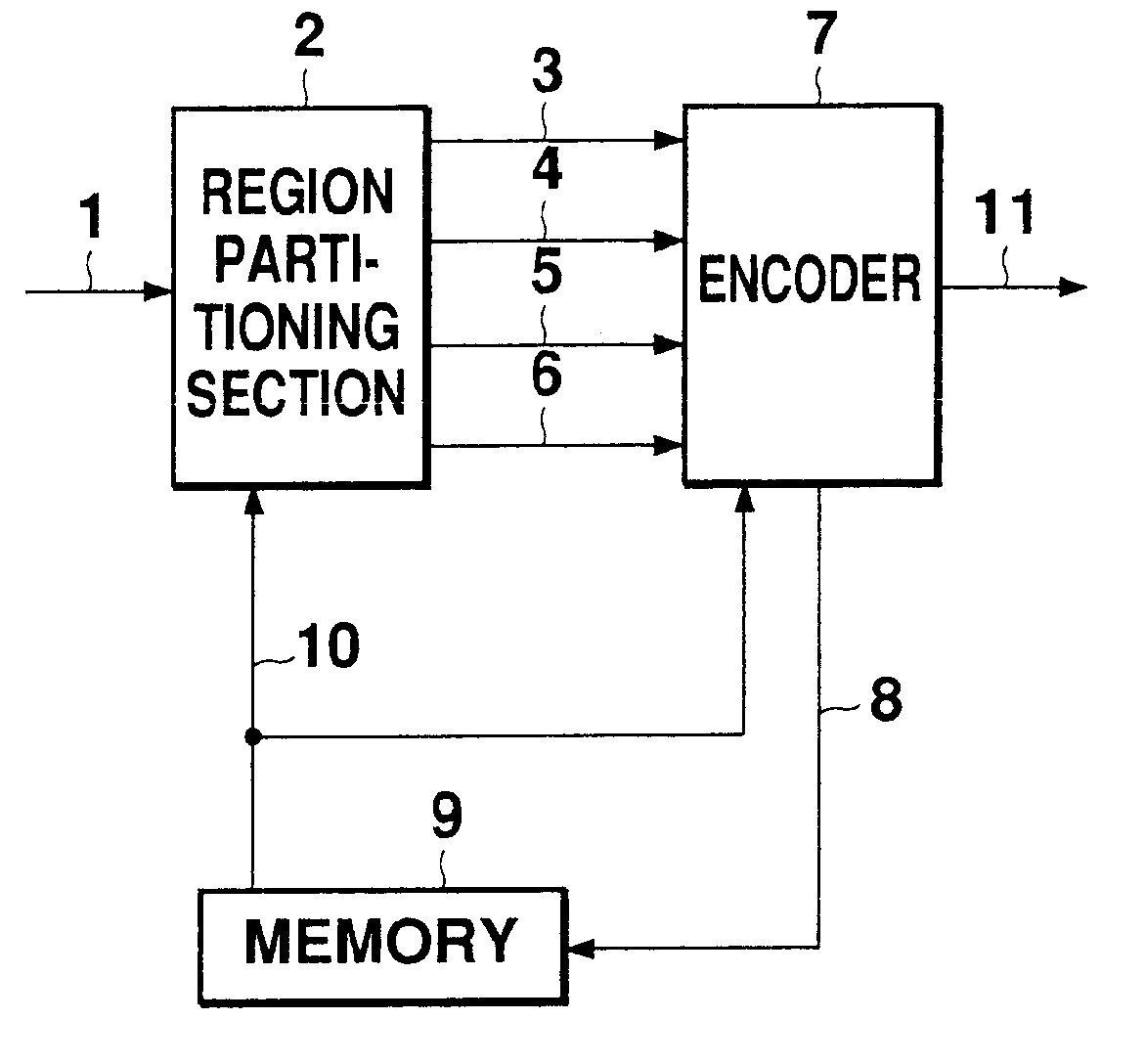
[0078] This embodiment relates to an apparatus wherein region partitioning section 2 of the first embodiment has been partially modified. FIG. 16 is an internal block diagram of region partitioning section 2 in this embodiment. As shown in this diagram, region partitioning section 2 of the second embodiment has a configuration wherein partitioning processing section 12 of FIG. 5 has been replaced by uniform partitioning section 15. As shown in FIG. 17, a threshold judgment of the activity is not performed in the initial partitioning process in this configuration, and uniform partitioning is unconditionally performed in square blocks of minimum region area. This minimum region area may be made selectable.
[0079] Setting of the threshold is unnecessary in this embodiment, and region partitioning is performed only for amount of code—distortion cost as the evaluation value. Therefore, the procedure associated with threshold setting becomes unnecessary, as do activity calculation and com...
third embodiment
[0080] In the partitioning process of this embodiment, a judgment is made as to whether or not partitioning is possible, not only including the activity, but also including an index (hereinafter called a class) indicating the importance of the region. It is preferable to perform detailed encoding for regions having high importance, and to reduce region areas. Regions having low importance are made as large as possible so as to reduce the amount of code per pixel.
[0081] The activity is, for example, a closed, local statistical value within the region. On the other hand, the classes in this embodiment are based on the features of the image spanning regions. In this embodiment, the classes are defined on the basis as to what degree a person views the region, namely, a person's degree of observation, due to the object structure traversing the region. For example, when the edge distribution of a given region spans a wide range and the connection with adjacent regions is strong, it is hi...
fourth embodiment
[0086] The degree of observation of the person was employed in class determination in the third embodiment. In this embodiment, features of a known image are stored, and classes are determined according to the degree of coincidence between the stored features and the features calculated from each region.
[0087] For example, for images of faces, considerable research has been conducted, and many techniques have been proposed for digitizing face structures. Once these features are stored, a person's face (generally having high importance) can be detected from within the image. For other objects, there are also many instances where they can be described by features based on luminance and texture information. In order to clearly express a person's face, the region having features coinciding with features of the person's face is set as the most important class A, while other regions are set as class B of normal importance.
[0088]FIG. 20 is a block diagram of class identifying section 29 ...
PUM
 Login to View More
 Abstract
Description
Claims
Application Information
 Login to View More