Unlock instant, AI-driven research and patent intelligence for your innovation.

Redundant column read in a memory array

a memory array and read-only technology, applied in the field of nonvolatile memory and sequential read operations, can solve the problems of significant delays in receiving correct data, degrade the efficiency of continuous read operations, and the amount of latency after a read command is entered until, so as to achieve no additional latency and slow read operation

Inactive Publication Date: 2007-01-25
ARTEMIS ACQUISITION
View PDF3 Cites 0 Cited by
  • Summary
  • Abstract
  • Description
  • Claims
  • Application Information

AI Technical Summary

Benefits of technology

"The patent describes a memory device that uses redundant memory bits to improve reliability. The device does not need to add dummy bytes between read commands and can quickly identify and replace faulty bits. The device can also perform speculative reading of redundant memory bits to allow for faster and more efficient data access. Overall, the device provides complete and correct data with no additional delay."

Problems solved by technology

A drawback of reading continuously from prior sequential memories involving redundancy has been the amount of latency after a read command is entered until data are output.
The delay from read command input to data output degrades an efficiency of continuous read operations.
In this way, the additional use of redundant memory may cause significant delays in receiving correct data.

Method used

the structure of the environmentally friendly knitted fabric provided by the present invention; figure 2 Flow chart of the yarn wrapping machine for environmentally friendly knitted fabrics and storage devices; image 3 Is the parameter map of the yarn covering machine
View more

Image

Smart Image Click on the blue labels to locate them in the text.
Viewing Examples
Smart Image
  • Redundant column read in a memory array
  • Redundant column read in a memory array
  • Redundant column read in a memory array

Examples

Experimental program
Comparison scheme
Effect test

Embodiment Construction

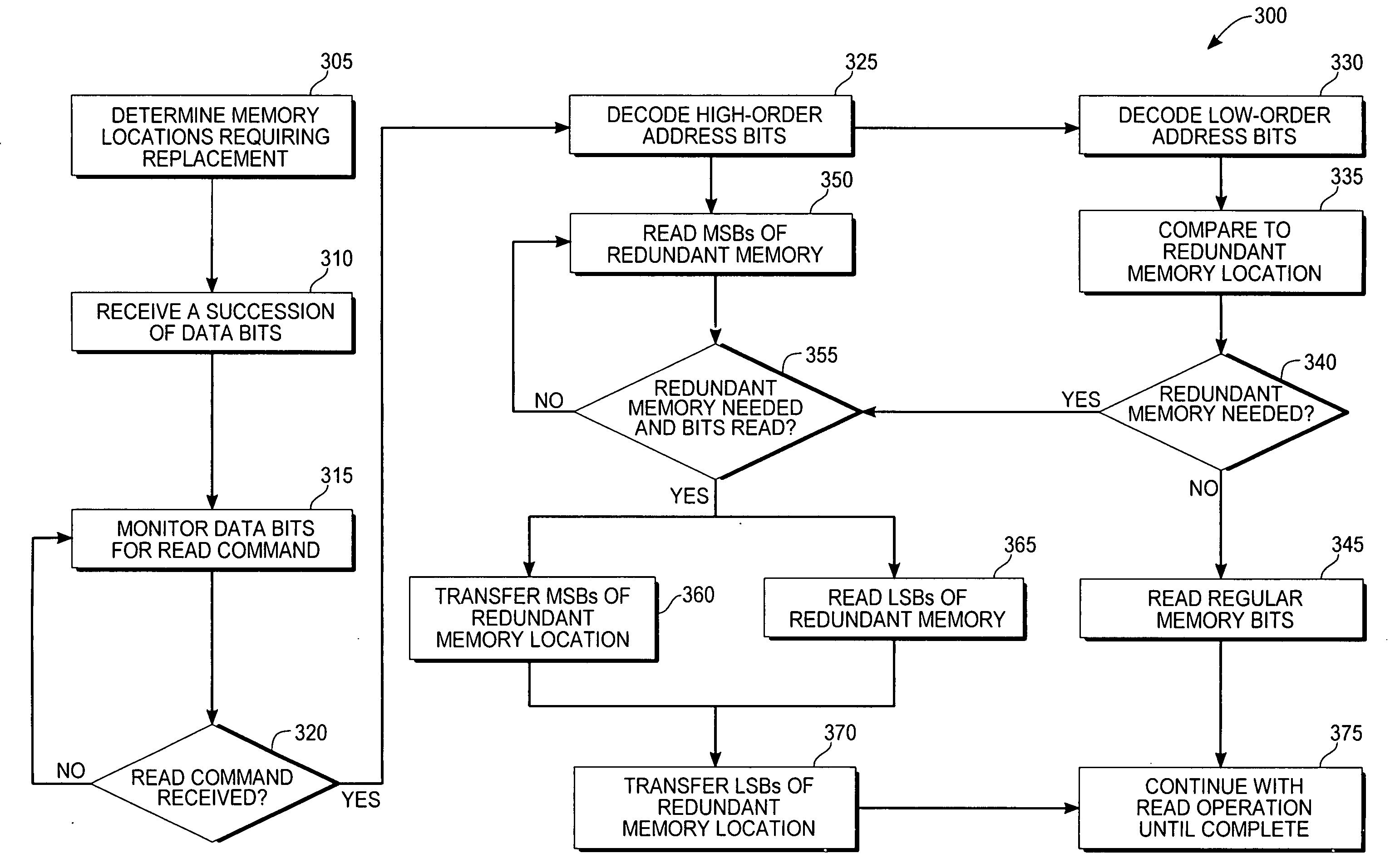
[0020] With reference to FIG. 2, an exemplary nonvolatile memory 200 of the present invention contains a memory array 205 including bit memory blocks 215 and redundant bit memory blocks 217. The memory array 205 is organized by memory locations taken from parallel bit positions across the bit memory blocks 215. Each memory location has a pair of redundant memory bits at a corresponding address in the redundant bit memory blocks 217.

[0021] At each bit position of the memory array 205, an output of each bit memory block 215 and an output of each of the pair of redundant bit memory blocks 217 is connected to a separate input of a corresponding bit position of a multiplexed register 222. At the four most significant bit positions 214 of the memory array 205, an output of a second one of the pair of redundant bit memory blocks 217 is routed to an input of one of four respective least significant bit positions of the multiplexed register 222.

[0022] Each output of the multiplexed registe...

the structure of the environmentally friendly knitted fabric provided by the present invention; figure 2 Flow chart of the yarn wrapping machine for environmentally friendly knitted fabrics and storage devices; image 3 Is the parameter map of the yarn covering machine
Login to View More

PUM

No PUM Login to View More

Abstract

A nonvolatile memory device requires no additional dummy bytes between receipt of a read instruction and a scanning out of data from a first target memory location requiring incorporation of redundant memory bits. A set of most significant redundant memory bits corresponding to a range of regular memory locations may be read speculatively after a particular set of the highest order address bits are received. After a complete address is received, any requirement for substitution of redundant memory bits is known. If no substitution is required, the regular memory contents are read. Any requirement for a substitution of memory bits may require replacement of the entire location. A regular read operation continues after the first location is read. In this way, complete and correct data for the memory location are available after receipt of a read instruction with no additional delay for including any required redundant memory bits.

Description

TECHNICAL FIELD [0001] The invention relates to nonvolatile memory and sequential read operations. More specifically, the invention reduces or eliminates any increase in read access delay in flash memory devices incorporating redundant memory. BACKGROUND ART [0002] Nonvolatile memories, known as flash memory devices, have become very popular in a variety of uses including mobile phones, digital answering machines, and personal digital voice recorders. Low pin count, low cost, and ease-of-use are key factors for the wide utilization of flash memory. [0003] Contents of a sequential type of flash memory may be accessed by supplying an initial address and applying a number of clock cycles equal to the number of sequential addresses desired for access in a memory operation. An internal address counter automatically increments an access address with each clock. Data from sequential addresses are available with each successive clock cycle. This avoids any requirement of additional address ...

Claims

the structure of the environmentally friendly knitted fabric provided by the present invention; figure 2 Flow chart of the yarn wrapping machine for environmentally friendly knitted fabrics and storage devices; image 3 Is the parameter map of the yarn covering machine
Login to View More

Application Information

Patent Timeline
no application Login to View More
Patent Type & Authority Applications(United States)
IPC IPC(8): G11C29/00
CPCG11C29/846G11C29/84
Inventor PERISETTY, SRINIVAS
Owner ARTEMIS ACQUISITION