
QKD station with efficient decoy state capability
a technology of decoy state and qkd station, applied in the field ofquantum cryptography, can solve the problems of unwieldy and complex commercial qkd system, and achieve the effect of reducing the complexity and unwieldiness of commercial qkd system
- Summary
- Abstract
- Description
- Claims
- Application Information
AI Technical Summary
Benefits of technology
Problems solved by technology
Method used
Image

Examples
Embodiment Construction
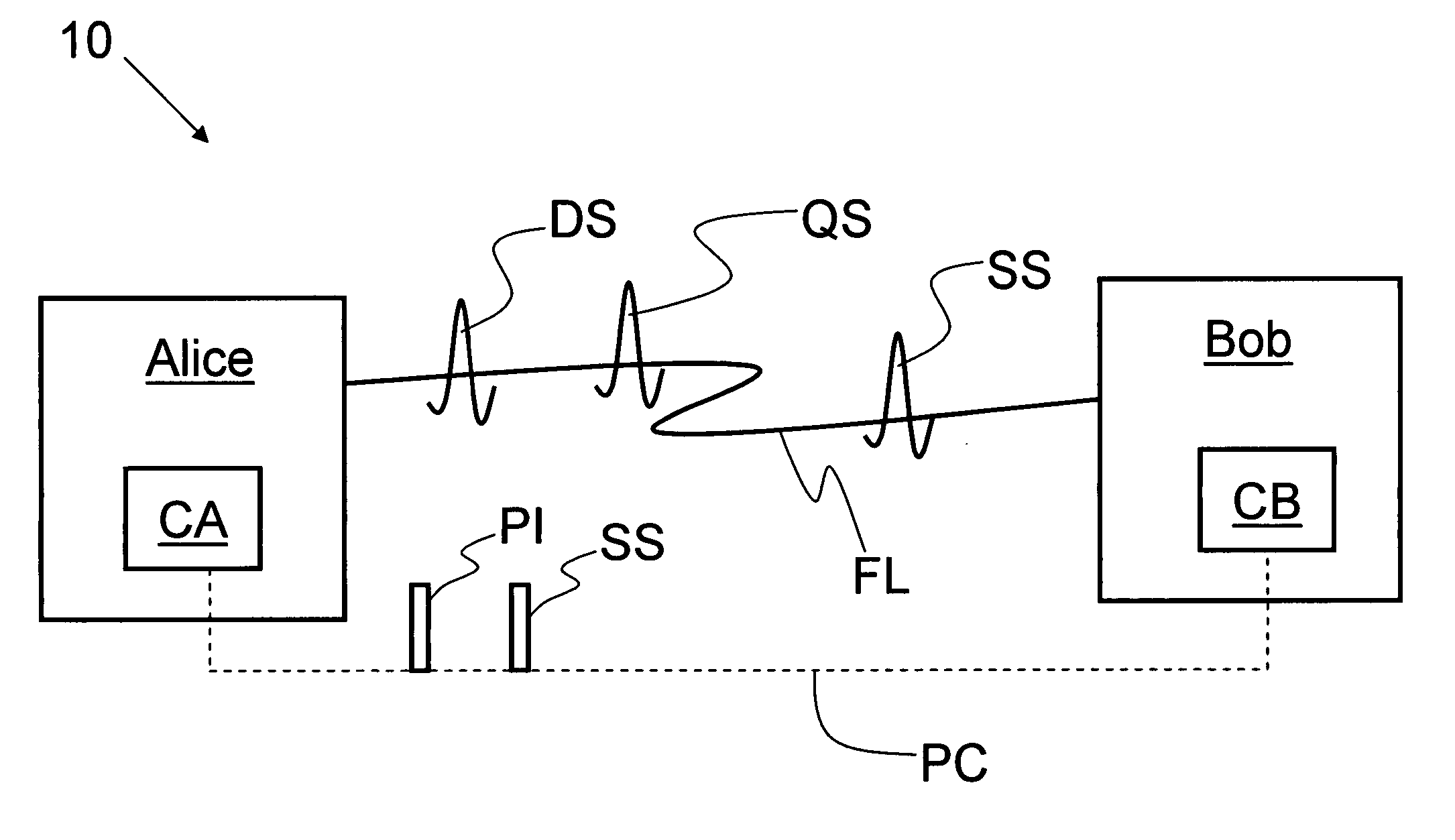
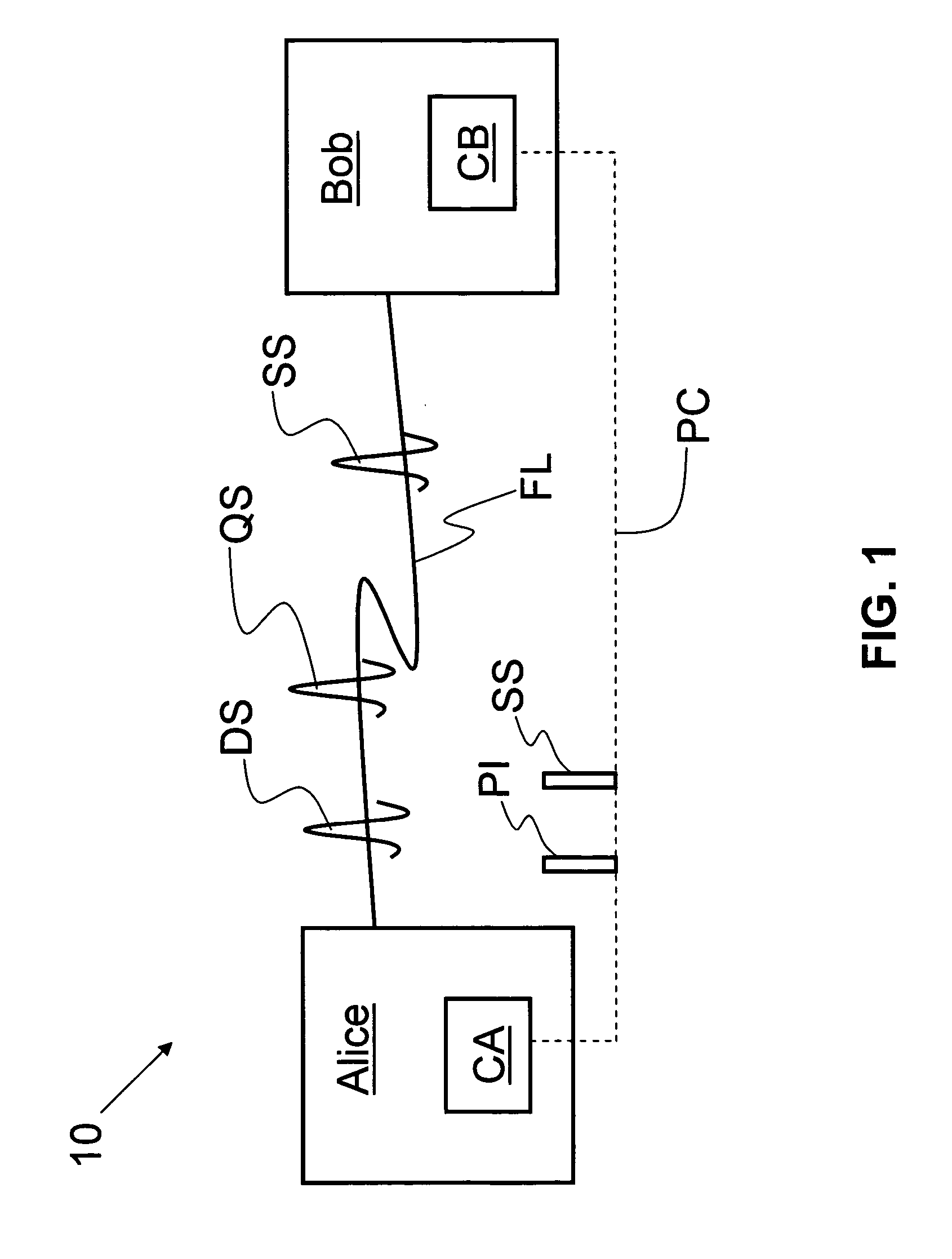
[0014]FIG. 1 is a schematic diagram of a generalized QKD system 10 that includes a first QKD station called “Alice” and a second QKD station called “Bob” operably coupled by an optical fiber link FL. Alice and Bob have respective controllers CA and CB that control the respective operations of the QKD stations, that communicate to coordinate the overall synchronization of the QKD system operation, and that exchange and process information (e.g., sifting, privacy amplification, etc.) in order to establish a final secure quantum key. Optical fiber link FL is adapted to carry weak optical pulses from Alice to Bob over a quantum channel. Here, weak optical pulses are defined as optical pulses having a mean photon number μ≦1. Quantum signals QS, which are used to establish a shared quantum key, are weak optical pulses exchanged over a quantum channel. Decoy state signals DS (hereinafter, “decoy signals”), generated as described below, may also be weak optical pulses having a different mea...
PUM
 Login to View More
 Abstract
Description
Claims
Application Information
 Login to View More