System and method for secure network connectivity

a network connectivity and network technology, applied in the field of secure network connectivity, can solve the problems of limiting or prohibiting the access to any corporate resource, corporations cannot enforce internal security policies on client computers, and computers may be precluded from accessing databases that store client data

US20070101405A1Inactive Publication Date: 2007-05-03BARCLAYS CAPITAL INC
9 Cites 174 Cited by

Patent Information

Authority / Receiving Office
US · United States
Patent Type
Applications(United States)
Current Assignee / Owner
Publication Date
2007-05-03
Estimated Expiration
Not applicable · inactive patent

Smart Images

  • Figure 1
    Figure 1
  • Figure 2
    Figure 2
  • Figure 3
    Figure 3
Patent Text Reader

Abstract

A system and method to ensure that a remote computer making a VPN connection complies with network security policies. Server-driven security checks may be configured to verify compliance with each access level before access is granted at that level. The security checks may be selected based at least according to the information received from the remote computer. After the server determines that the remote computer complies with the security policy for the requested access level, the server may pass a token to the remote computer, or may grant VPN access to the remote computer. If the remote computer does not comply with the security policy associated with the requested access level but is in compliance with a security policy corresponding to a lower access level, the server may grant the remote computer access to the lower access level.
Need to check novelty before this filing date? Find Prior Art

Description

BACKGROUND OF THE INVENTION

[0001] Many companies allow users to access internal corporate networks and resources externally. One such method uses a Virtual Private Network (VPN) connection. In a typical scenario, a user working on a remote computer connects to the Internet and initiates a client side VPN program. The VPN program uses an acceptable networking protocol to access a company's VPN gateway computer. The gateway computer, e.g., a VPN server, authenticates the user and establishes a remote networking session for the remote user. One benefit of such a VPN session is that the remote user's computer appears to be directly to the company's network.

[0002] Internal corporate networks are usually buffered or isolated from the external network or Internet, for security reasons. Internet traffic into, and out of, the internal network may be filtered based on the corporation's security policy. Security policies may restrict file and databases access, or may limit or prohibit access...

Examples

Embodiment Construction

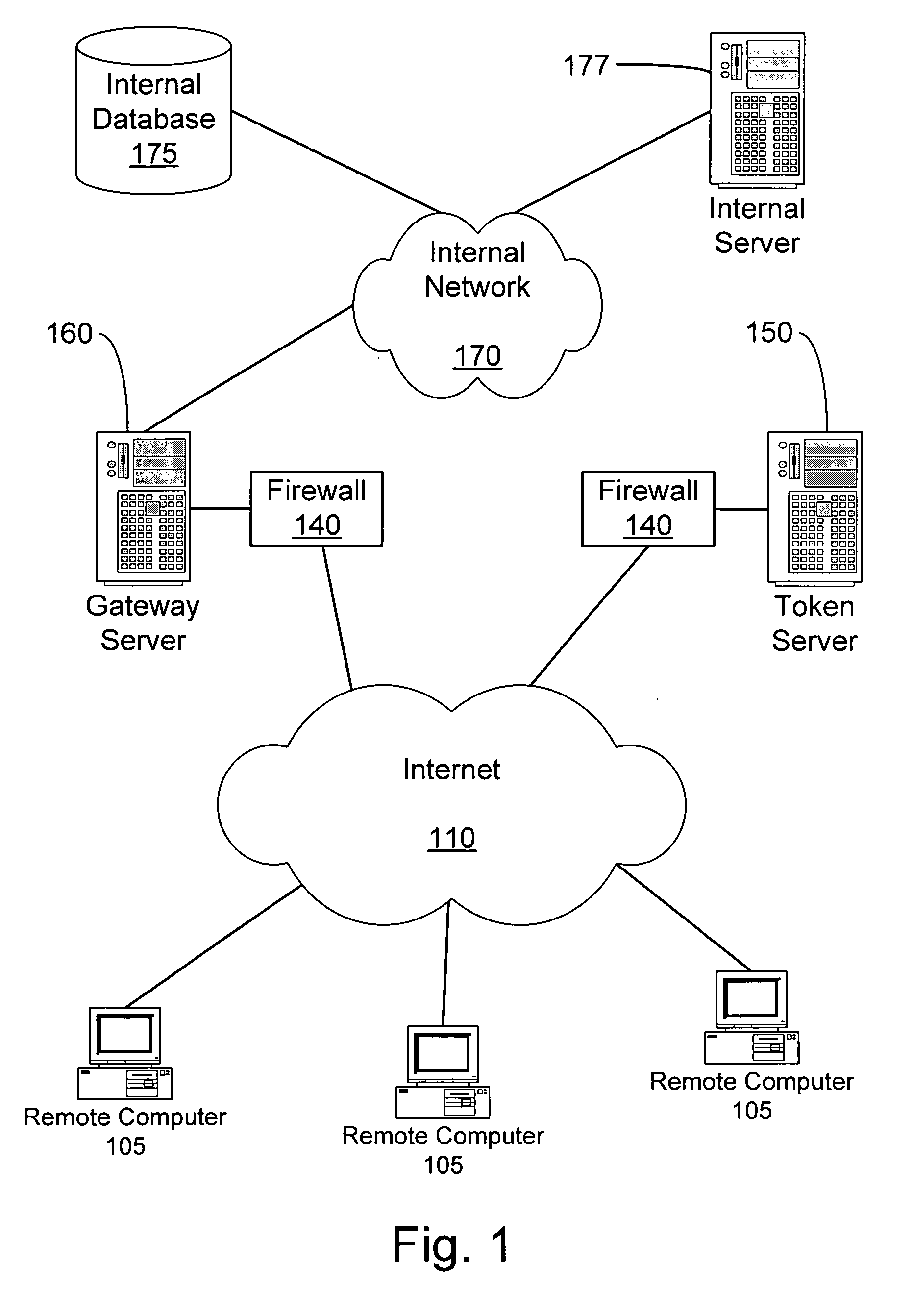
[0026]FIG. 1 illustrates one preferred embodiment of the present system and method. FIG. 1 shows a remote computer 105 connected to an external network 110, such as, for example, the internet. The remote computer 105 may connect to any other computer or network connected to the internet.

[0027] In FIG. 1, an internal network 170 is shown connected to internal network resources such as, for example, an internal database 175 and an internal server 177. As will be recognized by those skilled in the art, many servers may be connected to the internal network 170, including failover and load balancing servers. Further, any suitable network connection may be implemented in place of Internet 170, although connection using HTTP or HTTPS is preferred. Additionally, other corporate resources may be accessible through servers although these resources are not illustrated in FIG. 1. Examples of corporate resources may be, but are not limited to, printers, e-mail servers, applications servers, pro...