Unlock instant, AI-driven research and patent intelligence for your innovation.

Methods and systems of pixel illumination

a technology of pixel illumination and method, applied in the field of display systems, can solve the problems of increasing the difficulty of pixel illumination, so as to improve the apparent illumination response of the display, increase the brightness of pixels, and reduce the brightness of the display

Inactive Publication Date: 2007-08-16
ROSSELLA
View PDF5 Cites 5 Cited by
  • Summary
  • Abstract
  • Description
  • Claims
  • Application Information

AI Technical Summary

Benefits of technology

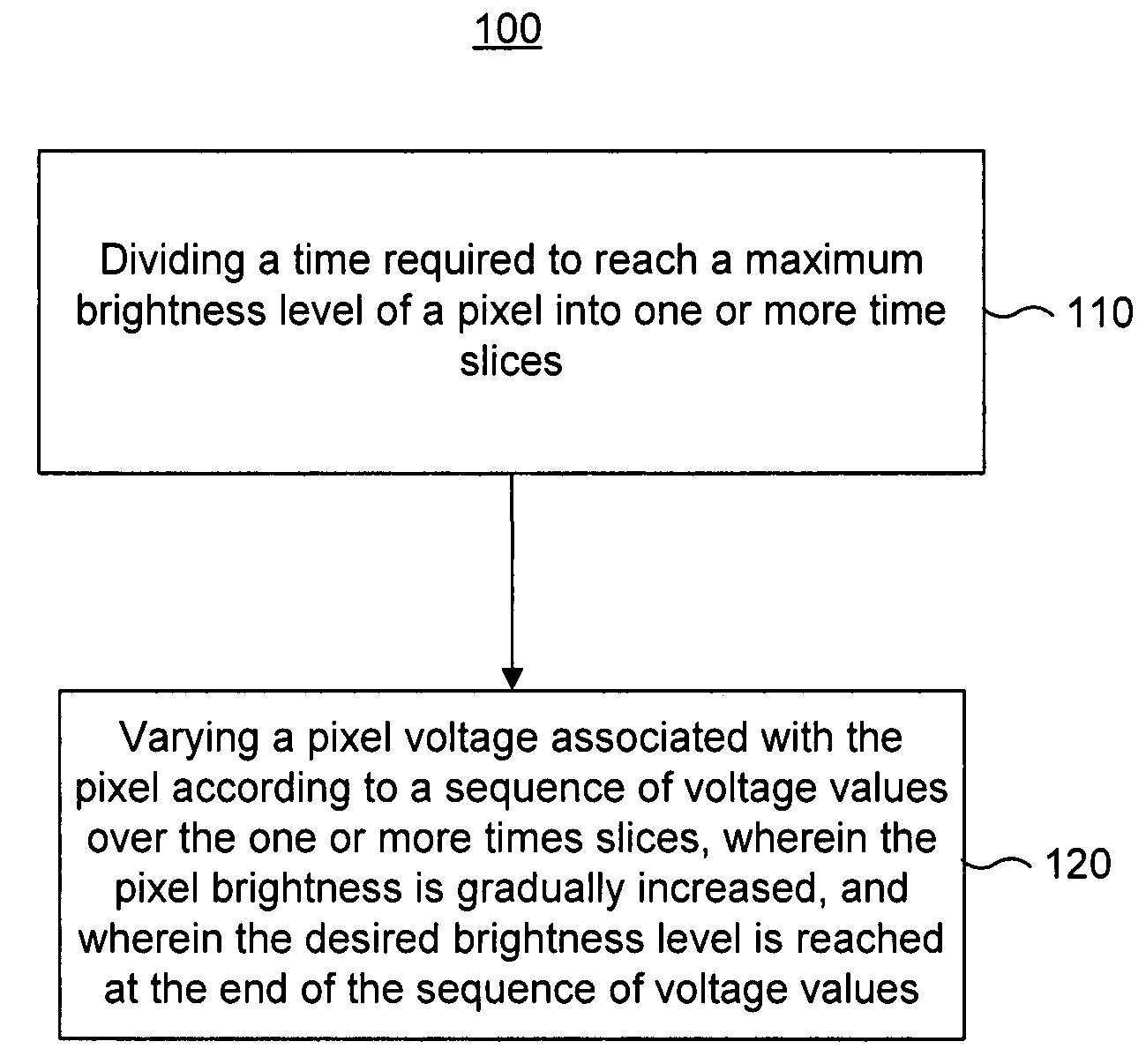
[0010]In one aspect, the present invention provides a method to illuminate a display having a plurality of pixels. The method works by gradually increasing the brightness of pixels, thereby providing a perceived uniform illumination of the display. The method provides that pixels on a lower portion of a screen are at least partially illuminated before the top portion of the screen is fully illuminated. Accordingly, the “brightness gradient” problem described above is overcome. The method further allows for an initial illumination of a pixel to some initial brightness level, and then for a gradual increase in brightness of the pixel to its desired brightness level by subsequent increments in brightness. This is in contrast to conventional illumination methods, where a pixel must be loaded with its final brightness level before it can be illuminated. The result is a faster apparent illumination response of the display. Conversely, the same method can be used to gradually decrease the brightness of the display.

Problems solved by technology

Accordingly, pixels may not be provided sufficient time to reach desired brightness levels when the display is turned on for periods shorter than the response time of the pixels.
This problem becomes more severe in the case of a line-addressed display, where the display is illuminated sequentially one row at a time.
Accordingly, the perceived brightness of the display is vertically non-uniform.
Brightness equalization techniques, however, negatively affect the contrast ratio of the display defined as the ratio of maximum to minimum brightness of the display.
While direct addressing seems to solve the “brightness gradient” problem, it is not a viable solution for large displays having thousands of pixels.

Method used

the structure of the environmentally friendly knitted fabric provided by the present invention; figure 2 Flow chart of the yarn wrapping machine for environmentally friendly knitted fabrics and storage devices; image 3 Is the parameter map of the yarn covering machine
View more

Image

Smart Image Click on the blue labels to locate them in the text.
Viewing Examples
Smart Image
  • Methods and systems of pixel illumination
  • Methods and systems of pixel illumination
  • Methods and systems of pixel illumination

Examples

Experimental program
Comparison scheme
Effect test

example bit

Sequence to Brightness Level Mapping

[0060]As described above with reference to FIG. 2, according to an embodiment of the present invention, the pixel voltage, over each time slice of the control field time, either maintains its previous value or takes a new value. Accordingly, the pixel voltage takes up to two voltage values over each time slice of the control field time. An example bit sequence to brightness level mapping is now provided.

[0061]FIG. 5 illustrates an example bit sequence to brightness level mapping according to an embodiment of the present invention. In the example of FIG. 5, brightness levels are represented in terms of corresponding integrals of pixel voltage over time.

[0062]Referring to FIG. 5, the control field time is divided into four time slices t0, t1, t2, and t3 having equal durations. A four bit sequence is used over the control field time. The voltage sequence, in the example of FIG. 5, is such that an integral of the voltage over time slices t0, t1, t2, a...

the structure of the environmentally friendly knitted fabric provided by the present invention; figure 2 Flow chart of the yarn wrapping machine for environmentally friendly knitted fabrics and storage devices; image 3 Is the parameter map of the yarn covering machine
Login to View More

PUM

No PUM Login to View More

Abstract

A method of illuminating a pixel on a display to a desired brightness level that includes dividing a time required to reach a maximum brightness level into one or more time slices, varying a pixel voltage associated with the pixel according to a sequence of voltage values over the one or more time slices, and gradually increasing the brightness of the pixel according to the pixel voltage.

Description

CROSS-REFERENCE TO RELATED APPLICATIONS[0001]The present application claims the benefit of U.S. Provisional Patent Application No. 60 / 772,525 filed on Feb. 13, 2006, which is incorporated herein by reference.FIELD OF THE INVENTION[0002]The present invention relates generally to display systems. More particularly, the invention relates to a method and system for illuminating a display.BACKGROUND OF THE INVENTION[0003]Technology using liquid crystals for displays is increasingly common in today's electronic applications. Liquid Crystal Display (LCD) and Liquid Crystal on Silicon (LCOS) are examples of such technology.[0004]In many liquid crystal applications, a display needs to be illuminated instantaneously and for short periods of time. Liquid crystal pixels, however, are characterized by a response time representative of the time required for pixels to transition from being completely dark to a certain brightness level. Accordingly, pixels may not be provided sufficient time to rea...

Claims

the structure of the environmentally friendly knitted fabric provided by the present invention; figure 2 Flow chart of the yarn wrapping machine for environmentally friendly knitted fabrics and storage devices; image 3 Is the parameter map of the yarn covering machine
Login to View More

Application Information

Patent Timeline
no application Login to View More
Patent Type & Authority Applications(United States)
IPC IPC(8): G09G5/10
CPCG09G3/2081G09G3/3208G09G2320/0252G09G2320/0233G09G3/3611
Inventor BOLOTSKI, MICHAEL
Owner ROSSELLA