
System and method for providing packet proxy services across virtual private networks
a virtual private network and packet proxy technology, applied in the field of communication, can solve the problems of posing a risk for more sensitive applications, unsecured transmission across the public network by any form of encryption, and reducing the advantages and problems so as to achieve the effect of substantially reducing or eliminating the disadvantages of providing secure communication and services across virtual private networks
- Summary
- Abstract
- Description
- Claims
- Application Information
AI Technical Summary
Benefits of technology
Problems solved by technology
Method used
Image

Examples
Embodiment Construction
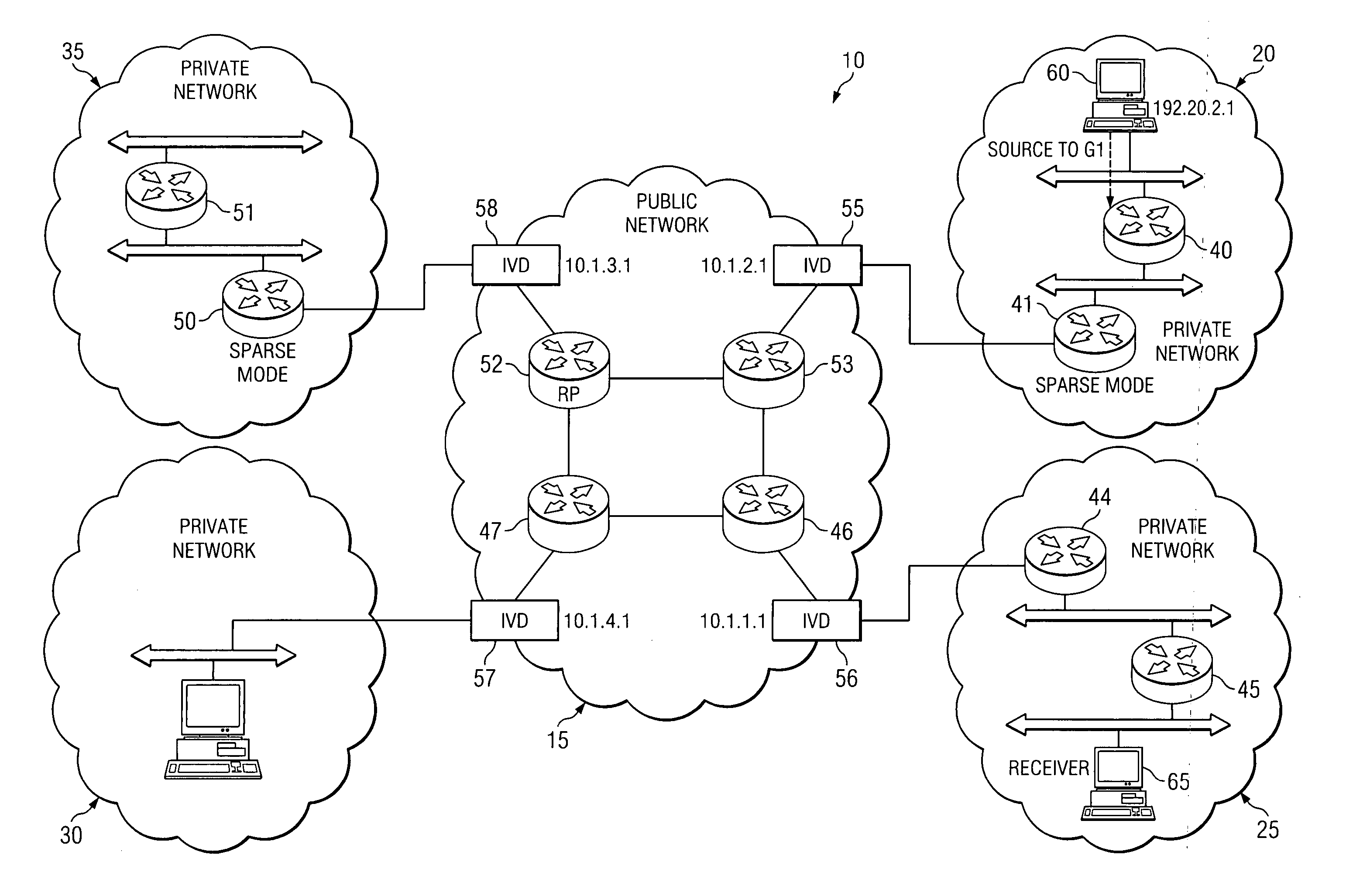
[0020]FIG. 1 is a simplified diagram of an exemplary communication system 10 in which the present invention may be practiced. Communication system 10 may include an unsecured public network 15 and one or more secured private networks, such as secured private networks 20-35. Note that the term “public network” is used herein interchangeably with “unsecured network.” Both terms refer to a broad concept of a network that provides open access to network resources, with little or no access controls. The Internet is one example of such a network. In contrast, the terms “private network” and “secured network” refer broadly to networks that implement access controls, restricting access to a finite set of authorized users. Many corporate intranets and military networks are secured networks. Referring again to FIG. 1 for illustration, public network 15 and each of secured private networks 20-35 generally include a variety of network elements, such as network elements 41-58. FIG. 1 generally m...
PUM
 Login to View More
 Abstract
Description
Claims
Application Information
 Login to View More