Phosphoinositide 3-kinase inhibitor compounds and methods of use
Active Publication Date: 2008-02-14
GENENTECH INC +1
View PDF8 Cites 157 Cited by
Summary
Abstract
Description
Claims
Application Information
AI Technical Summary
This helps you quickly interpret patents by identifying the three key elements:
Problems solved by technology
Method used
Benefits of technology
Benefits of technology
[0811] The words “comprise,”“comprising,”“include,”“including,” and “includes” when used in this specification and in the following claims are intended to specify the presence of stated features, integers, components, or steps, but they do not preclude the presence or addition of one or more other features, integers, components, steps, or groups thereof.
Problems solved by technology
These compounds, however, are nonspecific PI3K inhibitors, as they do not distinguish among the four members of Class I PI3 kinases.
Because of these factors, LY294002 would need to be administered at frequent intervals and thus has the potential to also inhibit PI3 kinases in normal cells thereby leading to undesirable side effects.
Method used
the structure of the environmentally friendly knitted fabric provided by the present invention; figure 2 Flow chart of the yarn wrapping machine for environmentally friendly knitted fabrics and storage devices; image 3 Is the parameter map of the yarn covering machine
View more
Image
Smart Image Click on the blue labels to locate them in the text.
Viewing Examples
Smart Image
Click on the blue label to locate the original text in one second.
Reading with bidirectional positioning of images and text.
[0243] A mixture of methyl 3-amino-2-thiophenecarboxylate 1 (13.48 g, 85.85 mmol) and urea (29.75 g, 5 eq.) was heated at 190° C. for 2 hours. The hot reaction mixture was poured onto sodiumhydroxide solution and any insoluble material was removed by filtration. The mixture was then acidified (HCl, 2N) to yield 1H-thieno[3,2-d]pyrimidine-2,4-dione 2 as a white precipitate, which was collected by filtration and air dried (9.49 g, 66%). 1H NMR 400 MHz, d6-DMSO) 6.90 (1H, d, J=5.2 Hz), 8.10 (1H, d, J=5.2 Hz), 11.60-11.10 (2H, br s).
[0244] A mixture of 1H-thieno[3,2-d]pyrimidine-2,4-dione 2 (9.49 g, 56.49 mmol) and phosphorous oxychloride (150 mL) was heated at reflux for 6 h. The reaction mixture was then cooled and poured onto ice / water with vigorous stirring yielding a precipitate. The mixture was then filtered to yield 2,4-dichloro-thieno[3,2-d]pyrimidine 3 as a white solid (8.68 g, 75%). 1H NMR. (400 MHz, CDCl3) 7.56 (1H, d, J=5.5 Hz), ...
[0246] A mixture of 2,4-dichloro-thieno[3,2-d]pyrimidine 3, (8.68 g, 42.34 mmol), morpholine (8.11 mL, 2.2 eq.) and MeOH (150 mL) was stirred at room temperature for 1 h. The reaction mixture was then filtered, washed with water and MeOH, to yield 2-chloro-4-morpholin-4-yl-thieno[3,2-d]pyrimidine 4 as a white solid (11.04 g, 100%). 1H NMR (400 MHz, d6-DMSO) 3.74 (4H, t, J=4.9 Hz), 3.90 (4H, t, J=4.9 Hz), 7.40 (1H, d, J=5.6 Hz), 8.30 (1H, d, J=5.6 Hz).
[0248] To a suspension of 2-chloro-4-morpholin-4-yl-thieno[3,2-d]pyrimidine 4 (1.75 g, 6.85 mmol) in dry THF (40 mL) at −78° C. was added a 2.5M solution of n-butyllithium (nBuLi) in hexane (3.3 mL, 1.2 eq.). After stirring for 1 h, dry DMF (796 μL, 1.5 eq.) was added. The reaction mixture was stirred for 1 h at −78° C. and then warmed slowly to room temperature. After a further 2 h at room temperature the reaction mixture poured onto ice / water yielding a yellow precipitate. This was collected by filtration and air-dried to yield 2-chloro-4-morpholin-4-yl-thieno[3,2-d]pyrimidine-6-carbaldehyde 10 (1.50 g, 77%). 1H NMR (400 MHz, d6-DMSO) 3.76 (4H, t, J=4.9), 3.95 (4H, t, J=4.9), 8.28 (1H, s), 10.20 (1H, s).
[0249] Also, to a suspension of 4-(2-chlorothieno[2,3-d]pyrimidin-4-yl)morpholine (1.75 g, 6.85 mmol) in dry THF at −78° C. was added a 2.5M solution of n-butyllithium (nBuLi) in hexane (3.3 mL, 1.2 eq.). Af...
the structure of the environmentally friendly knitted fabric provided by the present invention; figure 2 Flow chart of the yarn wrapping machine for environmentally friendly knitted fabrics and storage devices; image 3 Is the parameter map of the yarn covering machine
Login to View More
PUM
Property
Measurement
Unit
Angle
aaaaa
aaaaa
Energy
aaaaa
aaaaa
Composition
aaaaa
aaaaa
Login to View More
Abstract
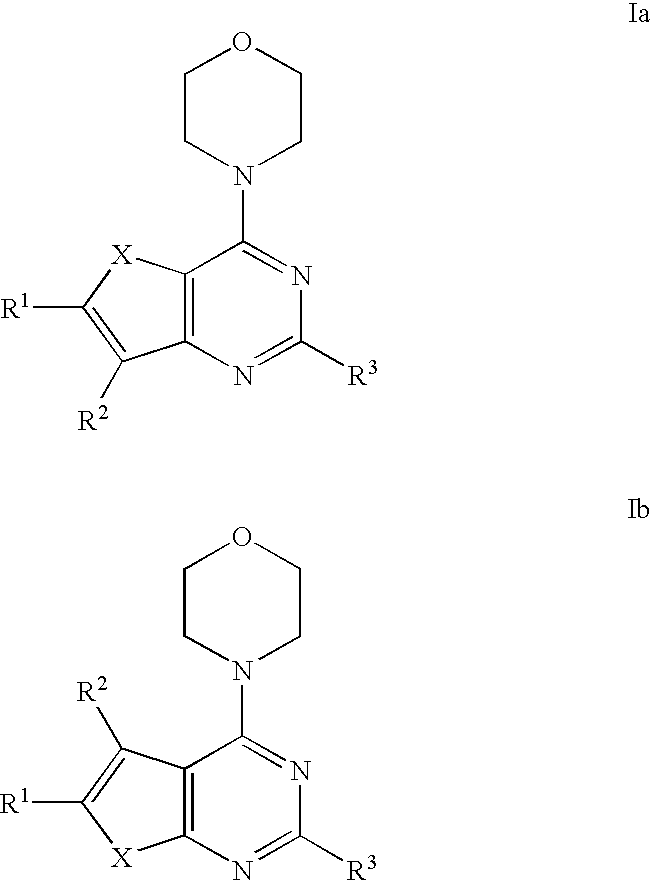
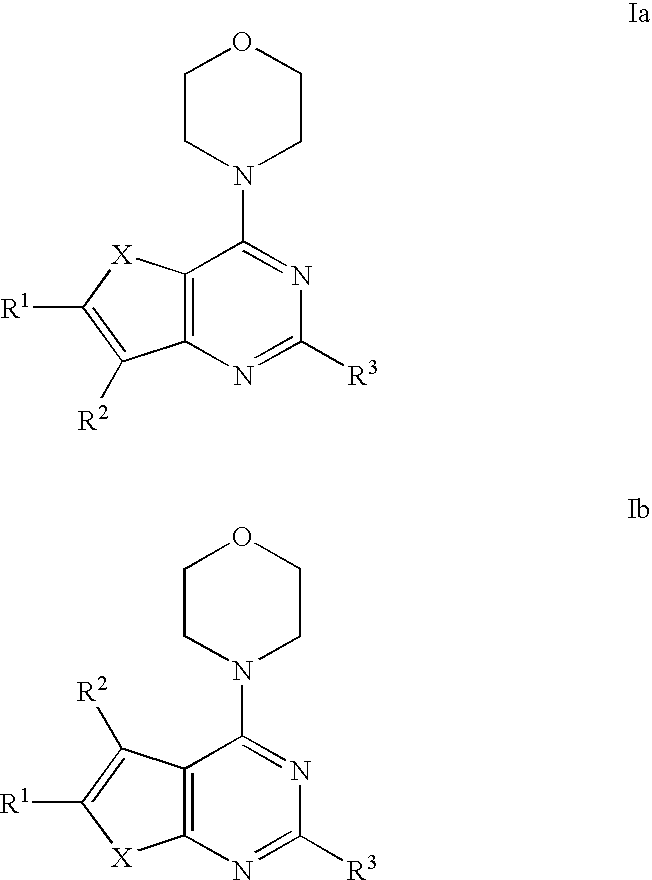
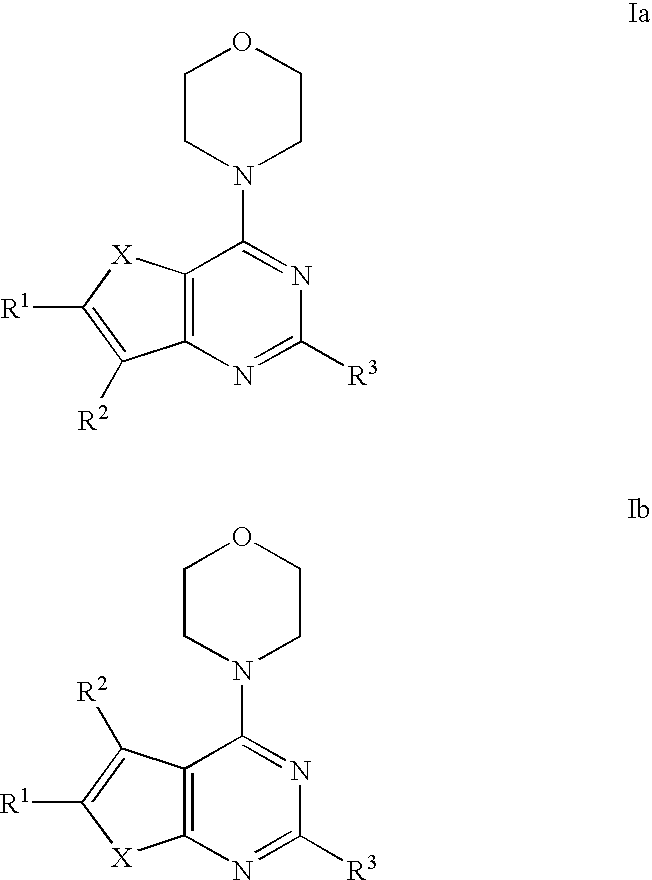
Compounds of Formulas Ia and Ib, and including stereoisomers, geometric isomers, tautomers, solvates, metabolites and pharmaceutically acceptable salts thereof, are useful for inhibiting lipid kinases including PI3K, and for treating disorders such as cancer mediated by lipid kinases. Methods of using compounds of Formula Ia and Ib for in vitro, in situ, and in vivo diagnosis, prevention or treatment of such disorders in mammalian cells, or associated pathological conditions, are disclosed.
Description
PRIORITY OF INVENTION [0001] This application claims priority to U.S. Provisional Application No. 60 / 795,047 that was filed on 26 Apr. 2006. The entire content of this provisional application is hereby incorporated herein by reference.FIELD OF THE INVENTION [0002] The invention relates generally to compounds with anti-cancer activity and more specifically to compounds which inhibit PI3 kinase activity. The invention also relates to methods of using the compounds for in vitro, in situ, and in vivo diagnosis or treatment of mammalian cells, or associated pathological conditions. BACKGROUND OF THE INVENTION [0003] Phosphatidylinositol (hereinafter abbreviated as “PI”) is one of a number of phospholipids found in cell membranes. In recent years it has become clear that PI plays an important role in intracellularsignal transduction. Cell signaling via 3′-phosphorylated phosphoinositides has been implicated in a variety of cellular processes, e.g., malignant transformation, growth factor...
Claims
the structure of the environmentally friendly knitted fabric provided by the present invention; figure 2 Flow chart of the yarn wrapping machine for environmentally friendly knitted fabrics and storage devices; image 3 Is the parameter map of the yarn covering machine
Login to View More
Application Information
Patent Timeline
Application Date:The date an application was filed.
Publication Date:The date a patent or application was officially published.
First Publication Date:The earliest publication date of a patent with the same application number.
Issue Date:Publication date of the patent grant document.
PCT Entry Date:The Entry date of PCT National Phase.
Estimated Expiry Date:The statutory expiry date of a patent right according to the Patent Law, and it is the longest term of protection that the patent right can achieve without the termination of the patent right due to other reasons(Term extension factor has been taken into account ).
Invalid Date:Actual expiry date is based on effective date or publication date of legal transaction data of invalid patent.


 Login to View More