

Fiber aided wireless network architecture
a wireless network and fiber technology, applied in the field of fiber aided wireless network architecture, can solve the problems of limiting mobile communications to data rates that are lower, infrastructures that do not support mobility, etc., and achieve the effect of power efficiency and quantization error balan
- Summary
- Abstract
- Description
- Claims
- Application Information
AI Technical Summary
Problems solved by technology
Method used
Image

Examples
Embodiment Construction
[0021]A description of example embodiments of the invention follows.
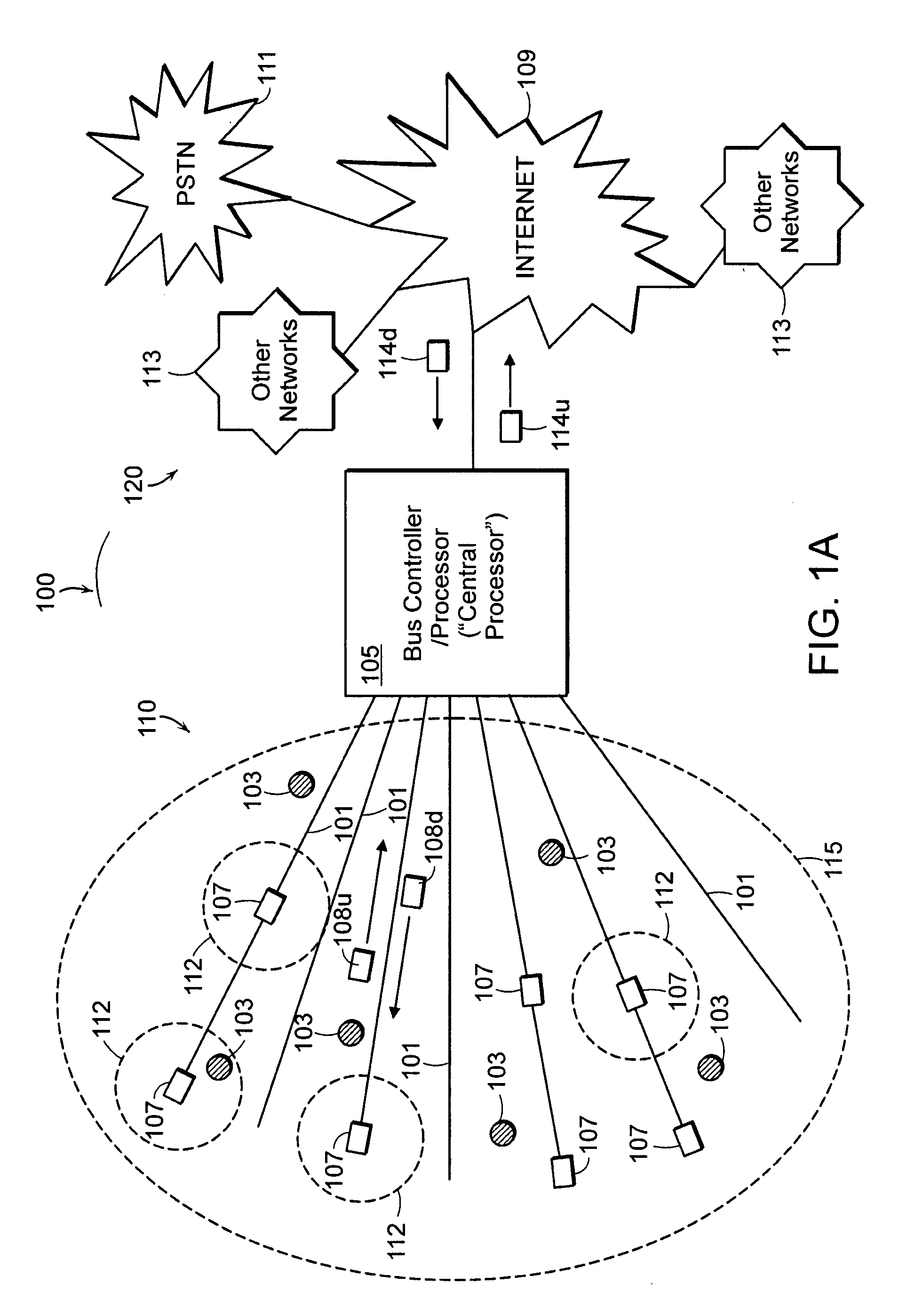
[0022]FIG. 1A illustrates an example embodiment of the present invention having a fiber aided wireless network architecture (FAWNA), which supports mobile connectivity with high-speed by leveraging speed of an optical network infrastructure. A communications network 100 includes a FAWNA system 110 employing optical fibers 101, which are passed through various wireless zones 112. A wireless network coverage area 115 may be divided into zones 112 such that the optical fibers 101 pass through each zone 112 to support the mobile connectivity.
[0023]Connected to one end of the fibers 101 is a bus controller / processor (“central processor”) 105, which coordinates use of the fibers 101 as well as connectivity to other networks 120 (“the outside world”). As shown in FIG. 1, the bus controller / processor 105 may be connected to traditional networks 120, such as the Internet 109, a public switched telephone network (PSTN) 111, o...
PUM
 Login to View More
 Abstract
Description
Claims
Application Information
 Login to View More