
Method of manufacturing an electrowetting-based variable-focus lens
a manufacturing method and electrowetting technology, applied in the field of variable lens manufacturing, can solve the problems of difficult to accurately control the position of the drop of oily liquid in the enclosure of the aqueous-liquid-filled lens, difficult to accurately control the internal pressure of the lens, and the overpressure in the lens that cannot be easily controlled accurately
- Summary
- Abstract
- Description
- Claims
- Application Information
AI Technical Summary
Benefits of technology
Problems solved by technology
Method used
Image

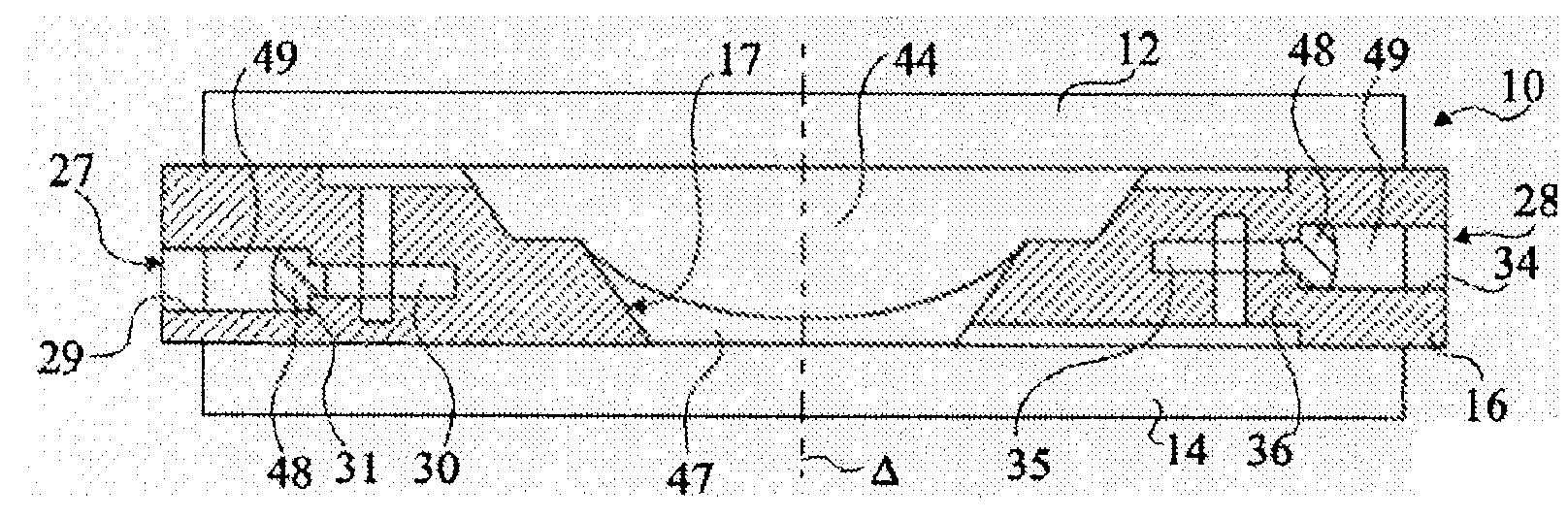
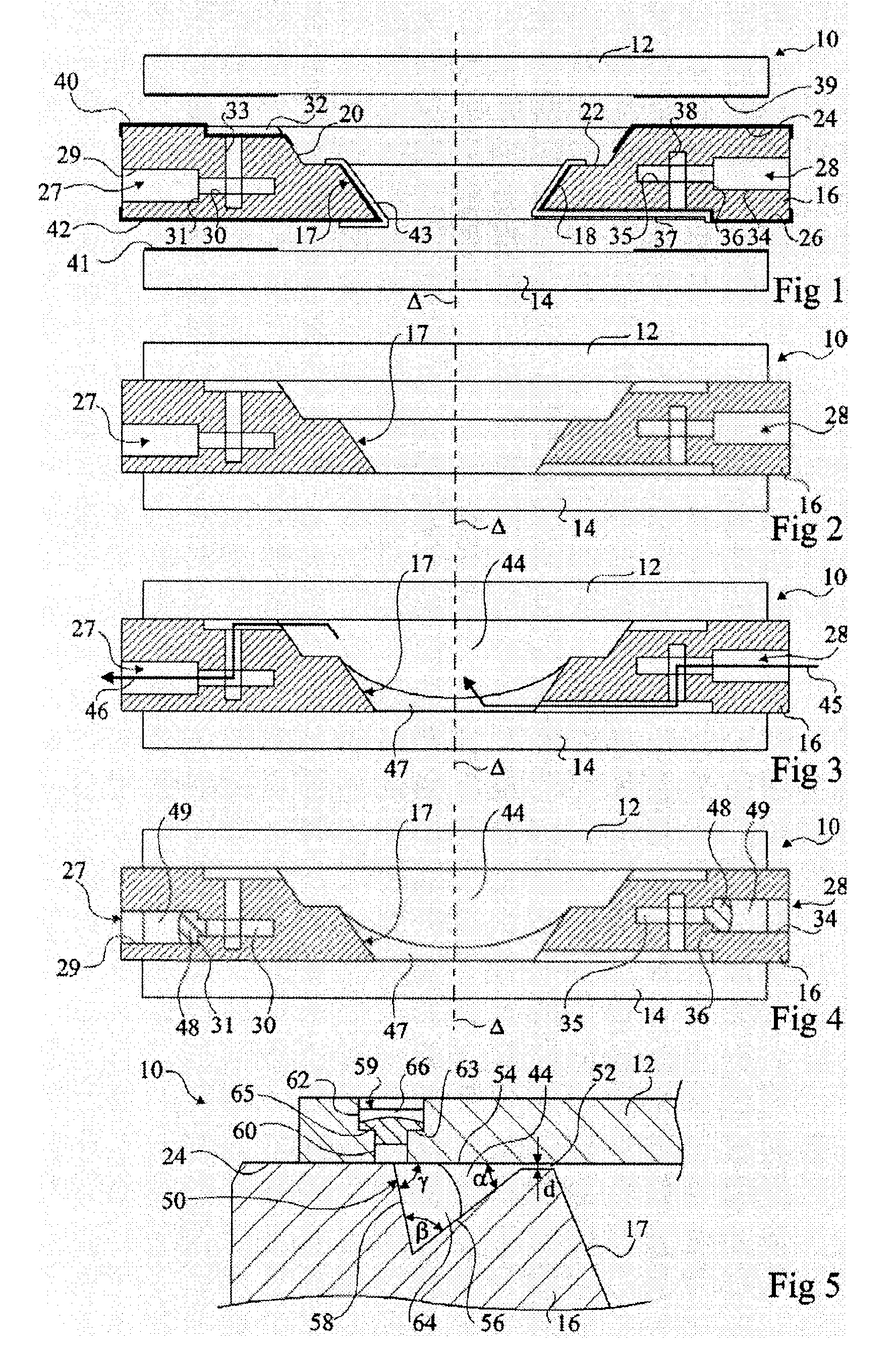
Examples
Embodiment Construction
[0027]For the sake of clarity, identical elements have been denoted by identical references in the various figures.
[0028]FIG. 1 is a sectional exploded view of a first exemplary embodiment of a variable-focus lens 10 according to the invention, comprising upper and lower circular transparent plates 12 and 14 of axis Δ and an annular ring 16 of axis A. The ring 16 has a central opening 17 which is bounded by a lower truncated-cone-shaped wall 18 (in other words a conical frustum) and an upper truncated-cone-shaped wall 20 that are separated by a shoulder 22. The ring 16 further comprises, on its upper surface, a planar face 24 on which the upper plate 12 is intended to bear, in order to form the topside of an enclosure. Similarly, the ring 16 comprises, on its lower face, a planar bearing surface 26 on which the lower plate 14 is intended to bear, in order to form the underside of the enclosure. The plates 12 and 14 and the ring 16 may be made of rigid insulating materials, for examp...
PUM
 Login to View More
 Abstract
Description
Claims
Application Information
 Login to View More