Nevertheless, it does not make it possible to identify emitters of alpha
radiation which is stopped entirely within the package, and it is unsuitable for probing packages of large dimensions containing small quantities of radioactive material.
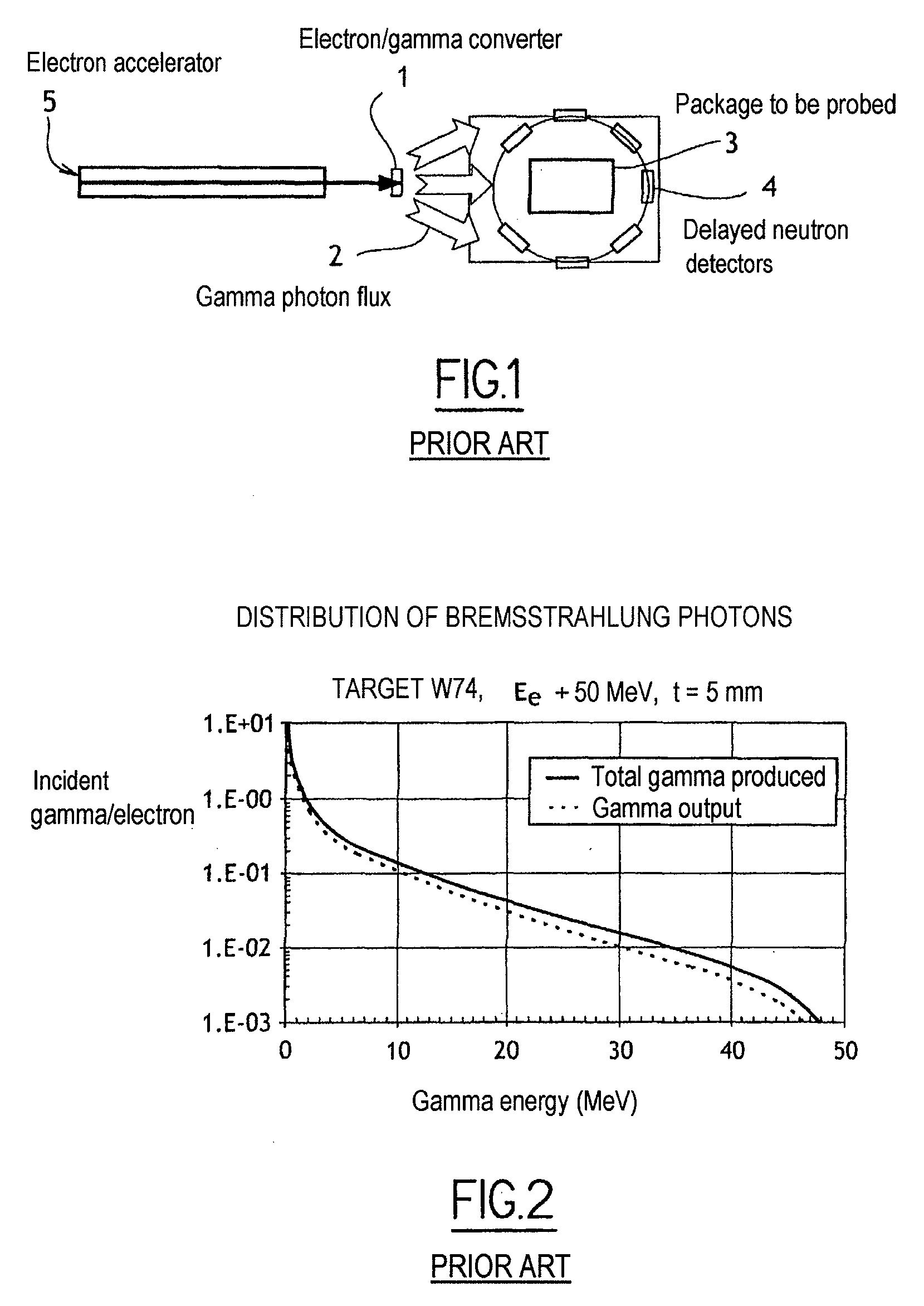
Firstly, the enormous quantity of gamma photons produced by
bremsstrahlung from the
electron beam can lead to ionizations in the
neutron detectors.
Secondly, since the conversion target has a
high atomic number, it produces, under the effect of
photon irradiation, parasitic neutrons in quantities greater than the quantities of prompt neutrons coming from the photofission.
The immediate consequence is to generate a very considerable
neutron environment (neutron
noise) that drowns the useful
signal.
Nevertheless, in that technique, a neutron flash dazzles the detectors and makes it necessary to take measurements only after the flash.
A consequence of this detection is that it is not possible to identify any actinides present in the package, which constitutes a first limitation on that method.
It is therefore not possible, in that prior art
system, to locate waste accurately within a package.
Nevertheless, it does not make it possible to identify different actinides directly.
A second limitation of that method according to French patent No. 2 764 383 (equivalent to U.S. Pat. No. 6,452,992), lies in the fact that it is only the
mass of the actinides that is measured and not their activity.
A third limitation of that method according to French patent No. 2 764 383 (equivalent to U.S. Pat. No. 6,452,992), lies in
noise, which limits the sensitivity of the
system to a value that is too high to make it possible to classify the package into a storage category and thus to determine the location where it ought to be stored.
Firstly, neutrons inside the waste drum follow poorly-controlled paths, which means that not all the regions within the drum can be reached, and also that the enormous quantity of neutrons (as produced by photons impacting the target) dazzles of all of the detectors, so as to make it impossible to measure prompt neutrons. Only delayed neutrons can be measured effectively, and this greatly affects measurement sensitivity. Finally, the efficiency of the method is extremely low, with a very small fraction of the emitted photons having sufficient energy to trigger a photofission reaction.
Nevertheless, the depth of
photon penetration is small, and the very great majority of the photons that have insufficient energy are stopped within the very first centimeters, which means that it is not possible to determine the composition of the drum throughout its thickness.
More generally, the method according to French patent No. 2 764 383 (equivalent to U.S. Pat. No. 6,452,992) presents the following three drawbacks: firstly it is the
mass of actinides that is measured and not their activity; secondly it is not possible to identify which actinides are present; and finally it is not possible to bring the
sensitivity limit down far enough to be able to determine the category in which the waste should be stored.



 Login to View More
  Login to View More