
Wind Farm and Method for Controlling the Same
a technology of wind farms and wind farms, applied in the field of wind farms, can solve the problems of higher losses than what, the change of the reactive power supplied by the individual wind turbine, etc., and achieve the effect of small effort and more flexibility
- Summary
- Abstract
- Description
- Claims
- Application Information
AI Technical Summary
Benefits of technology
Problems solved by technology
Method used
Image

Examples
Embodiment Construction
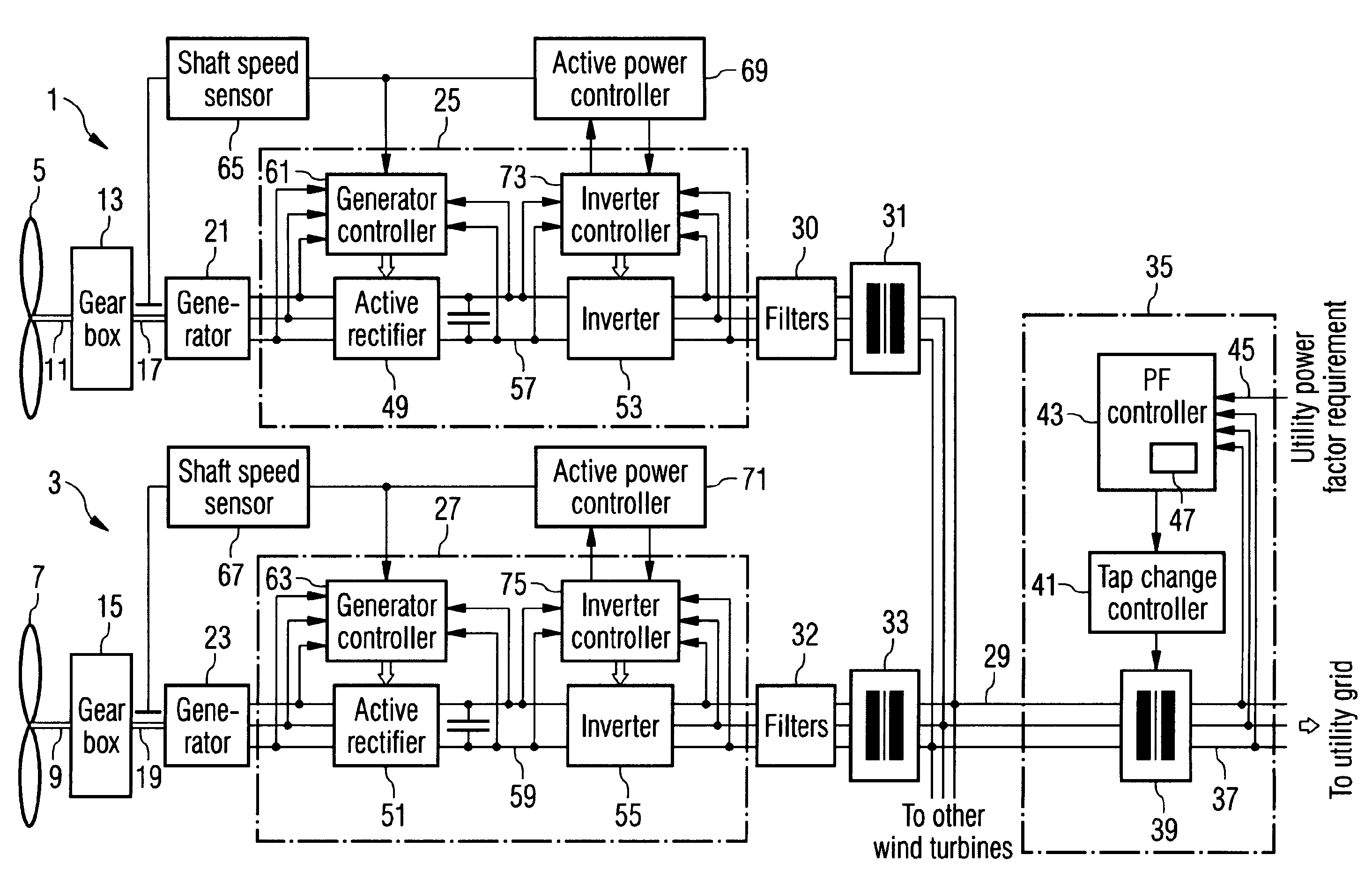
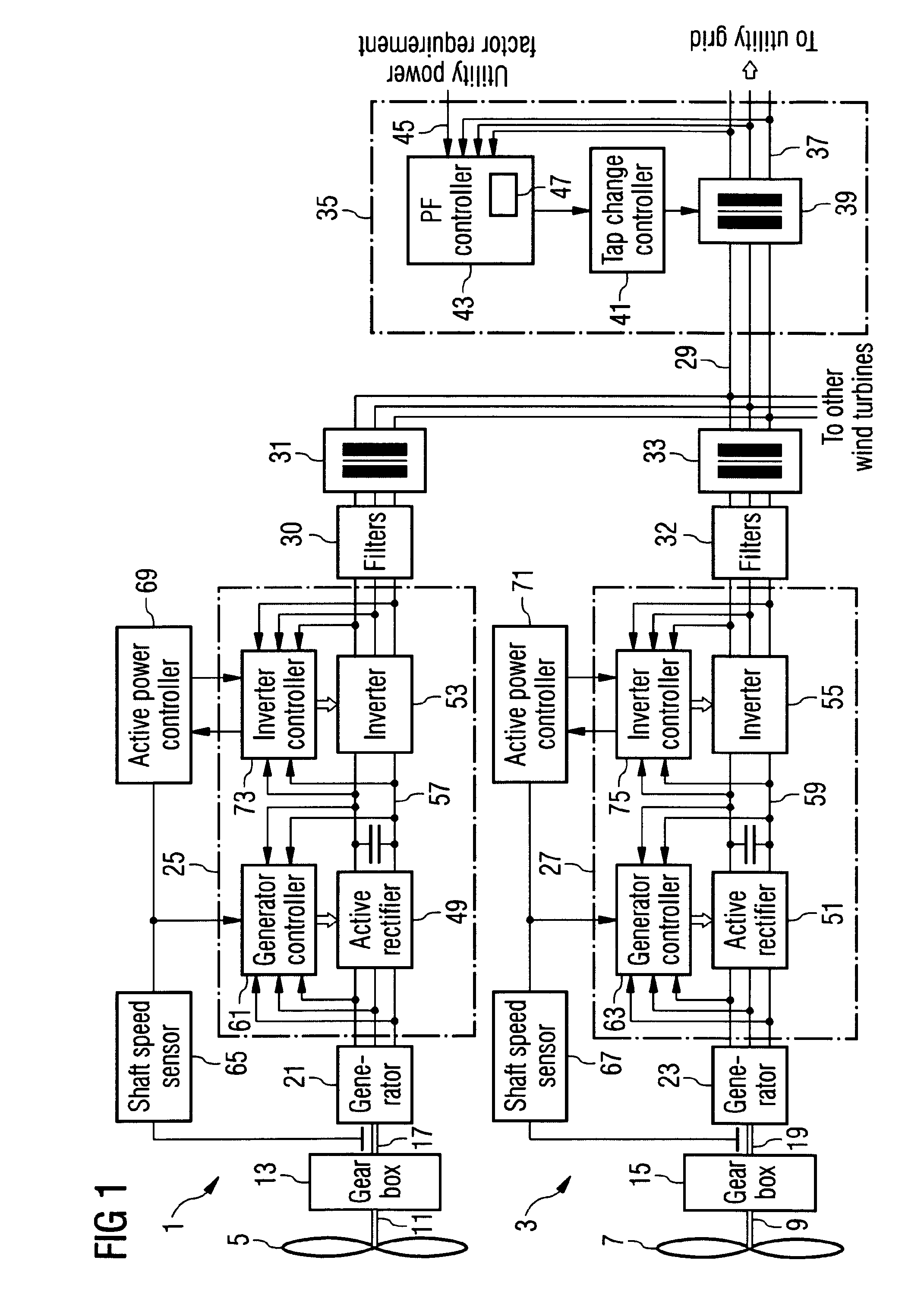
[0041]FIG. 1 shows a wind farm arrangement for carrying out a power factor control according to the invention. The wind farm is indicated by two wind turbines 1, 3, each comprising a rotor with a rotor shaft transmitting the rotational momentum of the turning rotor 5, 7 to a gear box 13, 15. In the gear box 13, 15, a transmission of the rotation to an output shaft 17, 2519 with a certain transmission ratio takes place.
[0042]The output shaft 17, 19 is fixed to the rotor of an AC generator 21, 23 which transforms the mechanical power provided by the rotation of the output shaft 17, 19 into the electrical power. The AC generator may either be a synchronous generator or an asynchronous generator. In a synchronous generator, the rotor rotates with the same rotational frequency as a rotating magnetic field produced by a stator of the generator. In contrast, in an asynchronous generator, the rotational frequencies of the stator's magnetic field and the rotor are different. The difference i...
PUM
 Login to View More
 Abstract
Description
Claims
Application Information
 Login to View More