[0016]Incidentally, Japanese Patent Publication No. 59-53861 described above discloses a method for obtaining a flat container that involves inflating a bottomed parison having a
circular section in a first blow mold into an intermediate molded article, inserting this intermediate molded article into a second blow mold, flattening the intermediate molded article into an elliptical shape by mold closing, and then performing blow molding. Under this method, as can be seen in Figure (C) of this document, an intermediate molded article 7 is depressed by mold closing, whereby also the major axis portion of the intermediate molded article 7 is brought into
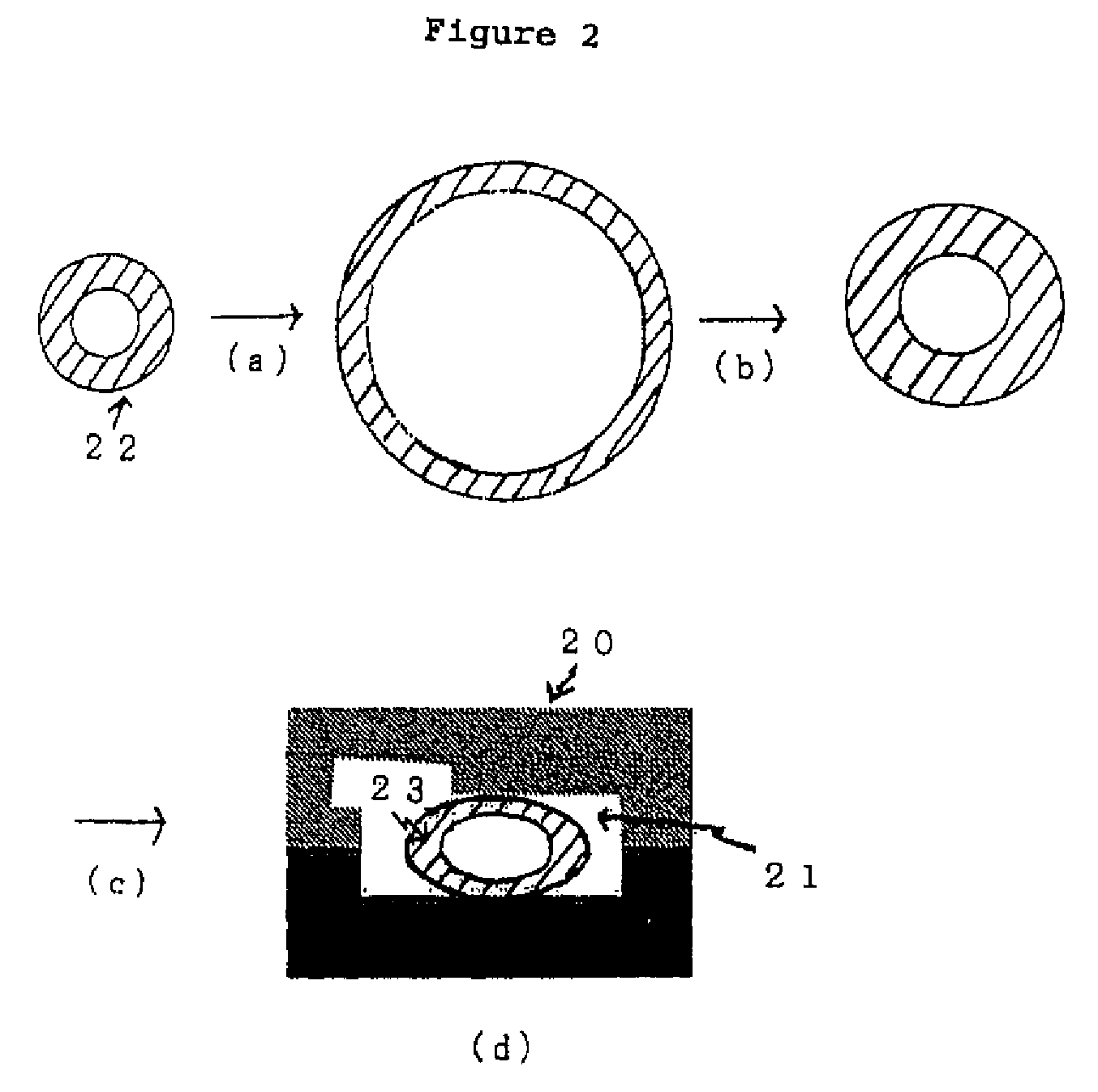
close contact with the mold. On the other hand, in the above-described prior inventions, a parison is subjected to primary blow molding and molded into a bottomed cylindrical body having a
diameter larger than the
minor axis of a mold for secondary blow molding, the bottomed cylindrical body is then caused to shrink in a heated condition, whereby the bottomed cylindrical body is caused to maintain a
diameter which is larger than the
minor axis of a cavity within the mold for secondary blow molding, the bottomed cylindrical molded article is then attached to the interior of the mold for secondary blow molding. And as shown in (d) of FIG. 2, mold clamping is performed, with the bottomed cylindrical molded article depressed in a flat condition in the
minor axis direction of the cavity within the mold for secondary blow molding, so that the major axis portion of the bottomed cylindrical body does not come into contact with mold surfaces. The prior inventions differ from the invention of this document in the two points of shrinkage under heat and mold clamping performed so that the major axis portion does not come into contact with mold surfaces. Thanks to these differences, in the prior inventions, the wall thickness is sufficiently made uniform and
mechanical strength and
heat resistance are improved.
[0019]On the basis of these recognitions, the inventors of the present application arrived at the constituent features: (1) by subjecting an upper portion and / or a lower portion of a body molding surface of the mold for blow molding at least on the long-side side of a container to mold surface treatment, the slipperiness of a resin material on a partial surface of the mold for blow molding is improved, and as a result of this, further uniformity of the wall thickness of the container is achieved; and (2) by forming one or more convexities, which are horizontal as viewed from the height of a container, in an upper portion and / or a lower portion of a body molding surface in the mold for blow molding at least on the long-side side of the container, the
waviness of concavities which partially occurs on the major axis side surface of an intermediate molded article is caused to be absorbed in the convexities and removed, and in a case where minor wrinkles incapable of being completely removed tend to remain, by stretching the wrinkles during secondary blow molding, the prevention of the occurrence of wrinkles on the surface is realized. Thus the present inventors found out the constituent features as the second basic invention of the present application. Furthermore, by combining the features (1) and (2), the occurrence of concavities and wrinkles can be suppressed more as the feature (3).
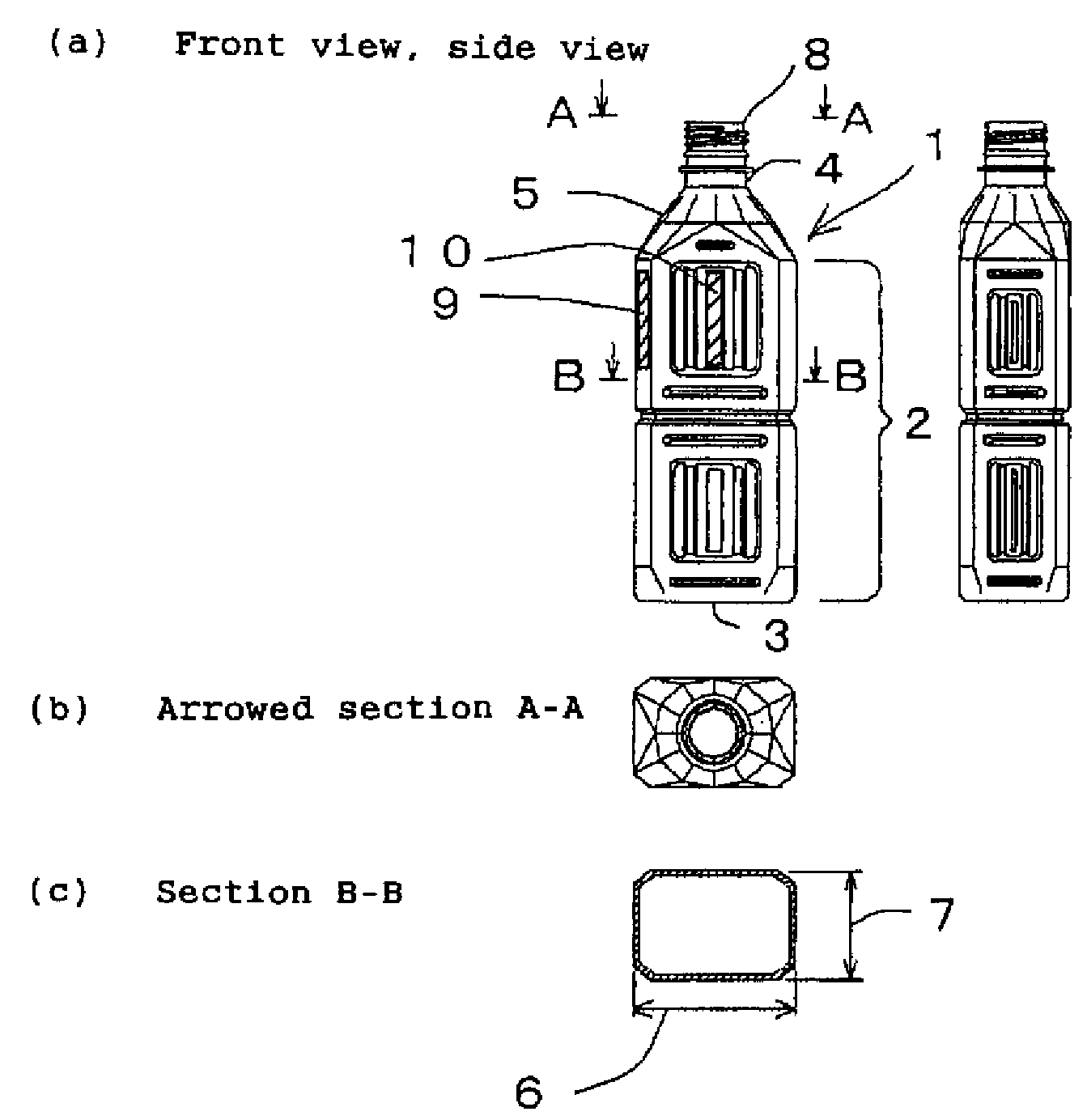
[0020]Incidentally, as the feature (4), in the body of the product container on the major axis side, transverse (horizontal) concave ribs (cross beams of grooves) are formed by convexities on the blow mold surface as shown in FIG. 7, and it has become possible to form a flat container with transverse ribs that has remarkable uniformity of wall thickness and is excellent in mechanical strength and heat resistance.
[0030][8] The flat
polyester resin container according to any one of [1] to [6], which is characterized in that the flat
polyester resin container is obtained by subjecting a bottomed parison preformed from a
polyester resin to primary blow molding, thereby molding the bottomed parison into a bottomed cylindrical body having a
diameter larger than the minor axis of a cavity within a mold for secondary blow molding, thereafter causing the bottomed cylindrical body to shrink in a heated condition, thereby to cause the bottomed cylindrical body to maintain a diameter which is smaller than the major axis of the cavity within the mold for secondary blow molding and larger than the minor axis thereof, attaching the bottomed cylindrical molded article to the interior of the mold for secondary blow molding, performing mold clamping, with the bottomed cylindrical molded article depressed in the minor axis direction of the cavity within the mold, feeding thereafter a pressure fluid into the bottomed cylindrical molded article, and causing the bottomed cylindrical molded article to flow in a heated condition along the shape of the cavity on an inner surface of the mold, thereby to mold the flat polyester resin container.
[0039][17] A method for manufacturing a flat container by the two-stage blow molding process, which is characterized in that the method comprises subjecting a bottomed parison preformed from a polyester resin to primary blow molding, thereby molding the bottomed parison into a bottomed cylindrical body having a diameter larger than the minor axis of a cavity within a mold for secondary blow molding, thereafter causing the bottomed cylindrical body to shrink in a heated condition, thereby to cause the bottomed cylindrical body to maintain a diameter which is smaller than the major axis of the cavity within the mold for secondary blow molding and larger than the minor axis thereof, attaching the bottomed cylindrical molded article to the interior of the mold for secondary blow molding, performing mold clamping, with the bottomed cylindrical molded article depressed in the minor axis direction of the cavity within the mold, then feeding a pressure fluid into the bottomed cylindrical molded article, and causing the bottomed cylindrical molded article to flow in a heated condition along the shape of the cavity on an inner surface of the mold, thereby to mold the flat container.



 Login to View More