Projectile
- Summary
- Abstract
- Description
- Claims
- Application Information
AI Technical Summary
Benefits of technology
Problems solved by technology
Method used
Image



Examples
second embodiment
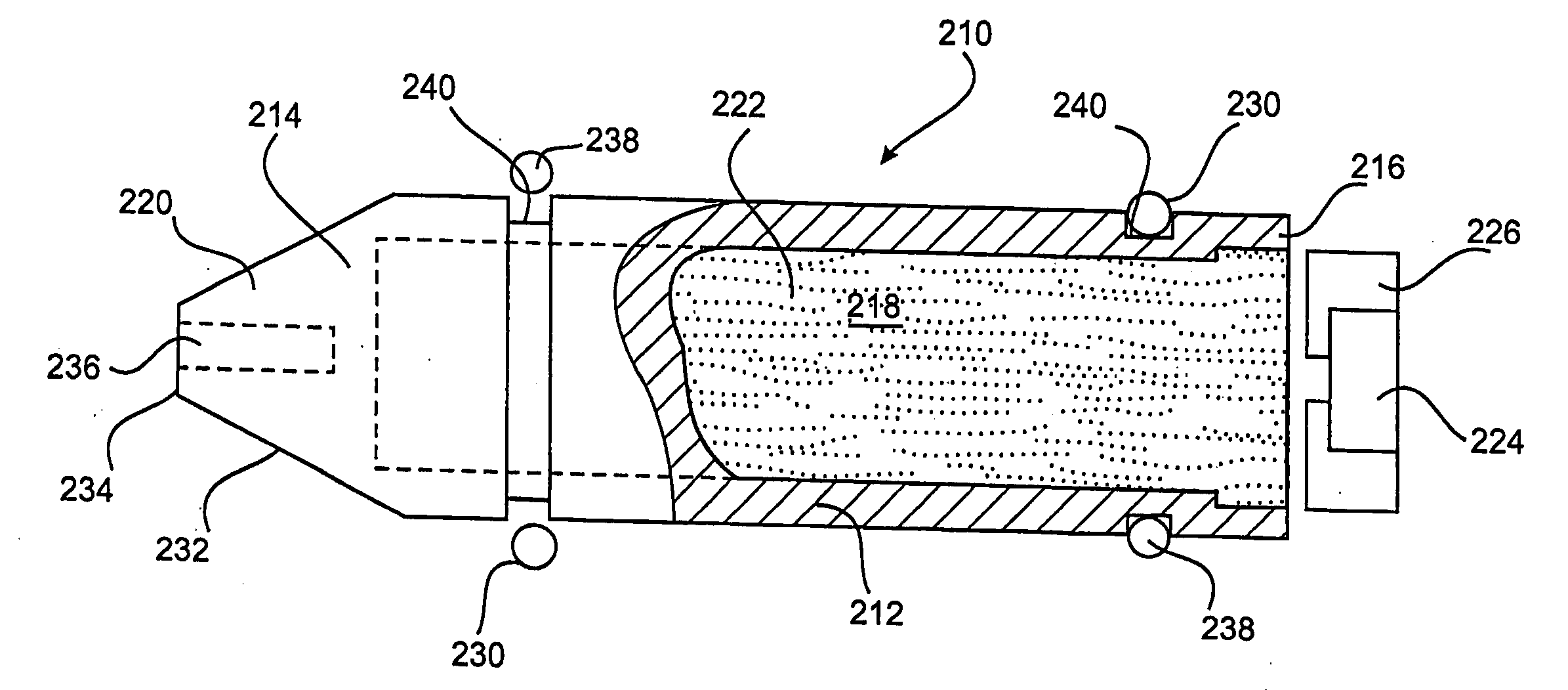
[0084]FIG. 2 shows a projectile 210 according to a The projectile 210 comprises a cylindrical body 212 with axially opposed first and second ends 214, 216 and a cavity 218 there between holding a volume of propellant 218. The first end 214 of the body 212 is closed by an integrally formed nose 220 with a flat leading face 234.
[0085]As with the projectile 10, the nose 220 of the projectile 210 comprises a portion 232 of frusto-conical shape reducing in diameter in a direction from the second end 216 to the first end 214. However projectile 210 differs from projectile 10 by the inclusion of a recess 236 (shown in broken lines) formed in the nose 220, the recess 236 opens onto the leading face 234. The recess 236 can be formed in any conventional manner including for example machining or casting. By virtue of the recess 236, the projectile 210 effectively acts as a “hollow tip” bullet.
[0086]The projectile 210 also differs from projectile 10 by the provision of seals 230 that comprise ...
fourth embodiment
[0094]FIG. 6 shows an end view of the base seal 26 and primer 24 which is used in the embodiments described above. FIG. 7 shows a projectile 410 having the same basic form as earlier embodiments and comprising a cylindrical body 412, opposite first and second ends 414, 416, a cavity 418 holding a volume of propellant 422, an integrally formed nose 420, and a base seal 426 that seals the cavity 418 and supports a primer 424.
[0095]The projectile 410 differs from earlier embodiments by the provision of eight seals 430 which extend about an outer circumferential surface 432 of the body 412 and protrude radially to form a substantial gas seal against an inner circumferential surface of the bore or barrel of the firearm from which the projectile 410 is fired. The seals 430 are arranged as two sets 460, 462 each of four seals 430. One set 462 is adjacent the second end 416 while the second set 460 is formed toward the first end 414 but inboard of the nose 420. In this embodiment, the seal...
fifth embodiment
[0099]FIG. 8 depicts a projectile 510 which is similar to the projectile 210 shown in FIG. 2 and includes the basic features of a body 512, opposite ends 514, 516, an integral nose 520 at end 514, a base seal 526 supporting a primer 524 at end 516, and an internal cavity 518 holding a volume of propellant 522. The projectile further comprises grooves 540 seating seals 530 in the form of individual sealing rings 538.
[0100]However in contrast to the projectile 210, in projectile 510, each ring 538 is hollow and contains a quantity of lubricant material 566. As the projectile 510 is fired through the barrel of a weapon, the rings 538 are deformed by contacting the rifling within the barrel. Lubricant 566 is then discharged from the respective ring 538. The lubricant 566 reduces friction between the projectile 510 and the barrel and can extend the life of the barrel.
[0101]The insert in FIG. 8 shows a ring 538 as the projectile 510 during firing. As shown in the insert, the lubricant 56...
PUM
 Login to View More
 Abstract
Description
Claims
Application Information
 Login to View More