Spreading Codes for A Satellite Navigation System

a satellite navigation and spreading code technology, applied in the direction of instruments, measurement devices, electrical appliances, etc., can solve the problems of ambiguity in the position determination, delay the initial acquisition of signals, and require more processing capability within the receiver, so as to achieve better acquisition properties, good individual properties, and easy acquisition

Active Publication Date: 2009-08-06
THE EURO UNION
View PDF6 Cites 20 Cited by
  • Summary
  • Abstract
  • Description
  • Claims
  • Application Information

AI Technical Summary

Benefits of technology

[0023]The provision of different secondary codes for different satellites has been found to reduce correlation between the codes from the different satellites, and so helps with improved receiver performance. The use of an optimisation process to determine the set of secondary codes offers more flexibility than codes sets based on mathematical algorithms (such as Gold codes), for example in terms of the length of the secondary code, the number of codes available in a set, and the particular properties of the codes.
[0027]In one embodiment, the optimisation process utilises a performance (or cost) function derived from the auto-correlation function for a bit pattern. This can be used to select bit patterns that have good individual properties. A performance or cost function derived from the cross correlation function can then be used to select a group of bit patterns that in combination form a good set of codes. It will be appreciated that minimal side-lobes in the auto-correlation function lead to a better acquisition properties, for example, the signal can be acquired more easily under poor reception conditions, such as indoors and under tree foliage, while minimum cross-correlation with other codes reduces multiple access interference and intra-system noise, thereby increasing the robustness of signal acquisition, tracking, and data demodulation.
[0028]The optimisation process may include a first phase of identifying bit patterns having good individual properties, and a second phase of selecting the set of secondary spreading codes from the identified bit patterns having good individual properties. The number of bit patterns identified as having good individual properties may be significantly higher than the number of satellites in the constellation. For example, the first phase may identify a group of 250 or more bit patterns that have good individual properties. Such a group then provides a good range of choice during the second phase of the optimisation, as well as accommodating potential uses of the codes outside the satellite constellation itself—e.g. in pseudolites, as discussed in more detail below, which can lead to a requirement for a larger number of potential codes.

Problems solved by technology

One reason for this is that the finite length of the spreading code can lead to ambiguity in the position determination.
On the other hand, having a longer repetition length for the spreading code may delay initial acquisition of the signal, as well as requiring more processing capability within the receiver.
The length of the spreading code also impacts the data rate that can be used for the navigation data, since there is normally only one bit of navigation data for each complete spreading code sequence (otherwise the two would interfere).
Although the use of Gold codes is well-established for existing satellite navigation systems, there are some limitations associated with such codes.
In some cases, the limitation on code length for Gold codes has been overcome by using truncated Gold codes, but this truncation has an adverse impact on the mathematical properties of the code set (in terms of the autocorrelation function, etc).
In addition, the cross-correlation properties of Gold codes are not generally optimised for the situation where the polarity of the code changes from one repetition of the code to the next, in accordance with the navigation data that is being transmitted.
This latter problem is exacerbated where the bit rate of the navigation data is relatively high (as for Galileo), since this leads to a significant probability that a spreading code transmission has the opposite polarity from the immediately preceding transmission of the spreading code.
In this situation, if an attempt is made to acquire the second satellite, there is a risk that the correlation against the stronger but incorrect first signal may yield a greater (or similar) result than the correlation against the weaker but correct second signal.
Although any resulting misidentification of the first signal as the second signal will normally be corrected later in a subsequent acquisition phase, this introduces delays, as the acquisition procedure then has to return to the first phase.

Method used

the structure of the environmentally friendly knitted fabric provided by the present invention; figure 2 Flow chart of the yarn wrapping machine for environmentally friendly knitted fabrics and storage devices; image 3 Is the parameter map of the yarn covering machine
View more

Image

Smart Image Click on the blue labels to locate them in the text.
Viewing Examples
Smart Image
  • Spreading Codes for A Satellite Navigation System
  • Spreading Codes for A Satellite Navigation System
  • Spreading Codes for A Satellite Navigation System

Examples

Experimental program
Comparison scheme
Effect test

Embodiment Construction

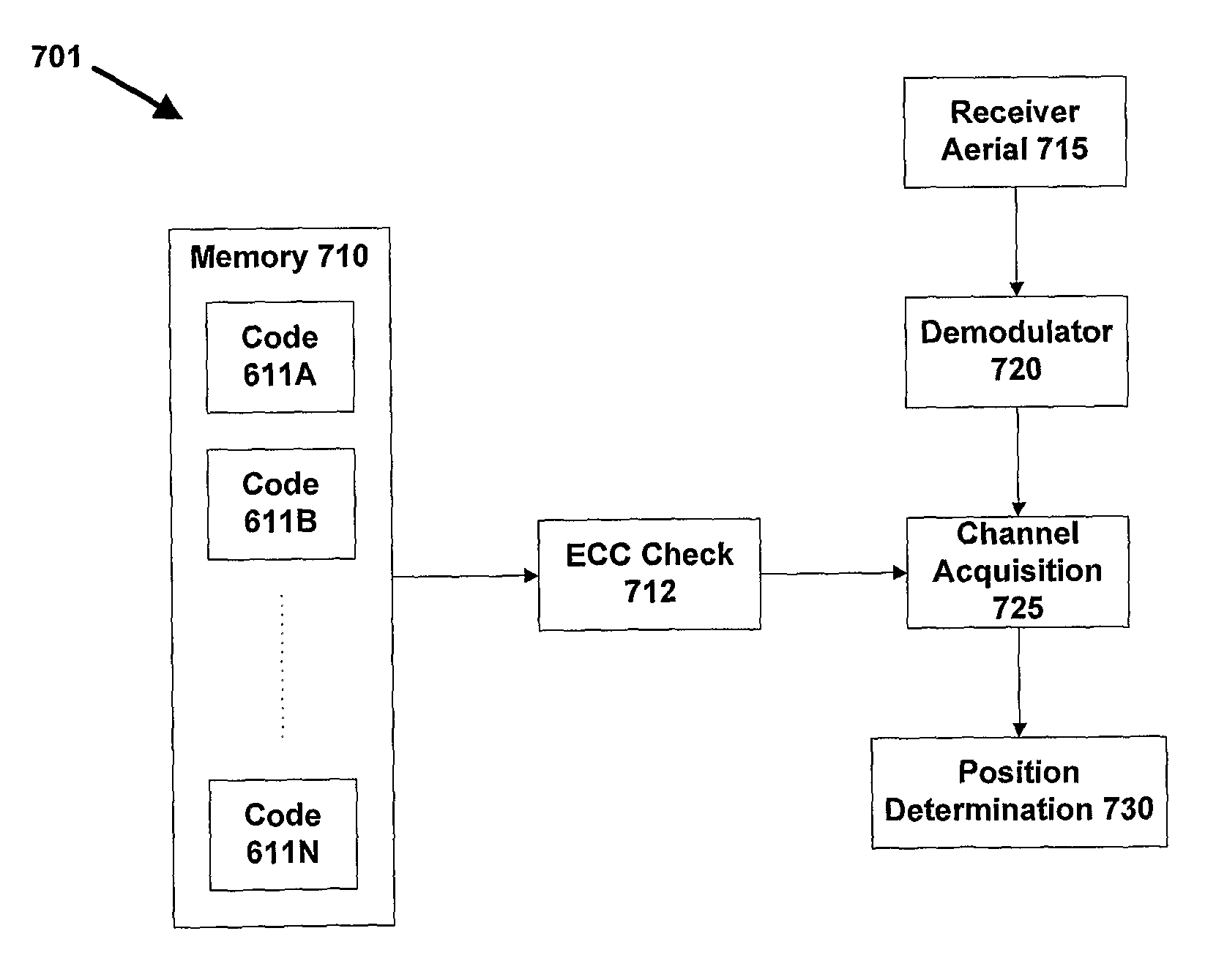
[0053]The following abbreviations are used in the present description:[0054]ACF Auto Correlation Function[0055]BPSK Binary Phase Shift Keying[0056]CCF Cross Correlation Function[0057]CRC Cyclic Redundancy Code[0058]CS Commercial Service[0059]CT Crosstalk[0060]DC Direct Current (zero frequency component)[0061]ECC Error Correcting Code[0062]ELW Excess Line Weight[0063]HNV Highest Neighbour Value[0064]LFSR Linear Feedback Shift Register[0065]MEWSD Mean Excess Welch Square Distance[0066]MP Multipath[0067]NV Neighbour Value[0068]PROM Programmable Read Only Memory[0069]PSK Phase Shift Keying[0070]RMS Root Mean Square[0071]ROM Read Only Memory

[0072]Note also that within this description code sequences are defined for convenience in logic level format (0 and 1); in practice these code sequences are translated to bipolar (±1) signal levels for modulation and correlation purposes. The mapping between the spreading code logic levels and corresponding signal levels in accordance with one embodi...

the structure of the environmentally friendly knitted fabric provided by the present invention; figure 2 Flow chart of the yarn wrapping machine for environmentally friendly knitted fabrics and storage devices; image 3 Is the parameter map of the yarn covering machine
Login to View More

PUM

No PUM Login to View More

Abstract

One embodiment of the invention provides a method of creating a set of secondary spreading codes for use in a satellite navigation system comprising a constellation of satellites. Each satellite in the constellation employs a tiered spreading code comprising at least a primary code and a secondary code. Each satellite in the constellation is allocated a different secondary spreading code from the set of secondary spreading codes. The method involves generating an initial set of bit patterns, where each bit pattern represents a potential secondary spreading code. The method further involves performing an optimisation process on bit patterns within the initial set of bit patterns. As a result of the optimisation, at least some of the bit patterns in the initial set are modified or replaced, to create a final set of bit patterns for use as the set of secondary spreading codes.

Description

FIELD OF THE INVENTION[0001]The present invention relates to the generation and use of spreading codes for a satellite navigation system.BACKGROUND OF THE INVENTION[0002]Satellite navigation systems are becoming increasingly important in a wide range of applications, including handheld devices for position determination, in-car navigation support, and so on. The main satellite navigation system in service at present is the global positioning system (GPS) operated by the United States Department of Defense. Worldwide sales of GPS equipment reached nearly 3.5 billion dollars by 2003, and this figure is expected to grow steadily over the next few years. A European counterpart satellite navigation system, named Galileo, is planned for launch and service availability later this decade.[0003]A satellite navigation system comprises a constellation of satellites that each broadcasts one or more signals to earth. The basic components of a satellite signal are a spreading code (also referred ...

Claims

the structure of the environmentally friendly knitted fabric provided by the present invention; figure 2 Flow chart of the yarn wrapping machine for environmentally friendly knitted fabrics and storage devices; image 3 Is the parameter map of the yarn covering machine
Login to View More

Application Information

Patent Timeline
no application Login to View More
IPC IPC(8): H04B1/707G01S19/02H04J13/00
CPCG01S19/02H04J13/10H04B2201/70715
InventorLEGATE, STEVEBARNES, BRIAN
OwnerTHE EURO UNION