
Semi-insert hearing protector having a helmholtz-type resonator
a hearing protector and helmholtz-type technology, applied in the field of hearing protection devices, can solve the problems of affecting the ear canal, earplugs also tend to impact the ear canal, and become uncomfortable, and achieve the effect of reducing nois
- Summary
- Abstract
- Description
- Claims
- Application Information
AI Technical Summary
Benefits of technology
Problems solved by technology
Method used
Image

Examples
first embodiment
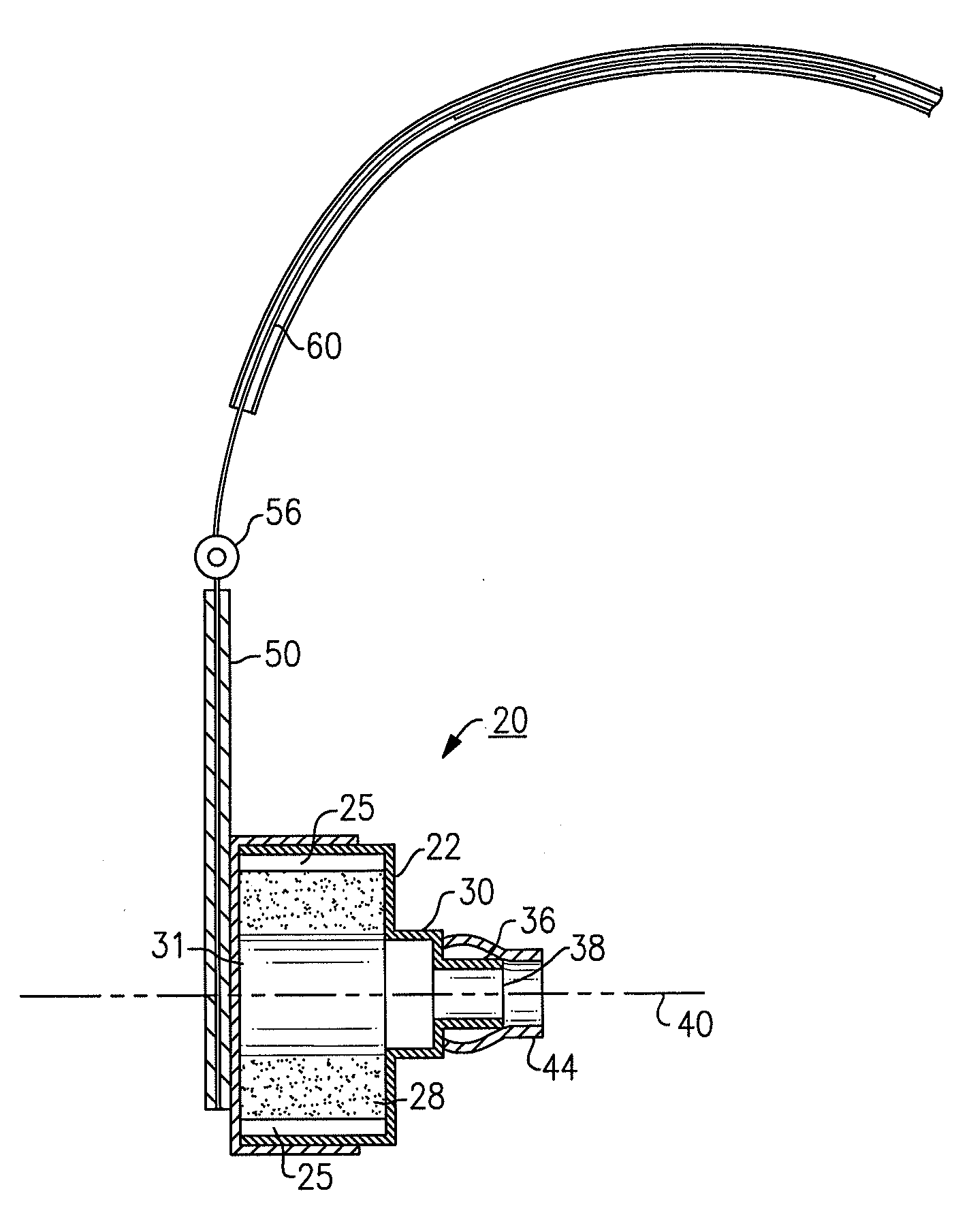
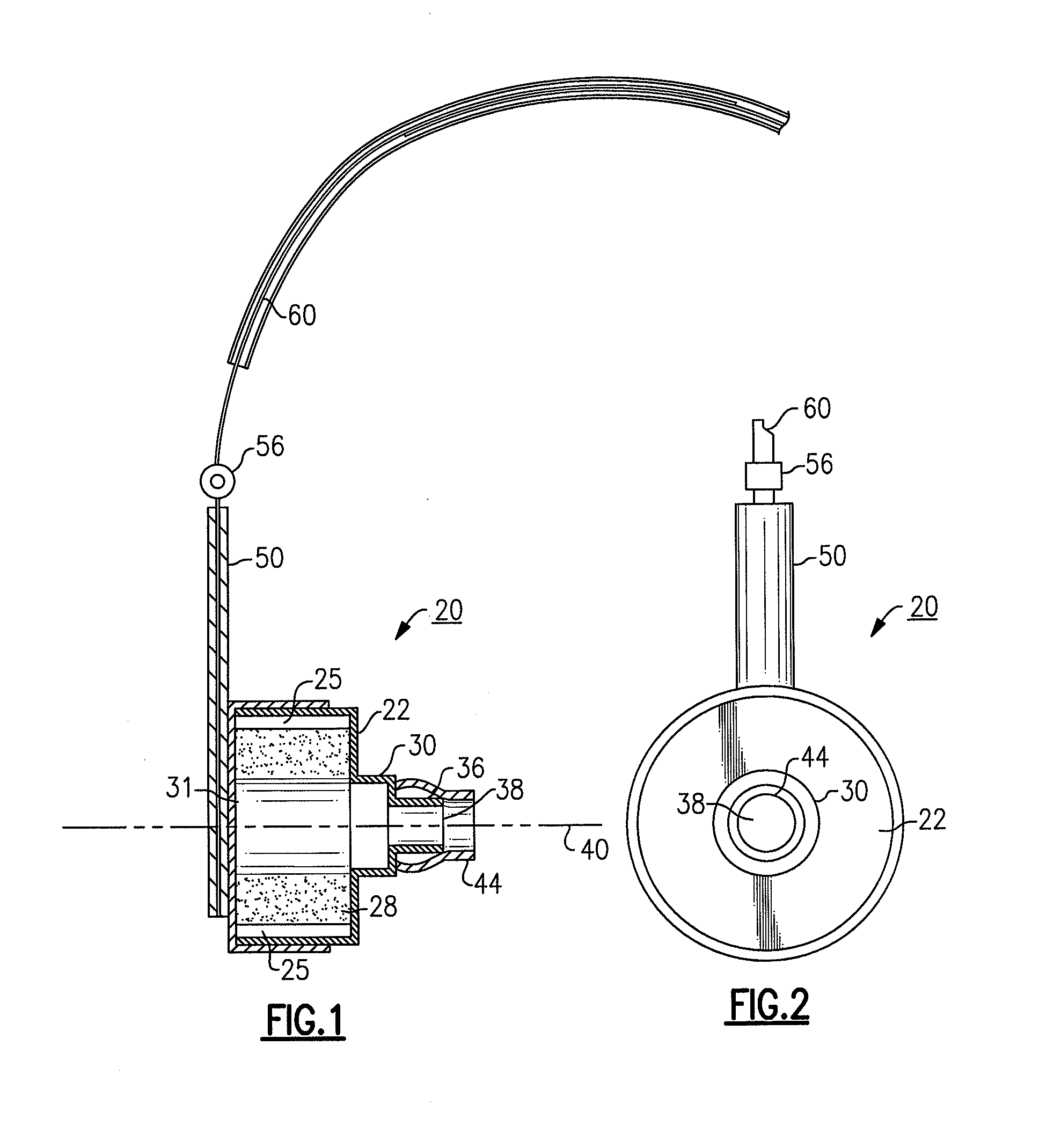
[0027]With the preceding summary, certain preferred embodiments are shown and described according to FIGS. 1-11. Referring to FIGS. 1 and 2, a semi-insert hearing protector is shown, the hearing protector 20 consisting of a substantially cylindrical enclosure 22 consisting of thin walls of a rigid or semi-rigid material, such as polyvinylchloride (PVC). The enclosure 22 can be made as a unitary component or, according to this specific version, from multiple sections. The enclosure 22 is defined by an interior 25 having disposed therein a quantity of sound absorbing material 28, such as an open-cell foam rubber or plastic, the material being provided in an axial tubular-shaped configuration 31. The enclosure 22 further includes an elongated section 30 having a substantially circular, oval or elliptical cross section extending outwardly to a connecting tube 36, also having a circular, oval or elliptical cross section, the tube having an open distal end 38 extending from the interior ...
second embodiment
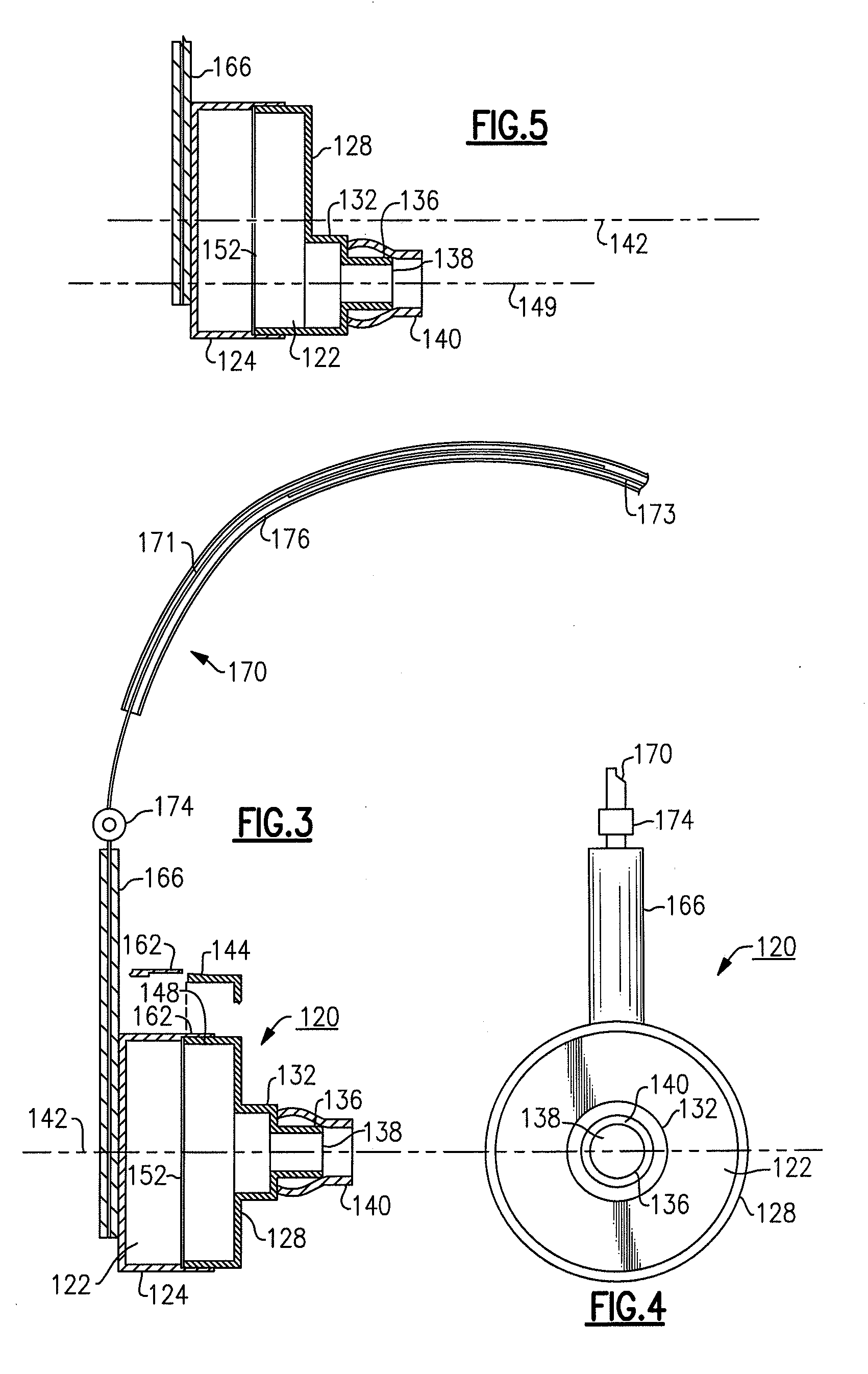
[0031]Referring to FIGS. 3 and 4, there is shown a hearing protector 120 made in accordance with a second embodiment, this version serving as an alternative to that described in FIGS. 1 and 2. According to this design, the hearing protector 120 comprises two nearly equal, overlapping shells, 124 and 128, each of the shells being defined as thin-wall structures and made from a rigid or semi-rigid material that are tightly joined together, thereby defining an enclosure 122. Like the preceding design, one of the shells 128 includes an elongated portion 132 having a substantially circular, elliptical or oval cross section that extends outwardly to a tube 136, also having a circular, elliptical or oval cross section, the tube being designed for connection to the ear canal (not shown) through a resilient exterior cuff 140. According to this embodiment, a joint 144 formed between the two shells 124, 128 of the enclosure 122 is provided with a narrow annular shelf 148 that permits the place...
PUM
 Login to View More
 Abstract
Description
Claims
Application Information
 Login to View More