
Variable spectral phase encoder/decoder based on decomposition of hadamard codes
a spectral phase encoder and variable spectral phase technology, applied in the field of optical communication, can solve the problems of difficult for one party in a conversation to hear the other party, the conversation will drown out the other conversation, and the number of users is quite limited in fdma and tdma data rates
- Summary
- Abstract
- Description
- Claims
- Application Information
AI Technical Summary
Problems solved by technology
Method used
Image

Examples
Embodiment Construction
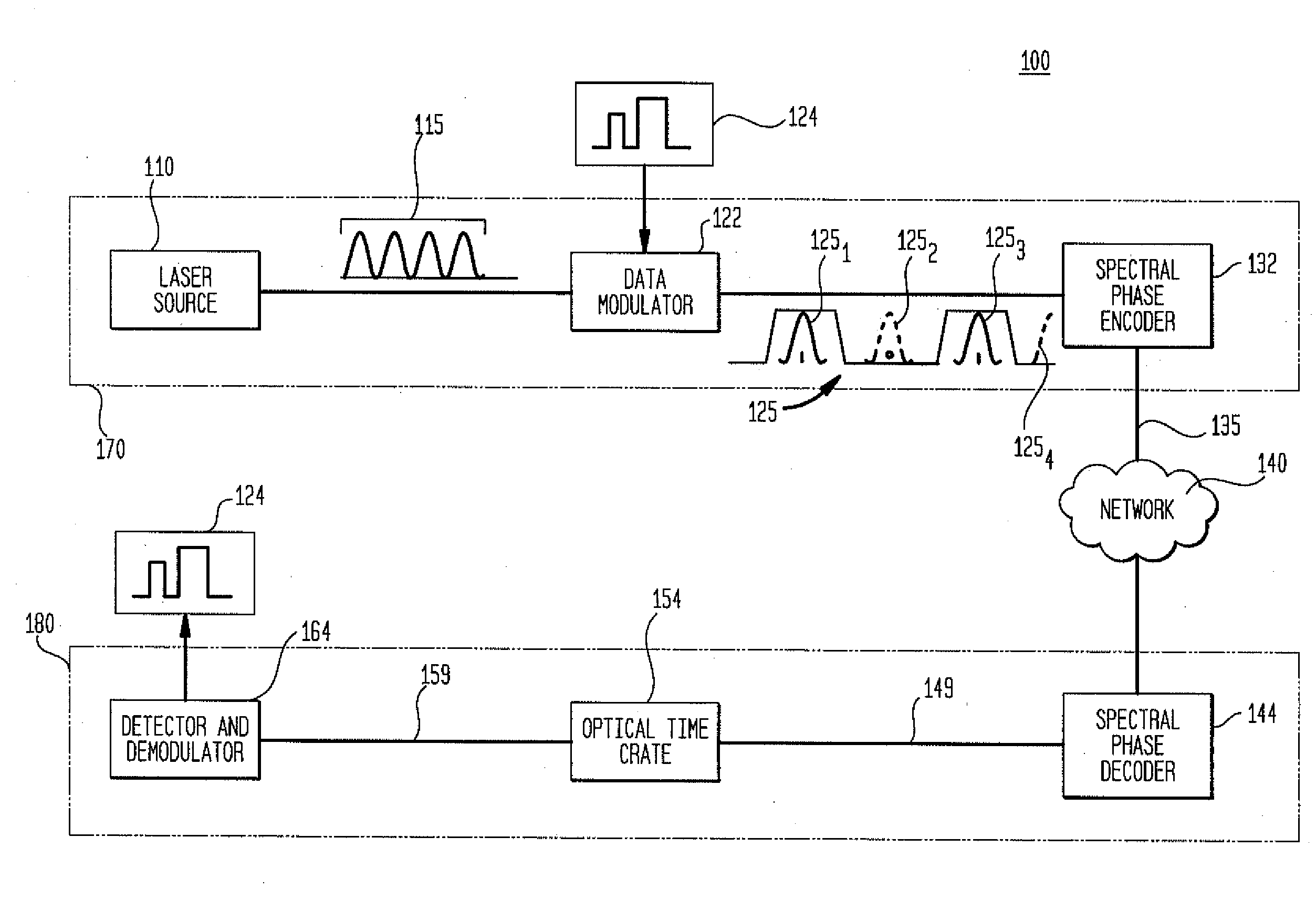
[0034]FIG. 1 illustratively depicts a system 100 in accordance with an aspect of the present invention. The system comprises a laser source 110 that generates a sequence of optical pulses 115 that are fed to a data modulator 120. The data modulator 122 also receives a data stream 122 that is used to modulate the sequence of optical pulses 115. The modulation data preferably comprises a digital data stream generated by a subscriber or user station 124. In a preferred embodiment, the data modulator 122 comprises an ON / OFF keyed data modulator wherein a “1” symbol or bit in the digital data stream corresponds to the presence of an optical pulse and a “0” symbol or bit corresponds to the absence of an optical pulse. In this way, each pulse represents a bit of information. For example, a modulated stream 125 is shown where the digital data stream comprises a “1010” data sequence. As shown, each time slot with the bit “1” will result in the presence of an optical pulse (1251 and 1253), wh...
PUM
 Login to View More
 Abstract
Description
Claims
Application Information
 Login to View More