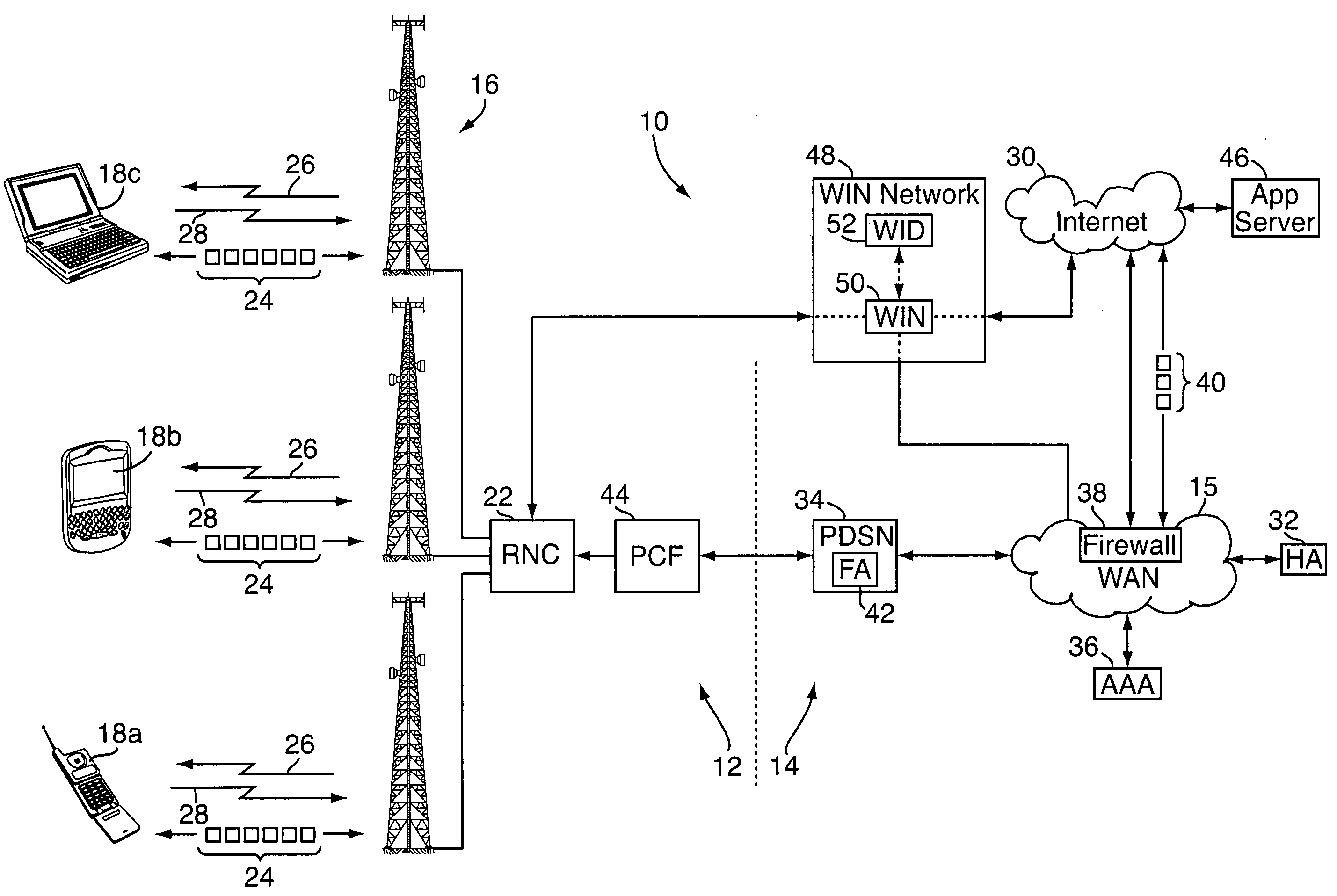
[0011]An embodiment of the present invention relates to a method and
system for packet delivery from an
application server to a mobile
client in a
wireless network, e.g. for reducing network resource overload caused by chatty applications. The
wireless network includes one or more base stations and one or more upstream network entities, e.g., a
radio network controller (“RNC”), connected to the
base station(s). The upstream network entities include necessary components (e.g., a
packet data serving node (“PDSN”)) to enable communication between an
application server connected to
the Internet and the
end user mobile clients. The
base station wirelessly communicates with a set of distributed
end user mobile clients, e.g., mobile phones. The RNC (or other upstream network entity) acts as an interface between the
base station and the upstream portion of the network. Thus, during communication, as the RNC receives data flows from an
application server designated for transmission to the
end user mobile clients, the data flows are transmitted to the base
station. (A “flow” is a uniquely defined
stream of data packets between a
source address / port and a destination address / port, wherein the packets are generated according to the same protocol.) The data flows over the RAN typically include tunneled or encrypted data packets, and therefore, it is very difficult for the RAN itself to inspect the data packets flowing through. The network additionally includes a wireless information node (“WIN”) network having at least one wireless information node and at least one wireless information
database. The WIN network is connected to the RAN network such that the WIN network is capable of detecting an element of the RAN network servicing the mobile
client, e.g. the RNC or base
station with which the mobile client is wirelessly communicating. Additionally, the WIN network is adapted for connection to the application
server, e.g. information may be transmitted between the WIN network and the application
server. Since the WIN network is connected to both the RAN network and the application server, the WIN network provides linkage between the IP data flows and the RAN elements or nodes that are delivering the flows to the mobile client, thereby eliminating the need for the RAN to inspect the data packets flowing through the RAN network.
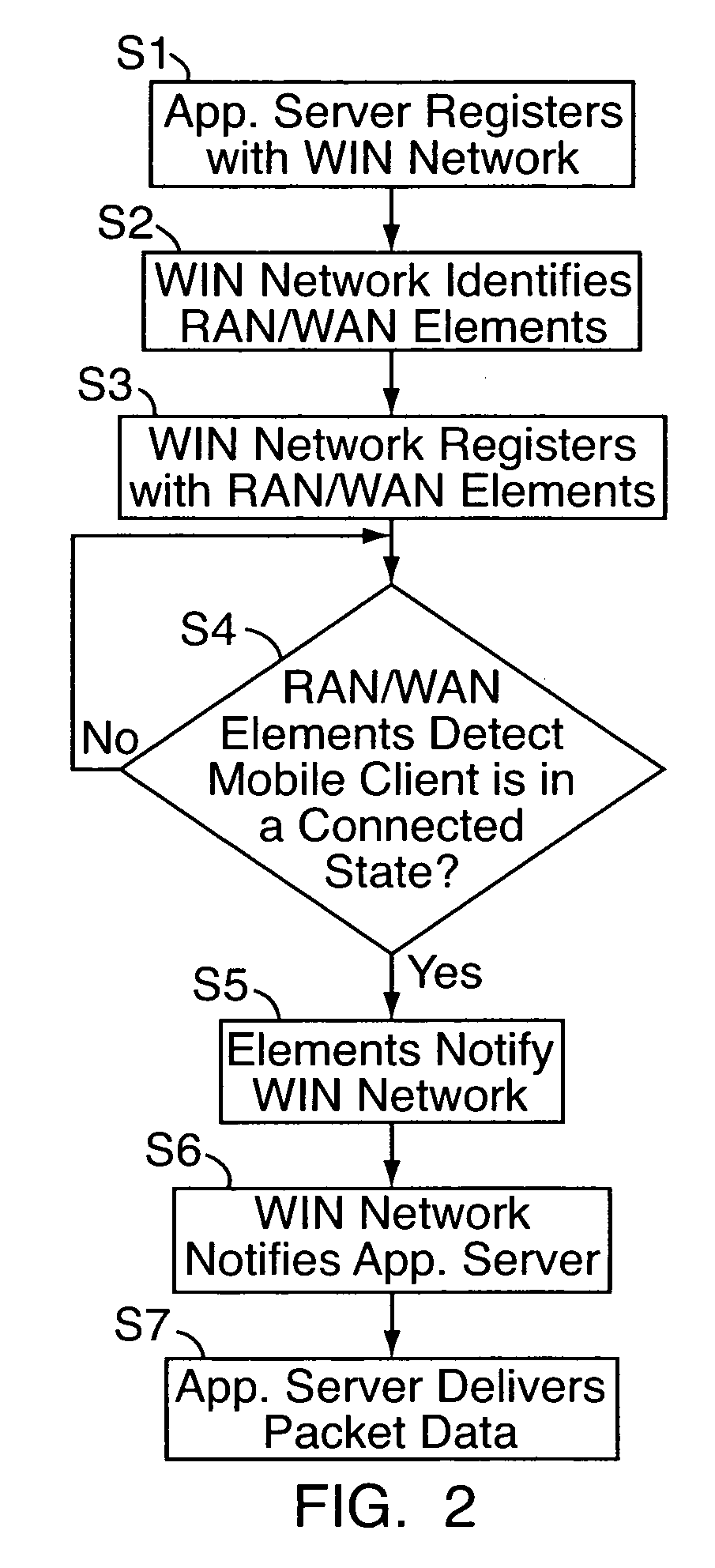
[0012]In operation, an application server registers with the WIN network to be notified when the mobile client with which communication is desired transitions to or from a connected state, e.g. from an idle state to a connected state. The WIN network detects the element(s) in the RAN network serving the mobile client and subscribes with the element(s) to be notified when the connection state changes. The element(s) serving the mobile client detects the connection state of the mobile client and notifies the WIN network of a change in the connection state of the mobile client, e.g. from idle to connected. The WIN network in turn notifies the application server of the change in the connection state of the mobile client, whereby the application server delivers packets to the mobile client upon notification of a connected state at the application server. Since the WIN network is connected to both the RAN network and the application server, the WIN network eliminates the need for the RAN to inspect the data packets flowing through the RAN network because the WIN network provides a linkage between the IP data flows and the RAN elements or nodes that are delivering the flows to the mobile client.
[0013]In another embodiment, the RAN network automatically delays
paging to initiate delivery of network initiated non-latency sensitive data, e.g. the data from an application server having
Quality of Service (“QoS”) requirements that allow the data to be delivered in the background. An application server registered with the WIN network may bypass the automatic
delay by sending a page request to the WIN network, the WIN network triggering
paging upon
receipt of the page request.


 Login to View More
  Login to View More