

Memory Access Control Device, Memory Access Control Method, Data Storage Method and Memory Access Control Program
a memory access control and memory control technology, applied in the direction of instruments, data conversion, generating/distributing signals, etc., can solve the problems of data other than the desired one being unnecessarily accessed at the same time, affecting the efficiency of access, so as to achieve the effect of significantly reducing the number of accesses to data other than the target data and improving memory access efficiency
- Summary
- Abstract
- Description
- Claims
- Application Information
AI Technical Summary
Benefits of technology
Problems solved by technology
Method used
Image

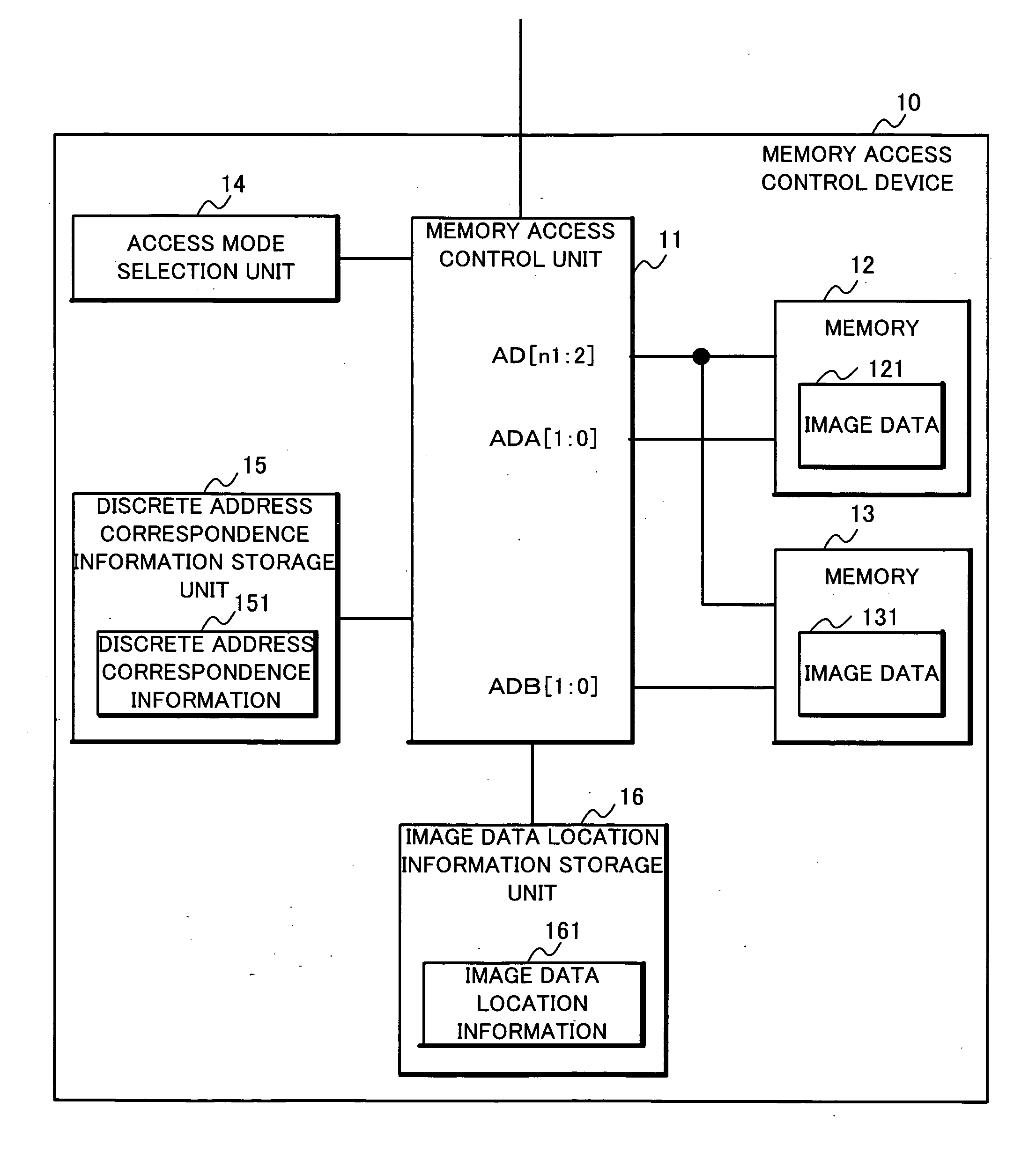


Examples
second exemplary embodiment
Effects of Second Exemplary Embodiment
[0172]According to this exemplary embodiment, even if the bus width per memory for the memories 12, 13 is increased to 16 bits from 8 bits as in the first exemplary embodiment, the effects similar to the first exemplary embodiment can be achieved by storing data of a plurality of laterally consecutive pixels at each address of the memories.
Third Exemplary Embodiment
[0173]This exemplary embodiment differs from the first exemplary embodiment in that each block is configured with two pixels by two lines (2×2) instead of two pixels by four lines (2×4) as in the first exemplary embodiment. Differences of this exemplary embodiment from the first exemplary embodiment will be described below.
Configuration of Third Exemplary Embodiment
[0174]FIG. 16 is a diagram which illustrates image data location information 161 according to this exemplary embodiment.
[0175]Similarly to the first embodiment, the memories 12, 13 according to this exemplary embodiment r...
third exemplary embodiment
Effects of Third Exemplary Embodiment
[0180]According to this exemplary embodiment, it is possible to achieve the same effects as the first exemplary embodiment, except that the mode to access two pixels on two vertically (longitudinally) alternate lines at a time is not available for selection.
fourth embodiment
[0181]This exemplary embodiment is a variation of the second embodiment. Differences of this exemplary embodiment from the second exemplary embodiment will be described below.
Configuration of Fourth Exemplary Embodiment
[0182]FIG. 20 is a diagram which illustrates image data location information 161 according to this exemplary embodiment.
[0183]Similarly to the second embodiment, the memories 12, 13 according to this exemplary embodiment respectively store image data of 1024 pixels by 1024 lines shown in FIG. 2 in the arrangements shown in FIGS. 21 and 22, based on the image data location information 161 shown in FIG. 20.
[0184]FIG. 21 is a diagram which shows example data (arranged image data 121) stored in the memory 12. FIG. 22 is a diagram which shows example data (arranged image data 131) stored in the memory 13.
[0185]If we assume that the lowest bit on the x coordinate is “a,” and that the lowest two bits on the y coordinate is “b,” the information contained in this particular b...
PUM
 Login to View More
 Abstract
Description
Claims
Application Information
 Login to View More