This installation and configuration process adds a degree of complexity and work to end-users who may otherwise spend their time doing other productive or enjoyable work.
Moreover, many unsophisticated users may be discouraged from adding new peripherals (e.g., printers, scanners, etc.) to their home computers or networks to avoid the inconvenience of installation and configuration.
In addition, conventional output or printing methods may
pose significantly higher challenges and difficulties for
mobile device users than for home and office users.
It is usually not a viable option given the hundreds, or even thousands of printer models in use, and the limited storage, memory space, and
processing power of the information apparatus.
Moreover, the user may not want to be bothered with looking for a driver or downloading it and installing it just to print out or display one page of email at the airport.
This is certainly an undesirable and discouraging process to promote pervasive or
mobile computing.
Another challenge for mobile users is that many mobile information apparatuses have limited memory space,
processing capacity and power.
These limitations are more apparent for small and low-cost mobile devices including, for example, PDAs, mobile phones, screen phones, pagers, e-books, Internet Pads, Internet appliances etc.
Limited memory space poses difficulties in installing and running large or complex printer or device drivers, not to mention multiple drivers for a variety of printers and output devices.
Slow
processing speed and limited power supply create difficulties driving an output device.
For example, processing or converting a
digital document into output data by a small mobile information apparatus may be so slow that it is not suitable for productive output.
Intensive processing may also drain or consume power or battery resources.
Therefore, a method is needed so that a small
mobile device, with limited processing capabilities, can still reasonably output content to various output devices.
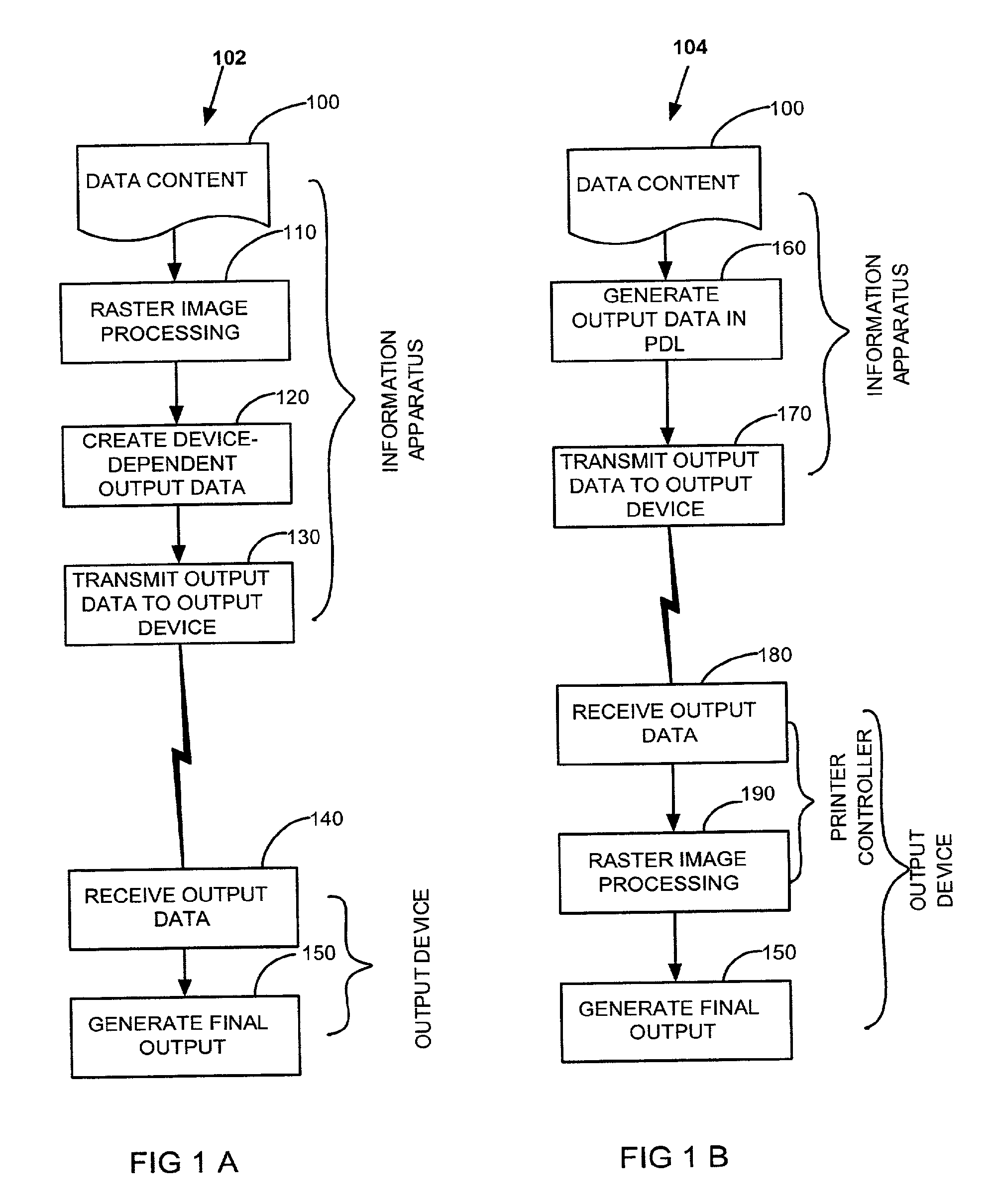
Halftoning operations such as
error diffusion can be computationally intensive and are included when the output device's bit depth (e.g. bits per pixel) is smaller than the input raster image bit depth.
One drawback for the data output method 102 of FIG. 1A is that the information apparatus performs most if not the entire
raster image processing operations 110 required for output.
The RIP operations may require intensive computation.
Many information apparatus such as mobile
information device might have insufficient computing power and / or memory to carry out at an acceptable speed the RIP operations 110 required in an output process.
Another drawback for the conventional data output method 102 of FIG. 1A is that the generated output data is device dependent and therefore is typically not very portable to other output devices.
As a result, the information apparatus may need to install
multiple applications or device drivers for multiple output devices, which may further complicate its feasibility for use in information apparatuses with limited memory, storage and processing power.
These drawbacks are especially apparent for
mobile computing devices with limited processing power and memory.
One such drawback is that the output data or print data, which include a
page description language (PDL) such as PostScript or PCL, can be very complex.
Furthermore, interpreting, decoding and then
raster image processing complex PDL can increase computation, decrease printing speed, and increase the cost of the output device or its printer controller.
Another drawback is that the output data that includes PDL can creates a very large
file size that would increase memory and storage requirements for the information apparatus, the output device and / or the printer controller etc.
Large
file size may also increase the bandwidth required in the
communication link between the information apparatus and the output device.
When a special
font or international characters is not included or missing in the printer controller, the rendering or output can potentially become inaccurate or inconsistent.



 Login to View More
  Login to View More