Process demand prediction for distributed power and resource management

US20100191854A1Active Publication Date: 2010-07-29VMWARE INC
21 Cites 164 Cited by

Patent Information

Authority / Receiving Office
US · United States
Current Assignee / Owner
Publication Date
2010-07-29

Smart Images

  • Figure 1
    Figure 1
  • Figure 2
    Figure 2
  • Figure 3
    Figure 3
Patent Text Reader

Abstract

Methods and systems for allocating resources in a virtual desktop resource environment are provided. A method includes making a prediction on the future demand for processes running on a distributed environment with several hosts. The prediction is based on the process demand history and includes the removal of historic process demand glitches. Further, the prediction is used to perform a cost and benefit analysis for moving a candidate process from one host to another, and the candidate process is moved to a different host when the cost and benefit analysis recommends such move. In another embodiment, the predictions on future process demand are used for distributed power management by putting hosts in stand-by mode when the overall demand decreases or by adding hosts to the distributed environment when the load increases.
Need to check novelty before this filing date? Find Prior Art

Description

CROSS REFERENCE TO RELATED APPLICATIONS

[0001] This application is related to U.S. patent application Ser. No. 11 / 735,929, filed Apr. 16, 2007, and entitled “Method and system for determining a cost-benefit metric for potential virtual machine migrations.”BACKGROUND

[0002] 1. Field of the Invention

[0003] The present invention relates to methods for allocating resources in a virtual desktop environment.

[0004] 2. Description of the Related Art

[0005] The computing industry has seen many advances in recent years, and such advances have produced a multitude of products and services. Computing systems have also seen many changes, including their virtualization. Virtualization of computer resources generally involves the abstraction of computer hardware, which essentially isolates operating systems and applications from underlying hardware. Hardware is therefore shared among multiple operating systems and applications each isolated in corresponding virtual machines. The result of virtualization i...

Examples

Embodiment Construction

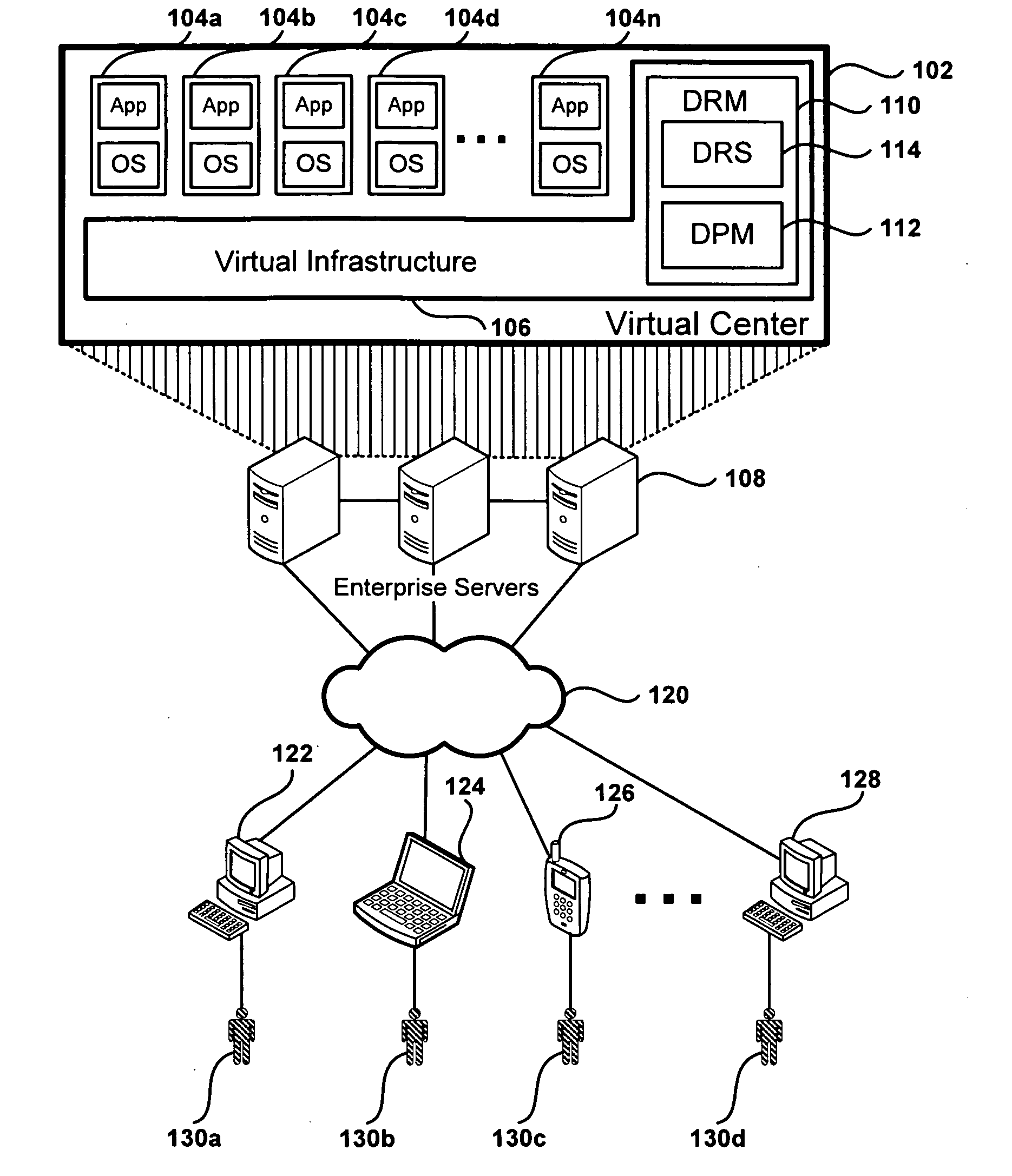
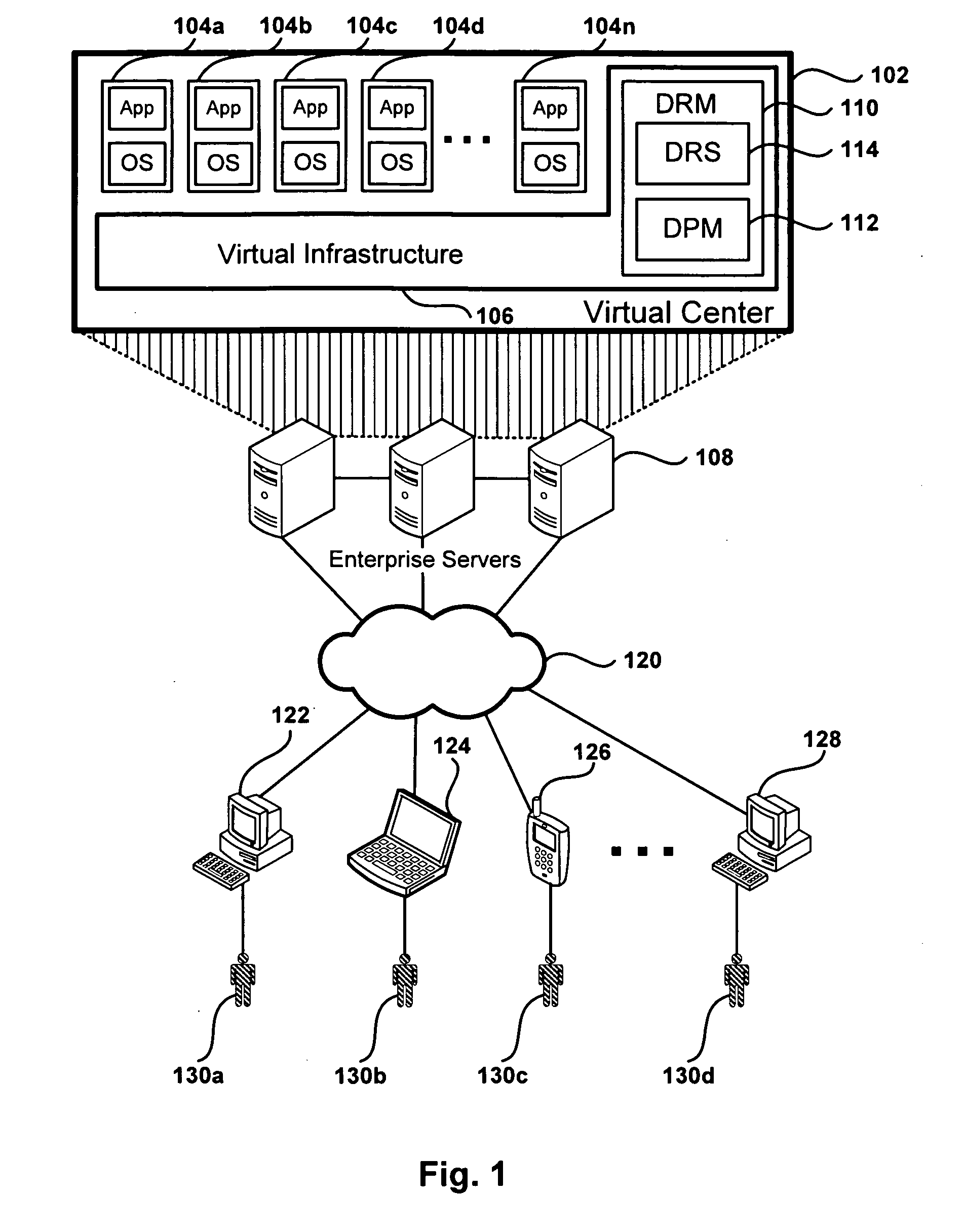
[0024]FIG. 1 depicts a remote desktop environment including virtual machine servers, according to one embodiment. The environment depicted in FIG. 1 includes enterprise servers 108, also referred to herein as hosts, that provide virtual desktop services to remote users 130a-d. Although embodiments of the present invention are described within a virtual desktop system, the embodiments presented can be used in other environments where several servers are used to support multiple clients which can be serviced by any of the servers. Some embodiments below are described with respect to virtual machines (VM), but the same principles apply to all kinds of processes running on a multi-host environment

[0025]The architecture of Virtual Center 102 is shown in FIG. 1, with some components omitted for simplification purposes. Virtual Center 102 includes virtual machines 104a-n, and virtual infrastructure 106. Virtual infrastructure 106 manages the assignment of virtual machines (VM) 104a-n to re...