
Method and device for measuring a sample in an NMR spectrometer using a coupling configuration with a press fit cell having a capillary envelope fastener
a coupling configuration and nmr spectrometer technology, applied in the direction of geological measurements, component separation, reradiation, etc., can solve the problems of inability to measure samples in a spectrometer, high mounting cost, time-consuming, etc., and achieve good elastic deformation properties, prevent inadvertent contact with users, and easy perception of the overall capillary
- Summary
- Abstract
- Description
- Claims
- Application Information
AI Technical Summary
Benefits of technology
Problems solved by technology
Method used
Image

Examples
Embodiment Construction
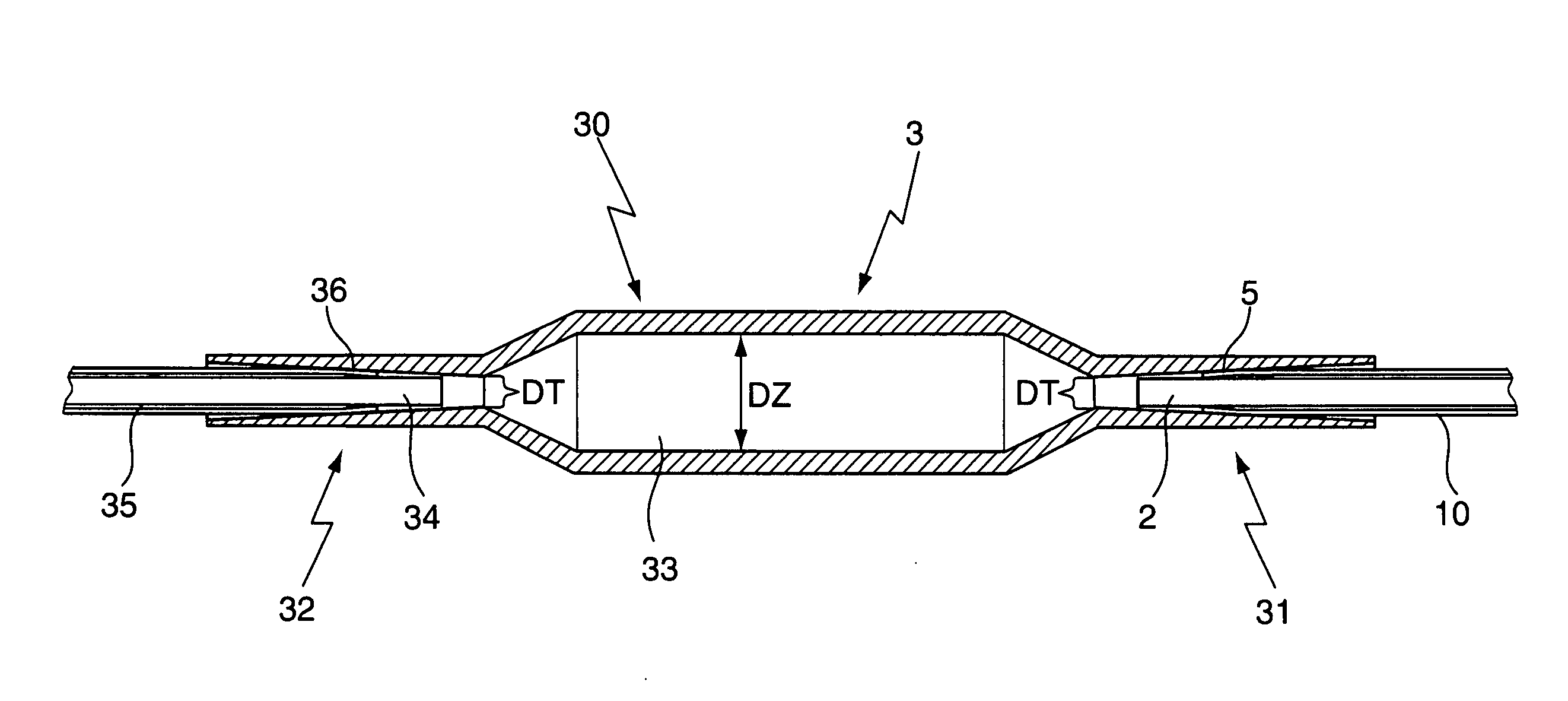
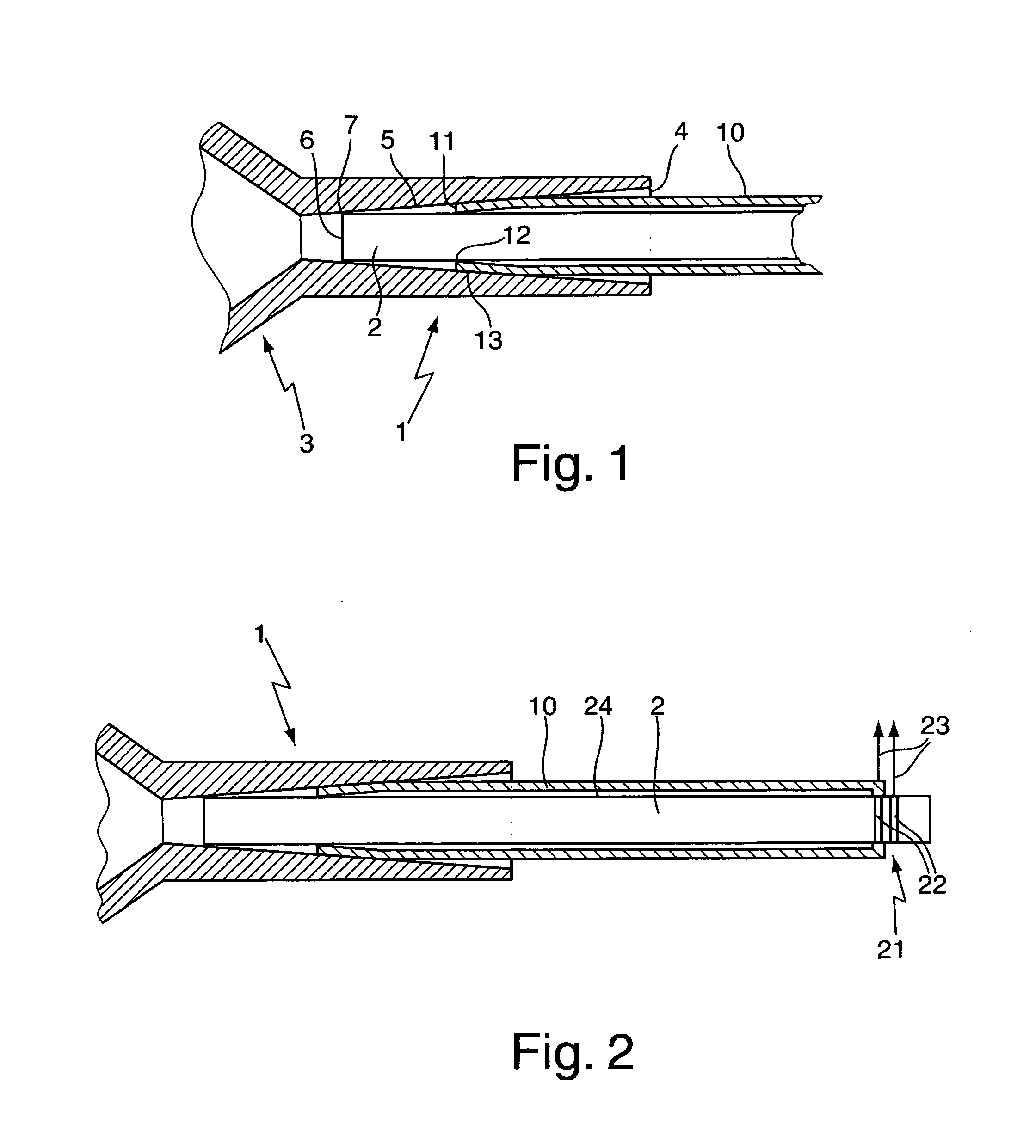
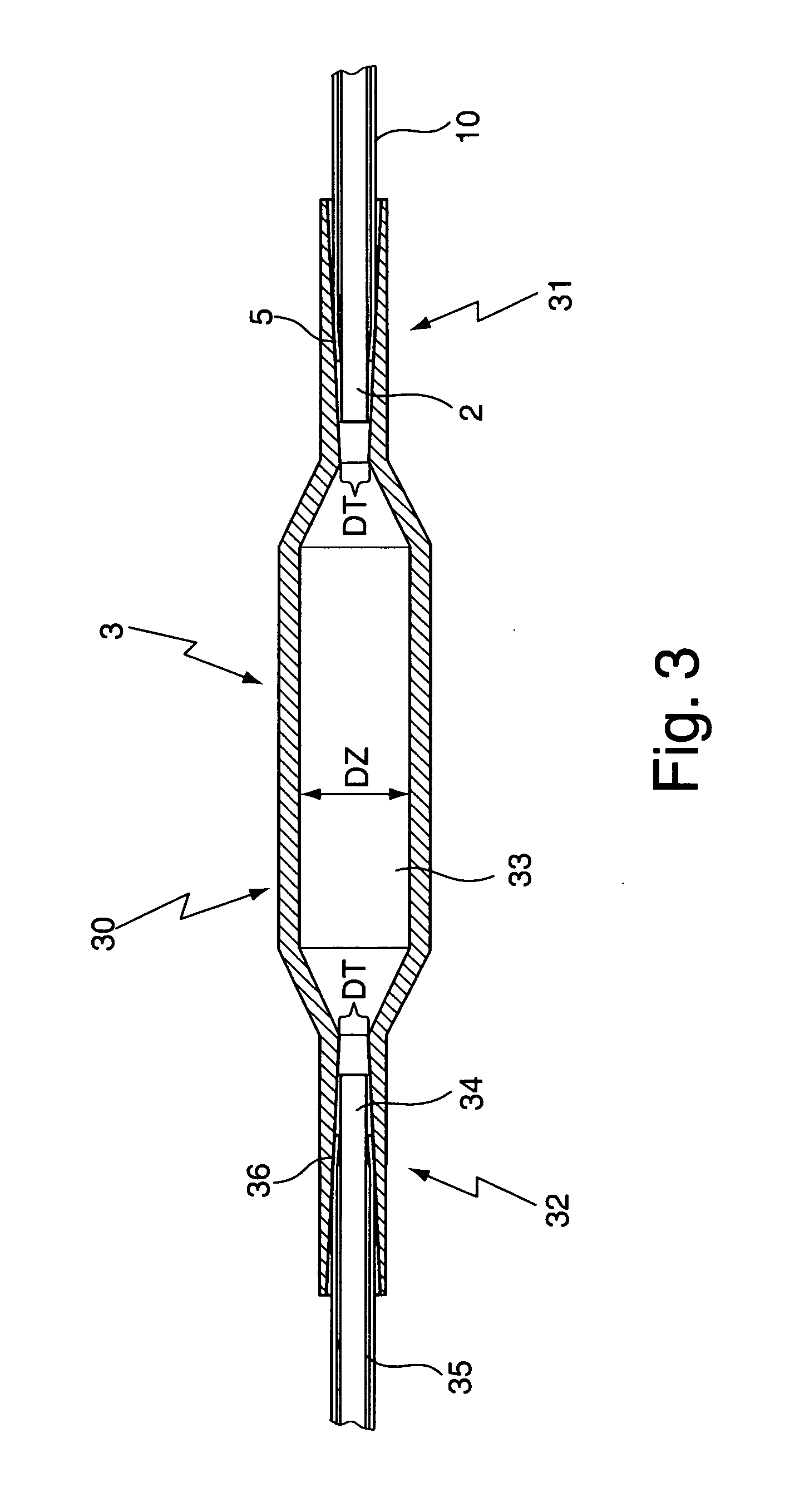
[0032]FIG. 1 shows a schematic cross-section through an inventive coupling configuration 1. The coupling configuration 1 comprises a supply capillary 2 and a coupling element 3 (marked with hatched lines) to which the supply capillary 2 is connected, and an envelope capillary 10 which surrounds the supply capillary 2 and is also connected to the coupling element 3.
[0033]The coupling element 3 has an opening 4 which merges into a funnel-shaped section 5. The funnel-shaped section 5 conically tapers from the opening 4, wherein the inner diameter linearly decreases with increasing depth (the funnel-shaped section 5 is therefore suitable for clamping a plurality of capillary diameters). Alternatively, the funnel-shaped section may also have a different tapering geometry.
[0034]The supply capillary 2 has been inserted and pressed into the funnel-shaped section 5 (in the present case towards the left, into the funnel-shaped section 5) such that an end 6 of the supply capillary 2 is clamped...
PUM
 Login to View More
 Abstract
Description
Claims
Application Information
 Login to View More