GNSS Signal Processing Methods and Apparatus with Geometric Filter

a signal processing and geometric filter technology, applied in satellite radio beaconing, measurement devices, instruments, etc., can solve the problems of not providing all free-to-air, lagging galileo launch schedule, etc., and achieve the effect of improving ambiguity estimation and improving the processing of gnss signals

US20110267228A1Active Publication Date: 2011-11-03TRIMBLE NAVIGATION LTD
2 Cites 36 Cited by

Patent Information

Authority / Receiving Office
US · United States
Patent Type
Applications(United States)
Current Assignee / Owner
Publication Date
2011-11-03

Smart Images

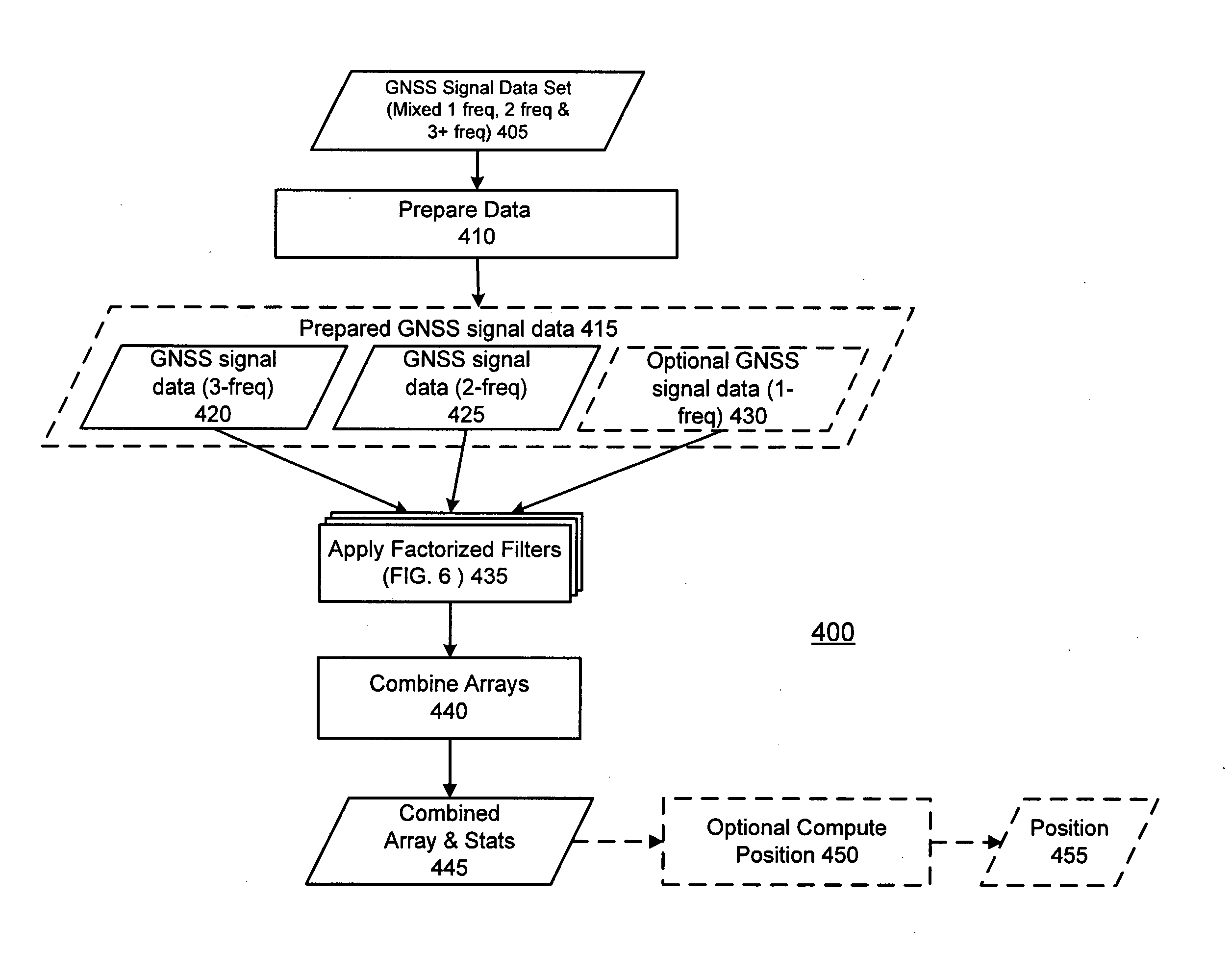
  • Figure 1
    Figure 1
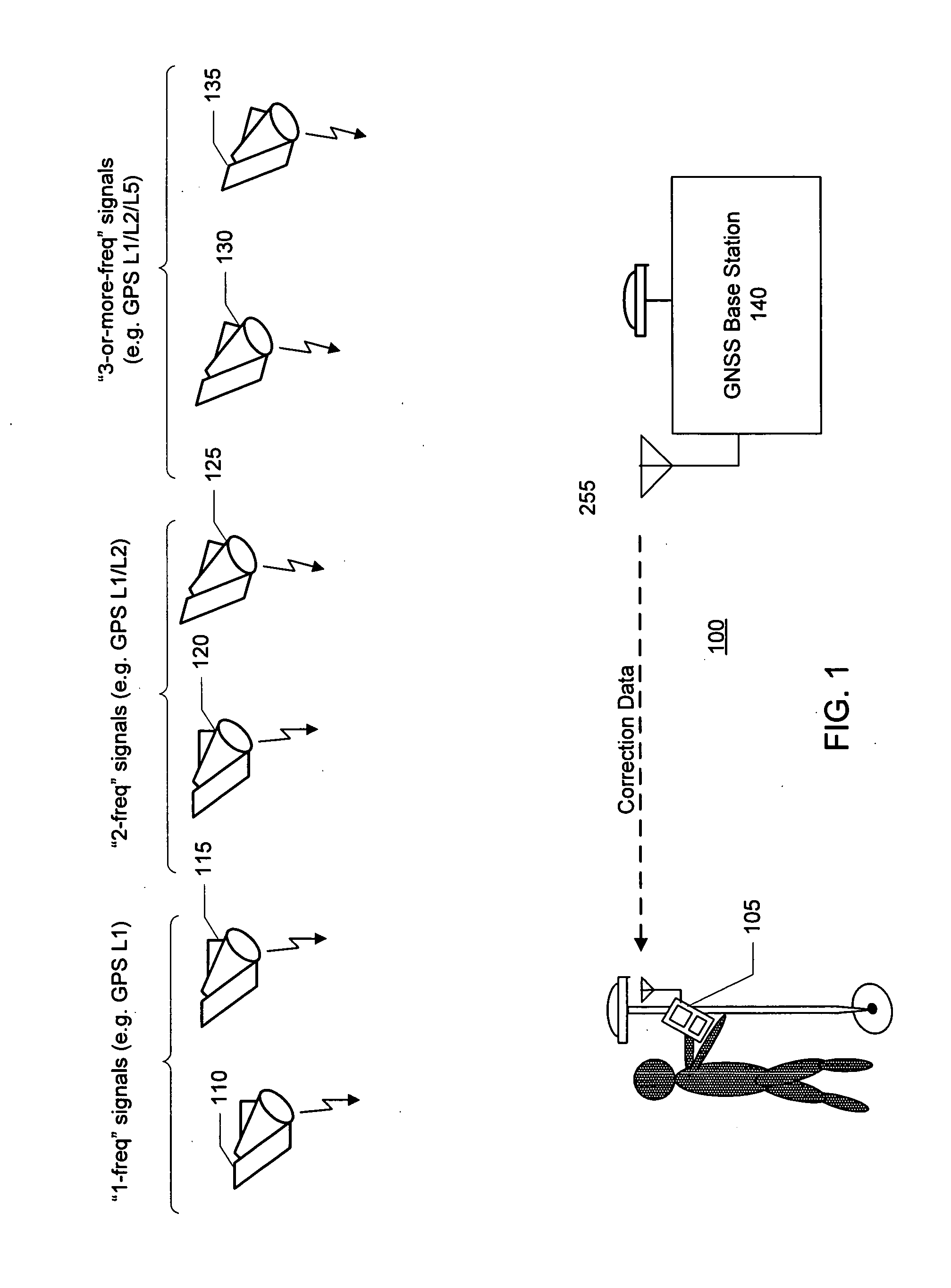
  • Figure 2
    Figure 2
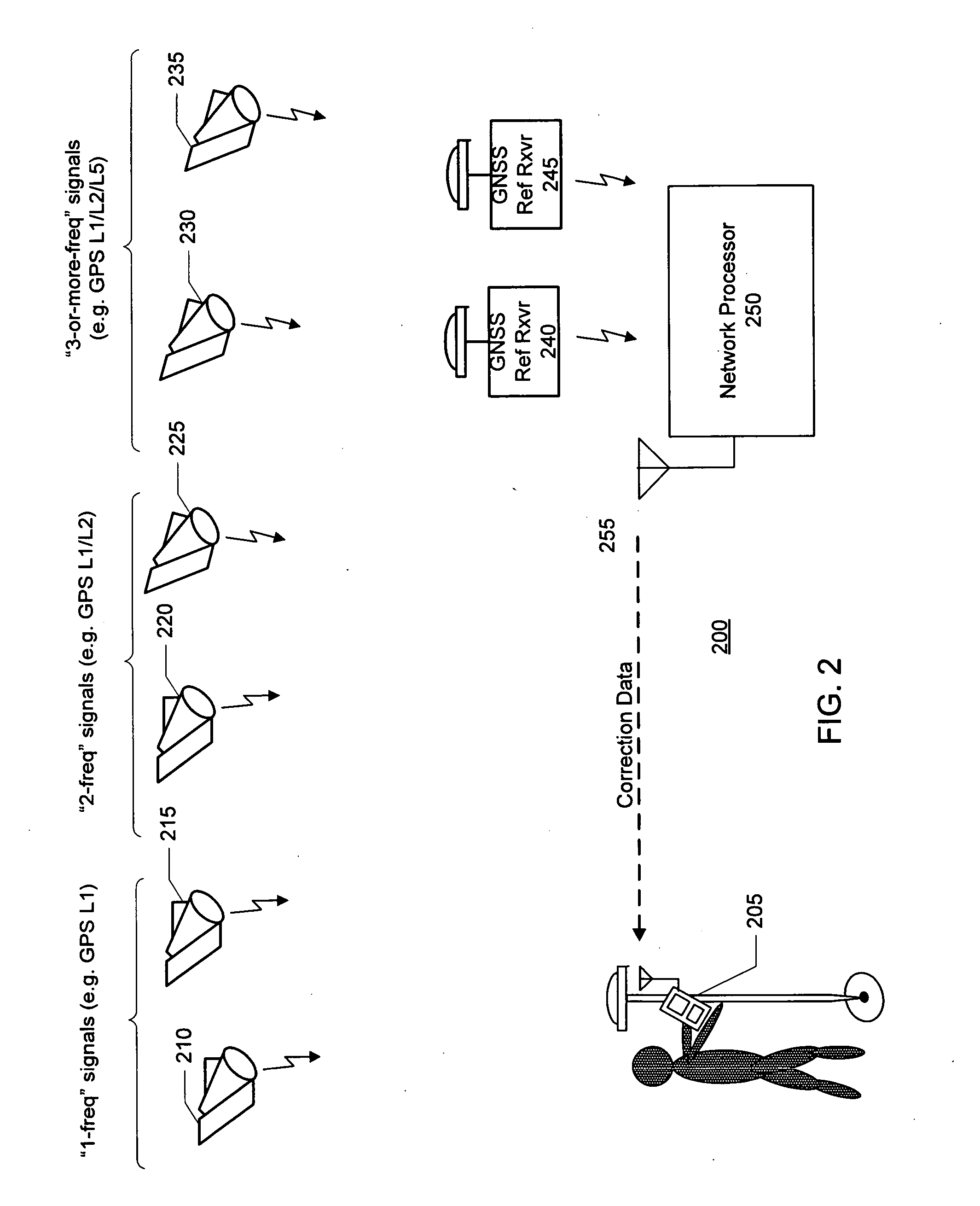
  • Figure 3
    Figure 3
Patent Text Reader

Abstract

Methods and apparatus are provided for processing a set of GNSS signal data derived from signals of a first set of satellites having at least three carriers and signals of a second set of satellites having two carriers. A geometry filter uses a geometry filter combination to obtain an array of geometry-filter ambiguity estimates for the geometry filter combination and associated statistical information. Ionosphere filters use a two-frequency ionospheric combination to obtain an array of ionosphere-filter ambiguity estimates for the two-frequency ionospheric combinations and associated statistical information. Each two-frequency ionospheric combination comprises a geometry-free two-frequency ionospheric residual carrier-phase combination of observations of a first frequency and observations of a second frequency. Auxiliary ionosphere filters use an auxiliary ionospheric combination to obtain an array of auxiliary-ionosphere-filter ambiguity estimates for the auxiliary ionospheric combinations and associated statistical information. Each auxiliary ionospheric combination uses carrier-phase observations of a third frequency and carrier-phase observations of at least one of the first frequency and the second frequency. A combined array of ambiguity estimates is prepared for all carrier phase observations and associated statistical information by combining the arrays of the geometry filter and the ionosphere filters and the auxiliary ionosphere filters.
Need to check novelty before this filing date? Find Prior Art

Description

CROSS REFERENCE TO RELATED APPLICATIONS

[0001] The content of U.S. Pat. No. 7,432,853, VOLLATH U., “Ambiguity Estimation of GNSS Signals for Three or more Carriers,” is incorporated herein by this reference.

[0002] The content of U.S. patent application Ser. No. 12 / 286,672, VOLLATH U., “Ambiguity Estimation of GNSS Signals for Three or more Carriers,” filed Sep. 30, 2008, is incorporated herein by this reference.

[0003] The content of U.S. Pat. No. 7,312,747, VOLLATH U. and DOUCET K., “Multiple-GLASS and FDMA High-Precision Carrier-Phase Based Positioning,” dated Dec. 25, 2007 is incorporated herein by this reference.

[0004] The content of Patent Application Publication US 2008 / 0165055, VOLLATH U. and DOUCET K., “GNSS Signal Processing with Frequency-Dependent Bias Modeling” dated Jul. 10, 2008 is incorporated herein by this reference.

[0005] The content of Patent Application Publication US 2008 / 0165054, VOLLATH U. and DOUCET K., “GNSS Signal Processing with Partial Fixing of Algorithms,” dat...

Examples

Embodiment Construction

[0049]Overview

[0050]Embodiments of the invention relate generally to any GNSS with a mixture of 2 and 3 or more frequency bands. For GPS, the three frequency bands are L1, L2 and L5. For GLONASS, the latest M satellites support L1 and L2 signals, however there are plans for GLONASS to support a new frequency band, denoted L3, located between 1164 and 1215 MHz on the GLONASS-K satellites.

[0051]The Galileo signal structure includes L1, E5A, E5B and E6 bands. The E6 band is a public regulated signal and therefore is unlikely to be available for general use. The E5A and E5B signals can be tracked separately and therefore Galileo can be used for three-frequency operation if desired. It is also possible to combine the E5A and B signals to produce carrier phase and code measurements with high accuracy (excellent multipath suppression). Hence Galileo can be used in either 2-, or 3-frequency modes.

[0052]The Chinese Beidou (Compass) satellite system is already under development, however detai...